
Advertising strategy: build a plan you can test
Create an advertising strategy with clear objectives, audience choices, budget assumptions, creative direction, and measurement. Includes a worked planning example.
An advertising strategy defines the audience you want to reach, the change you want advertising to produce, the promise you can support, and how you will allocate money and measure progress. The plan turns those choices into campaigns, assets, dates, and responsibilities. Start with the business outcome and the constraints; choose channels after you know what they need to accomplish.
What belongs in an advertising strategy?
A strategy explains why a particular approach should work. A plan explains how the team will execute it. A tactic is a specific action, such as producing a demonstration video or buying a placement. Confusing the three can produce a detailed campaign calendar with no clear reason for the activity.
Marketing strategy has a wider scope, including the product, pricing, distribution, and customer relationship. Advertising uses paid communication to support part of that work. It can introduce a product, explain a benefit, reinforce a memory, or encourage a response. It cannot reliably compensate for an offer the business cannot fulfill.
OpenStax's advertising planning chapter covers objectives, budgets, strategy, execution, and evaluation, including informative and persuasive advertising. Use those categories to check completeness. The choices inside them should come from your audience and economics rather than a generic template.
A usable strategy can fit into a paragraph: reach a defined customer at a relevant moment, communicate a specific promise with credible proof, and send interested people to a suitable next step. Then state the budget limit, the outcome that matters, and the evidence required before expanding. If those choices remain vague, additional channels will usually add complexity.
Choose the business outcome and the advertising job
Begin with the change the business needs. More qualified leads, higher trial activation, stronger awareness in a new market, and repeat purchasing are different objectives. The advertising job should be a plausible contribution to that change, with an outcome the team can observe over an appropriate period.
For a lead campaign, a completed form is an intermediate event. Define a qualified lead with sales or operations before launch. For an app, an install may be the first step toward activated use or a purchase. For awareness, short-term clicks may tell you little about recognition or memory. Choose the measurement that fits the job.
State a baseline and a constraint. A hypothetical service business might want more booked consultations while keeping acquisition cost within its contribution margin and its staff's available capacity. If the team can handle only a limited number of appointments, buying more low-quality inquiries will not solve the underlying problem.
| Advertising job | Useful primary evidence | Important guardrail |
|---|---|---|
| Introduce a category or product | Suitable reach and awareness measurement | Correct audience and brand recognition |
| Explain a complex offer | Understanding and qualified next actions | Expectations match the product |
| Generate leads | Qualified leads or booked appointments | Lead validity and sales capacity |
| Acquire app users | Relevant activation or value event | Retention and acquisition economics |
| Encourage purchases | Purchases and contribution after advertising | Refunds, fulfillment and repeat demand |
Choose one primary decision metric for a test and a few diagnostic checks. A dashboard with many metrics does not resolve a conflict between them. Decide beforehand what you will do if clicks improve while qualified conversions worsen. That conversation is easier before anyone has invested emotionally in the creative.
Select an audience you can serve well
Describe the audience through a situation and a need. Demographics may help with scope, but they rarely explain the full purchase. A person replacing a broken appliance has a different decision window from someone researching a future renovation, even if both live in the same neighborhood and earn similar incomes.
Document the trigger, the alternative, the objection, and the product's evidence. What makes someone start looking? What are they already using? What makes switching feel risky? What can you demonstrate honestly? Answers from customer conversations and first-party behavior can make a brief more specific than a fictional persona biography.
Choose a starting market that your product and operations can support. Language, payment methods, availability, support hours, and fulfillment all affect whether an advertising promise is deliverable. A market that appears attractive in public advertising data can still be a poor first choice if the purchase experience fails there.
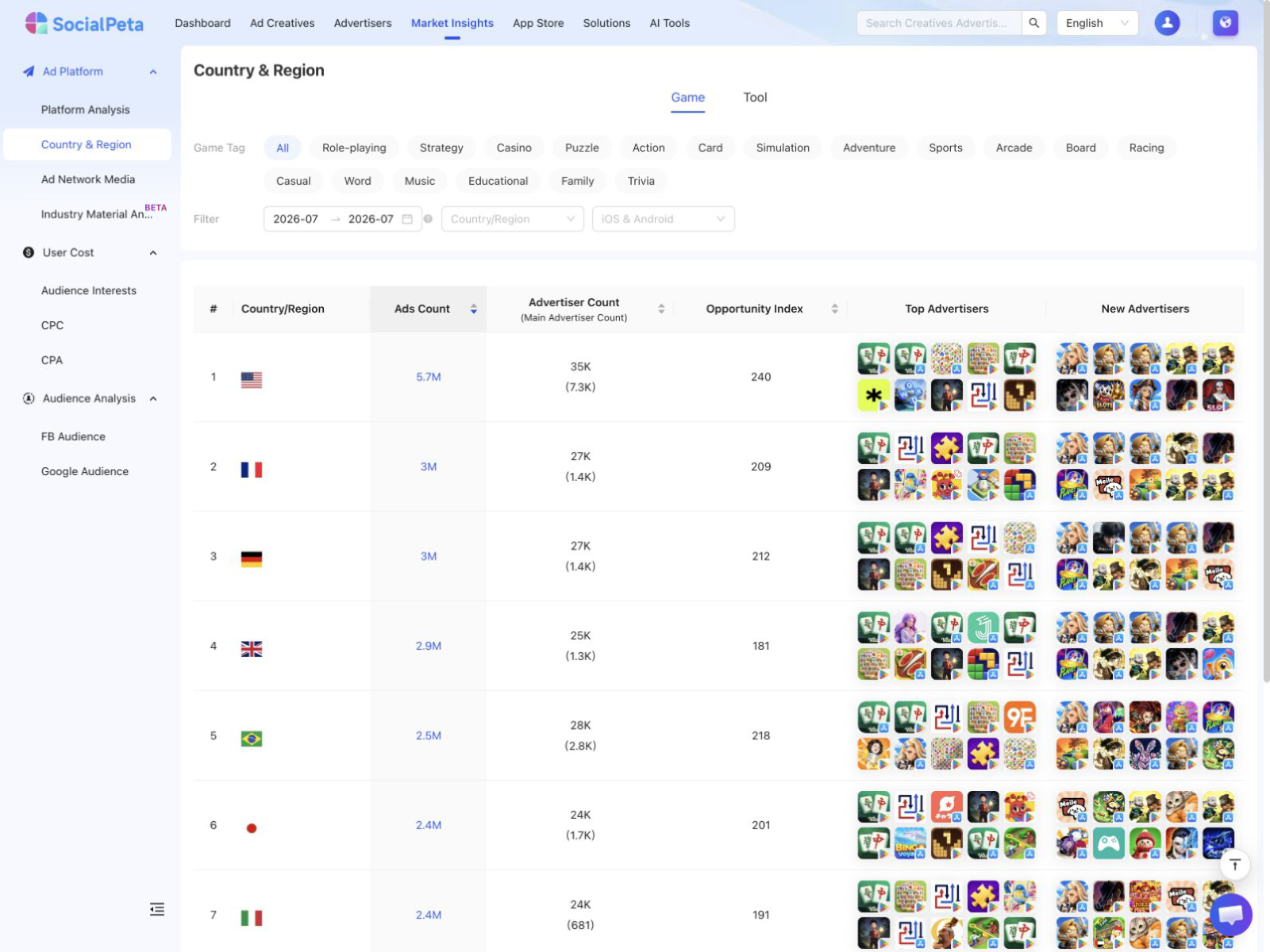
In SocialPeta, Country and Region Analysis belongs to the market-insight workflow. The page uses app type and date context, and changing app type clears category and tag selections. Check those selections again after a change. A research comparison should preserve its scope instead of accidentally mixing different product groups.
Use competitor research to sharpen the promise
Study competitors after defining the customer's problem. Look for repeated promises, differences in proof, and the alternatives that ads leave unaddressed. A crowded theme may indicate customer interest, but it can also make a generic version of the same promise difficult to distinguish.
The useful question is what your product can credibly demonstrate. If every competitor claims speed, perhaps you can show a specific task completed with fewer steps. If the category depends on trust, your strongest proof may be a transparent process or an observable result. The promise should survive a careful look at the actual product.
Separate message research from performance conclusions. Seeing many versions of an offer tells you it deserves investigation. It does not reveal how much was spent, whether the campaign was profitable, or why the advertiser kept it active. The competitive research guide explains how to combine these observations with offer and customer evidence.
Write a creative brief that includes the audience situation, one main promise, the supporting evidence, the desired response, and the destination. Add specific boundaries: claims the team cannot make, assets it cannot use, and product details it must show accurately. These constraints help creative work stay useful without prescribing every frame.
Assign each channel a clear role
A channel earns its place when it can perform a needed job for the audience. Search may reach people expressing a relevant need. Social video may make an unfamiliar product understandable. Specialist media can provide a useful context. The appropriate mix depends on the offer, available demand, production capability, and measurement limits.
Avoid spreading a small budget across many channels simply to appear comprehensive. Each additional channel needs suitable assets, a functioning destination, measurement, and someone able to interpret the result. A modest campaign with a clear question can teach more than several campaigns receiving too little traffic to evaluate.
Distinguish reaching new customers from re-engaging existing visitors. If an audience has already seen the brand, its response may differ from that of an unfamiliar audience. Reporting both together can hide how the strategy acquires demand and how it follows up on existing interest. Preserve those distinctions where the available reporting supports them.
Plan for the destination as part of the channel choice. A video ad can create an expectation that a generic homepage does not meet. A local service ad can fail if the form asks for information unrelated to the appointment. Review the path on the device and in the language the audience will use.
For each proposed channel, write the expected contribution and the main reason it might fail. This turns selection into an explicit bet rather than a habit. Revisit the bet when evidence changes; do not keep a channel in the plan solely because last quarter's presentation included it.
Build the budget from constraints and economics
A budget is a limit on what the team can spend and a statement of what it expects to learn or achieve. Include media, creative production, measurement, and operating work. Treat a competitor's reported spending as context rather than a prescription for your own company.
Consider a hypothetical product sold for $80. Suppose product and variable fulfillment costs total $44, leaving $36 before advertising and other overhead. If the business needs to retain $12 per first order after acquisition, it can allocate at most $24 to acquisition under those simplified assumptions. Refunds, fees, discounts, and other variable costs would change the calculation.
At a $24 acquisition cost, first-order revenue divided by advertising spend is about 3.33. That ratio is not a universal ROAS target. It follows from this example's price, costs, and retained contribution. A subscription business, a repeat-purchase product, or a service with limited capacity needs a different model and a justified value horizon.
Do not use speculative lifetime value to rescue a weak first-order model. If repeat behavior is part of the plan, state the observation window, customer cohort, and evidence for the assumption. A forecast can help with planning, but the team should know how much of the allowable acquisition cost depends on behavior that has not yet occurred.
Separate the amount committed to known campaigns from the amount reserved for learning. There is no universal percentage that fits every business. A new offer with little evidence may need a different approach from a mature campaign with dependable results. The total must remain affordable even when an experiment teaches you that the idea does not work.
Design tests that can change a decision
A test should isolate a useful question. Comparing a new hook while also changing the audience, price, and landing page makes interpretation difficult. Sometimes a whole campaign concept is the right unit to compare, but then report it as a concept comparison rather than claiming to know which individual change caused the result.
Write the hypothesis, primary metric, guardrails, comparison method, and review conditions. Consider conversion delay and normal business cycles. A test that looks weak after a few hours may still be waiting for the relevant outcome, while a campaign with clear tracking failures needs attention immediately.
Google's custom experiment guidance describes setting up experiments within supported campaign contexts. Platform tools can help structure comparisons, but the team still needs to choose a meaningful question and understand the reporting. Do not assume that merely running two ads side by side creates a controlled experiment.
Plan the amount of data needed around the expected baseline, the difference worth detecting, and the uncertainty you can accept. A fixed rule such as spending a few times the target CPA is a budgeting heuristic, not proof of statistical reliability. If the affordable test cannot resolve a small difference, ask a larger, more practical question.
Keep an inconclusive result as an available outcome. It may be appropriate to collect more data, simplify the test, or pause because the remaining uncertainty is too expensive to resolve. For creative development after research, the winning ads testing playbook provides a more focused next step.
Work through a small launch plan
Imagine a hypothetical app that helps freelancers organize invoices. The team has a limited launch budget and wants users who complete an invoice workflow, not merely install the app. Its initial audience is freelancers already using a manual document, and its strongest demonstrable benefit is reducing repeated data entry.
The research finds that competitor ads often emphasize a broad collection of business features. The team chooses a narrower demonstration: enter client information once and reuse it in the next invoice. The landing page shows the same task, explains the relevant plan limits, and sends users to the correct store listing.
The first campaign compares that demonstration with an existing product-overview creative in one supported market. Both use a comparable offer and destination. The team records installs as a diagnostic metric but evaluates the cost of completed invoice workflows, then checks continued use over the chosen follow-up period.
If installs increase while completed workflows do not, the next step is to inspect the promise and onboarding. If activation improves but users leave after discovering a plan limit, the team needs clearer expectations or a better product fit. Expanding the budget before examining those outcomes would magnify the uncertainty.
This example is a planning scenario, not a SocialPeta customer result. Its lesson is the sequence: define the valuable action, investigate the audience and alternatives, demonstrate a credible difference, and judge the campaign at the point where customer value begins. The exact channel and budget depend on the business.
Give the plan an owner and a stopping rule
Turn the strategy into a working document with owners for creative, media, destination, and measurement. Record which changes require coordination. A new price on a landing page can invalidate the offer in an active ad, while a tracking change can make a performance trend difficult to interpret.
Use a review that separates implementation problems from strategy results. First ask whether the campaign delivered as intended and whether measurement works. Then inspect the audience response and business outcomes. A broken form is an implementation failure; low qualified demand with a working form asks a different question.
Agree on actions before the review: repair a failure, continue collecting evidence, revise the hypothesis, expand cautiously, or stop. Keep a reason for each decision. The next campaign should inherit what the team learned rather than only the assets it produced.
Before launch, someone unfamiliar with the brief should be able to explain who the ad is for, what it promises, where it sends the viewer, and how success will be judged. If they cannot, simplify the plan. Clear choices make later performance discussions more useful because the team knows which assumption it was testing.
Frequently asked questions
What is an advertising strategy?
An advertising strategy defines the audience, intended business contribution, supported promise, channel roles, budget constraints, and measurement approach. A campaign plan translates those choices into assets, schedules, and responsibilities.
How much should I budget for an advertising strategy?
Start with an affordable total and the economics of the outcome you want. Include production and measurement costs, state assumptions about customer value, and reserve a justified amount for learning. Competitor spend and fixed percentage rules do not establish the right budget.
What is the difference between advertising strategy and marketing strategy?
Marketing strategy covers the wider product, pricing, distribution, and customer relationship. Advertising strategy explains how paid communication contributes to those business choices and how that contribution will be evaluated.