
Top Mobile Game Ad Creatives and Advertising Trends in May 2026
In May 2026, SocialPeta analyzed global mobile game advertising activity across the App Store and Google Play, focusing on creative volume, formats, localization, target markets, and the UA strategies behind Match Villains and Color Block: Combo Blast.
In May 2026, SocialPeta analyzed global mobile games with advertising activity across both the App Store and Google Play. This report aims to help mobile game publishers, marketers, and developers better understand the latest shifts in user demand and competitive dynamics within the global mobile gaming market.
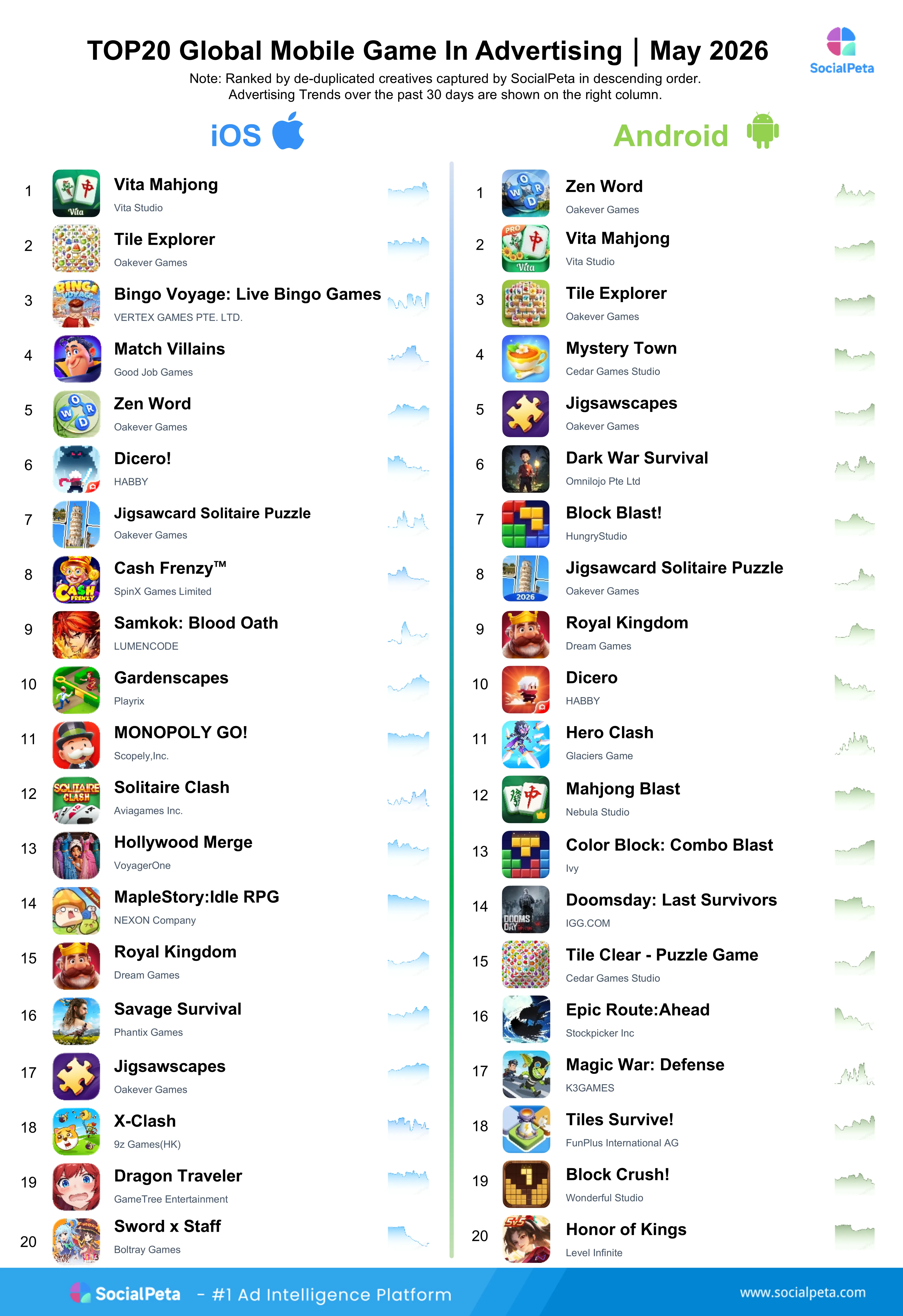
Overview: Mobile Game Ad Creatives in May 2026
Several key patterns emerged among the top-performing mobile games in May:
- Match Villains uses a police-and-thief-inspired meta gameplay loop to support user acquisition, generating approximately 18,000 deduplicated creatives across iOS and Android.
- Color Block: Combo Blast capitalized on the continuing popularity of block-matching puzzle mechanics, with its daily active creative volume peaking at 6,819.
Together, the two cases illustrate how mobile game publishers were using creative volume, vertical video, recognizable gameplay, reusable storytelling templates, and localized distribution to expand user acquisition in May 2026.
Match Villains: Minigame-Driven UA in a Match-3 Market
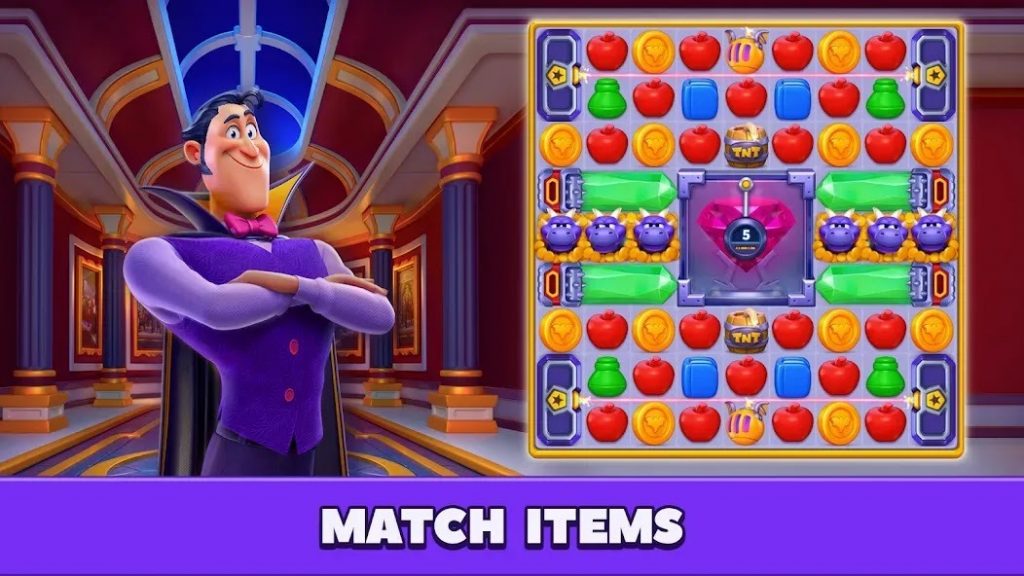
Good Job Games has once again demonstrated its instinct for creating mobile hits, this time in the Match-3 category. The Turkish developer previously gained significant traction in the hyper-casual market with titles such as Color Balls 3D and Fun Race 3D.
In recent years, however, the studio has increasingly moved beyond the short lifecycle and rapid turnover associated with traditional hyper-casual games, shifting toward hybrid and casual puzzle products designed for longer lifecycles and deeper monetization. Match Villains represents one of the clearest examples of that transition.
From a gameplay perspective, Match Villains retains a familiar Match-3 foundation. Where many competitors build their surrounding metagame around home renovation, simulation management, or kingdom defense, Match Villains adopts a more theatrical phantom-thief family theme.
As players clear Match-3 stages, they follow characters including the Vampire Count, the butler, and the daughter through a series of heist adventures. The result combines gem matching and puzzle mechanics with narrative missions designed to create a stronger sense of progression and immersion.
Match Villains advertising activity in May
According to data tracked by SocialPeta, Match Villains began running advertising campaigns as early as June 2024. By May 2026, its cumulative deduplicated ad creatives across iOS and Android reached approximately 18,000. On iOS, several advertising characteristics stood out:
- Peak ad volume: its 30-day single-day creative volume reached a peak of 3,870 on May 19.
- Creative format: video accounted for 96.2% of creatives during the preceding 30 days, with vertical 720×1280 video being the most heavily deployed format.
- Advertising copy: English dominated, with terms including "No ads," "free," and "new puzzle" appearing frequently.
- Top regions: the United States, Italy, Germany, the United Kingdom, and France were the five leading target regions for ad distribution.
Crisis hooks and minigames dominate the creative strategy
Match Villains' popular video creatives can broadly be divided into two categories. The first follows the familiar puzzle-game structure of an attention-grabbing hook, a crisis or failure setup, and a gameplay demonstration. The second uses side-gameplay or minigame concepts that may differ from the core Match-3 loop.
This mass-production approach has become common across Match-3 and Merge-2 advertising. Royal Match is a well-known example: its UA creatives repeatedly place the King in dramatic situations involving threats such as wild animals or environmental hazards before asking the viewer to solve a puzzle.
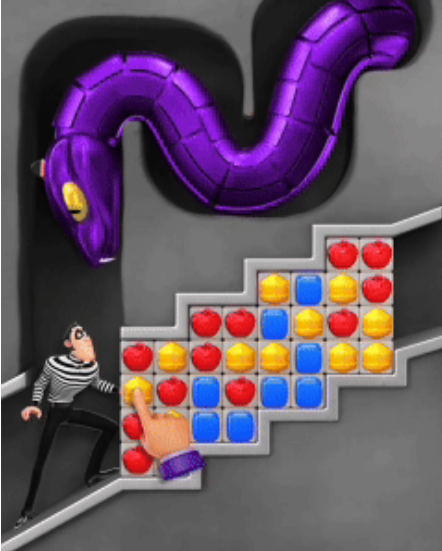
Match Villains pushes the formula further by packing several high-stakes concepts into a single asset. One creative begins with an approximately three-second crafting clip as an initial hook, then moves rapidly through five or six different crisis scenarios within a roughly one-minute video.
The rapid sequence increases the number of visual hooks available within a single asset and amplifies the deliberately unsuccessful ending used to provoke the viewer into wanting to solve the challenge correctly.
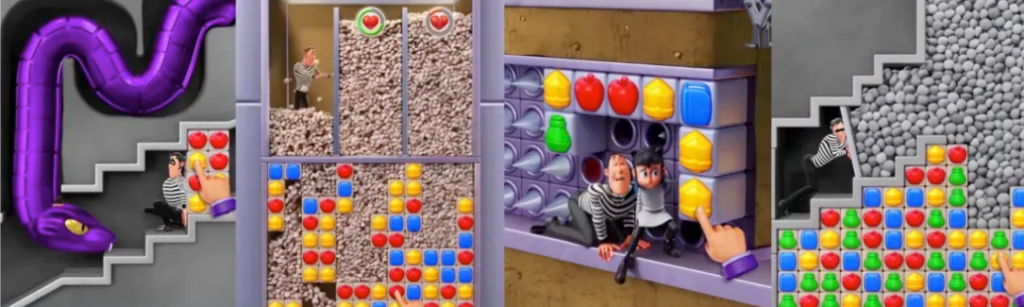
One concept, multiple creative variations
Match Villains also produces multiple variations around the same underlying creative concept. In environment-integration and tracking-evasion scenarios, for example, the advertiser developed different wall-cling solutions involving gummy candy and two-tone chocolate.

This kind of variation allows the same basic hook to be refreshed without rebuilding the entire creative structure. For UA teams, that provides a practical way to iterate on a proven concept while testing new visual details, failure conditions, and resolutions.
The "Cops and Robbers" minigame becomes a UA asset
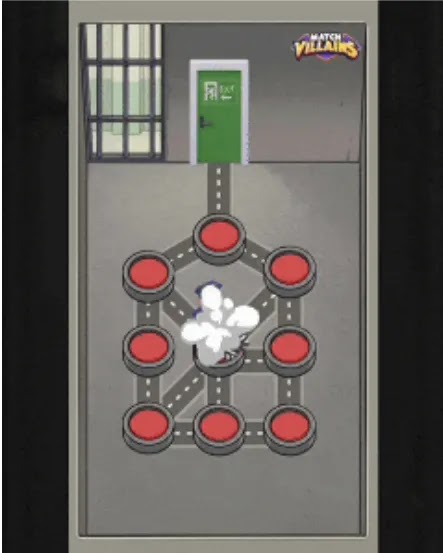
SocialPeta's tracking also showed Match Villains running minigame ads built around a "Cops and Robbers" concept. Puzzle-based police-and-thief mechanics have appeared in mobile game advertising before; following the success of X-Clash's "draw-to-save-the-doge" creatives, Glaciers Game also experimented extensively with puzzle-oriented Cops and Robbers concepts.

Good Job Games then extended the concept beyond advertising. The studio turned the UA minigame into a standalone spin-off, Police Escape! Match Villains, showing how a concept first used to attract traffic can potentially become a product experiment of its own.
Color Block: Capitalizing on Category Momentum for UA
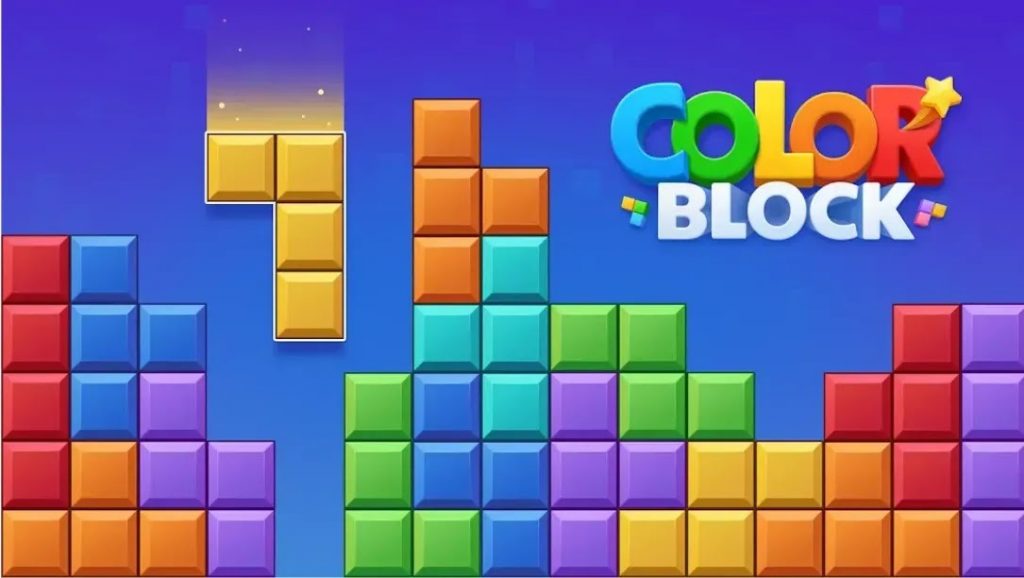
The growth of Color Block: Combo Blast reflects Ivy Mobile's rapid response to the popularity of the block-puzzle category.
Ivy Mobile has long focused on casual games, with products spanning established categories including endless runners, bubble shooters, merge games, and block puzzles. Its strategy combines recognizable gameplay, straightforward product packaging, and scalable user acquisition designed to reach a broad casual audience.
Color Block: Combo Blast follows this approach closely. Players drag differently shaped colored blocks onto a grid and clear complete rows or columns while trying to chain consecutive combos within limited board space.
Compared with traditional elimination games, the experience places greater emphasis on spatial planning and the immediate satisfaction of successive combos. At the same time, its mechanics are simple enough for users to understand quickly from a short advertising demonstration.
Color Block advertising activity in May
According to data captured by SocialPeta, Color Block: Combo Blast began advertising as early as September 2025. By May 2026, its cumulative deduplicated creatives across iOS and Android reached approximately 13,000. On Android, the campaign showed several notable characteristics:
- Peak volume: active creatives reached a daily peak of 6,819 on May 29 within the preceding 30-day period.
- Creative formats: video represented approximately 80.1% of creatives over the previous 30 days, while vertical 720×1280 videos accounted for about 63% of the total.
- Advertising copy: in addition to English, the campaign used localized copy in languages including Spanish and Turkish.
- Top geographies: the Philippines, Vietnam, Indonesia, the United States, and Brazil were the five leading regions for ad distribution.
Live-action drama creates the hook
Color Block: Combo Blast uses a classic UA structure: a short live-action mini-drama creates the initial hook, followed by a direct demonstration of the game.
One example opens in a gym. The protagonist appears to be distracted by their phone, leading a trainer to take the device away. The situation then reveals that the user has simply become absorbed in a block puzzle game.
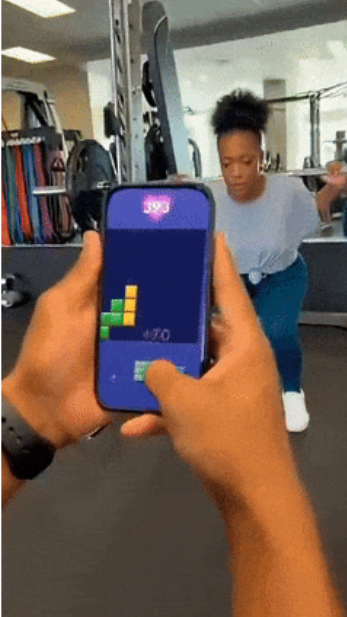
Other variations reuse the same basic transition from everyday conflict into gameplay, including relationship disputes and scenarios involving a thief grabbing a phone.


The payoff returns quickly to core gameplay
Once the live-action hook finishes, the creative pivots quickly to Color Block's core satisfaction points: dragging pieces, completing rows and columns, triggering eliminations, and extending combo chains.
Rising scores and consecutive combo effects provide repeated visual feedback, while copy such as "No Wi-Fi," "Play anytime, anywhere," and "You won't be able to stop" positions the game as simple, accessible entertainment that can be played with little friction.
The combination is significant for casual-game UA: the live-action opening gives the advertiser a flexible storytelling hook, while the gameplay segment communicates a mechanic that viewers can understand within seconds.
Key Takeaways for Mobile Game Marketers
- Scalable creative iteration matters as much as the original concept. Match Villains repeatedly modifies proven crisis and minigame structures instead of relying on a single execution.
- Vertical video remains central to mobile-game UA. Video represented 96.2% of Match Villains' recent iOS creatives and 80.1% of Color Block's recent Android creatives, with 720×1280 prominent in both campaigns.
- Minigames can do more than generate clicks. Match Villains demonstrates how a UA mechanic can be iterated extensively and even extended into a standalone product experiment.
- Familiar mechanics benefit from unfamiliar hooks. Both games advertise easily understood puzzle gameplay but surround it with dramatic situations, character conflict, or alternative minigames to make the opening seconds more distinctive.
- Localization can be layered onto reusable templates. Match Villains maintained an English-led campaign across major Western markets, while Color Block combined English with localized copy including Spanish and Turkish while distributing heavily across Southeast Asia, the United States, and Brazil.
- Advertising signals should be analyzed alongside market performance. Creative volume can reveal how aggressively a game is acquiring users, but download and revenue data provide essential context for understanding whether that activity translates into broader market momentum.
To connect these advertising trends with market performance, see SocialPeta's analysis of the top mobile games by downloads and revenue in May 2026.
Together, the May campaigns show how leading mobile game publishers combine high creative output with rapid iteration, recognizable mechanics, localized distribution, and repeatable storytelling structures. For UA teams, the lesson is not simply to produce more ads, but to develop creative systems that can test multiple hooks around a clear gameplay proposition.