
What Actually Makes a UA Channel Scalable: A Platform x Agency Perspective
A practical look at sustainable user acquisition growth from both sides of the ecosystem: what a platform needs to support scale, and how an agency evaluates, tests, measures, and expands a UA source without sacrificing user quality.
A user acquisition channel can look highly promising during a small test and still struggle once budget increases. Install volume may remain healthy while retention, return on ad spend, and overall user quality begin to weaken. For mobile marketers, the real question is therefore not whether a channel can deliver an attractive test, but whether it can preserve performance when spend and traffic expand.
Gamelight and AdChampagne explored this problem in a joint guide that combines two complementary perspectives. Gamelight looks at the platform capabilities required to support scalable Rewarded UA, while Anton Antonov, Media Buying Team Lead at AdChampagne, explains how an agency evaluates potential traffic sources, structures tests, and decides when a source is ready for additional investment.
Taken together, the two perspectives show that sustainable UA scale is less about simply increasing budget and more about traffic capacity, reliable measurement, optimization depth, source quality, and disciplined execution.
The Platform Side: Three Things That Matter at Scale
Traffic volume is the most visible requirement for scale, but raw volume alone is not enough. A channel needs sufficient reach across the relevant geographies, operating systems, and audience segments so that a campaign can continue finding incremental users as spend rises.
Without enough depth in the available audience, performance can hit a ceiling immediately after a successful test. The ability to reach different user groups and multiple markets gives a campaign more room to expand before saturation becomes a problem.
Performance stability is equally important. Retention, engagement, conversion rates, and ROAS need to remain reasonably consistent as budgets grow. A source that produces impressive early results but deteriorates quickly at higher spend does not provide meaningful scalability.
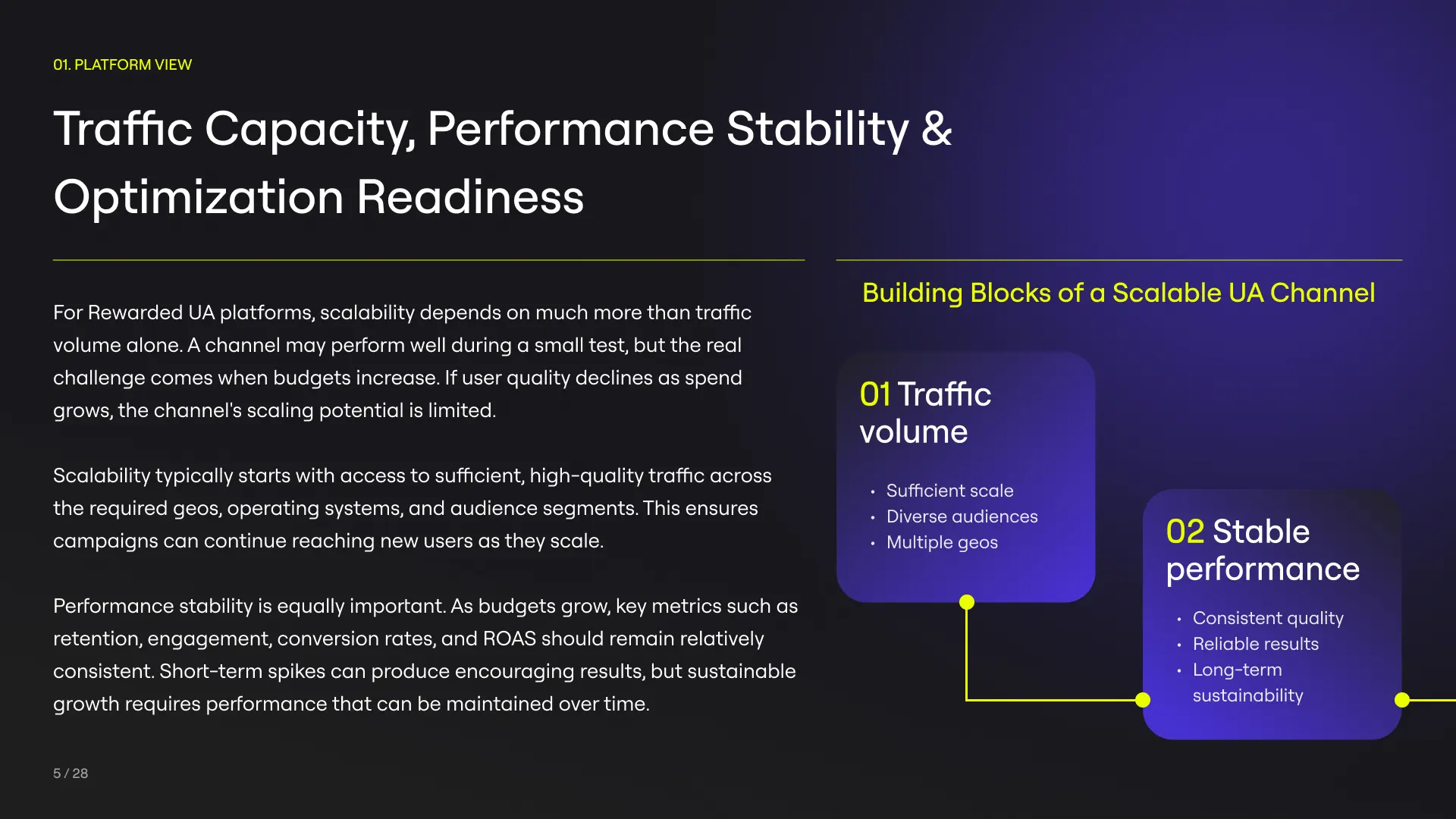
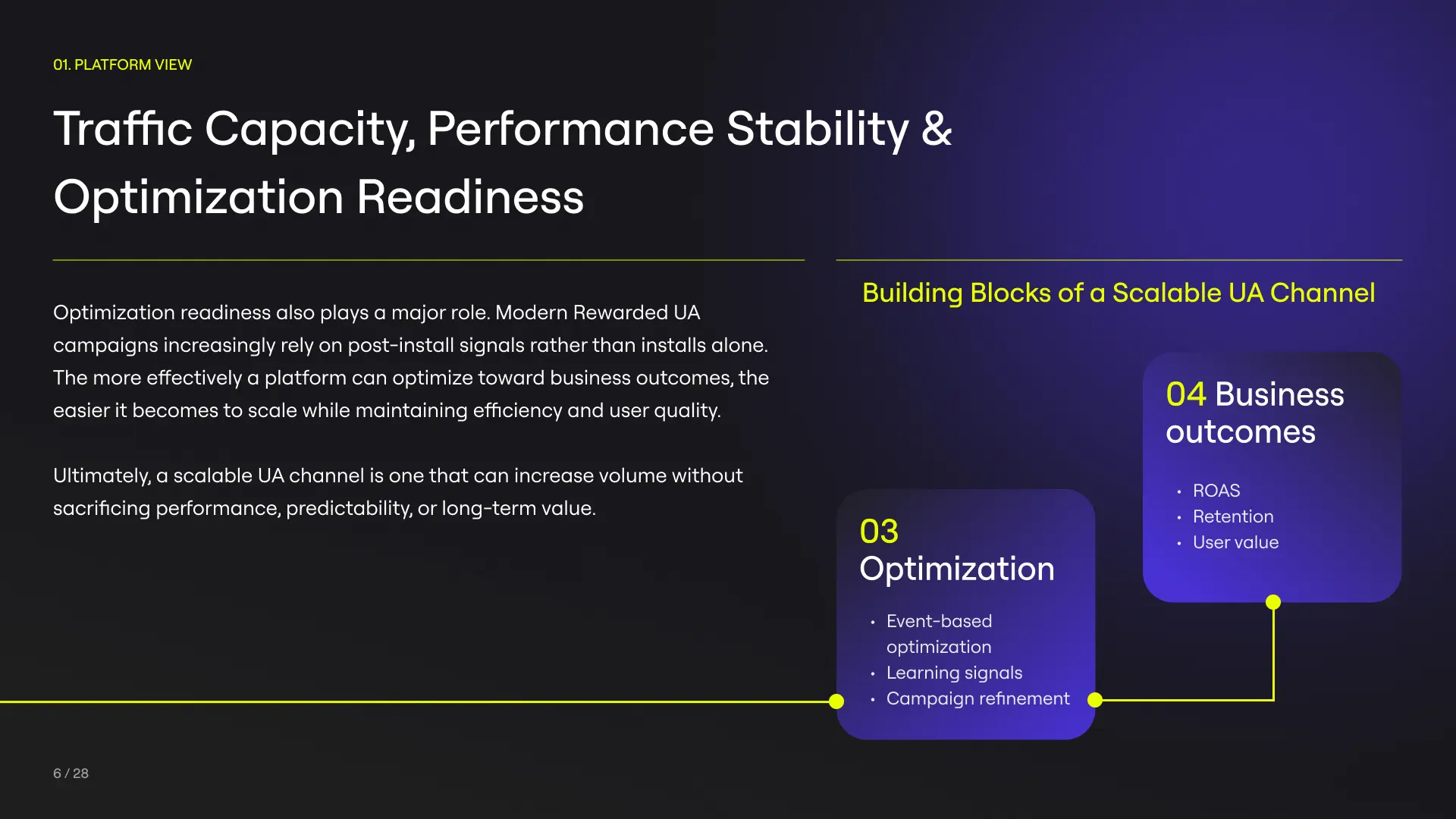
The third requirement is optimization readiness. Rewarded UA campaigns increasingly depend on post-install behavior rather than the install event alone. Platforms capable of learning from registrations, purchases, subscriptions, and other meaningful events give advertisers more control over the quality of users being acquired.
Data and Optimization Logic
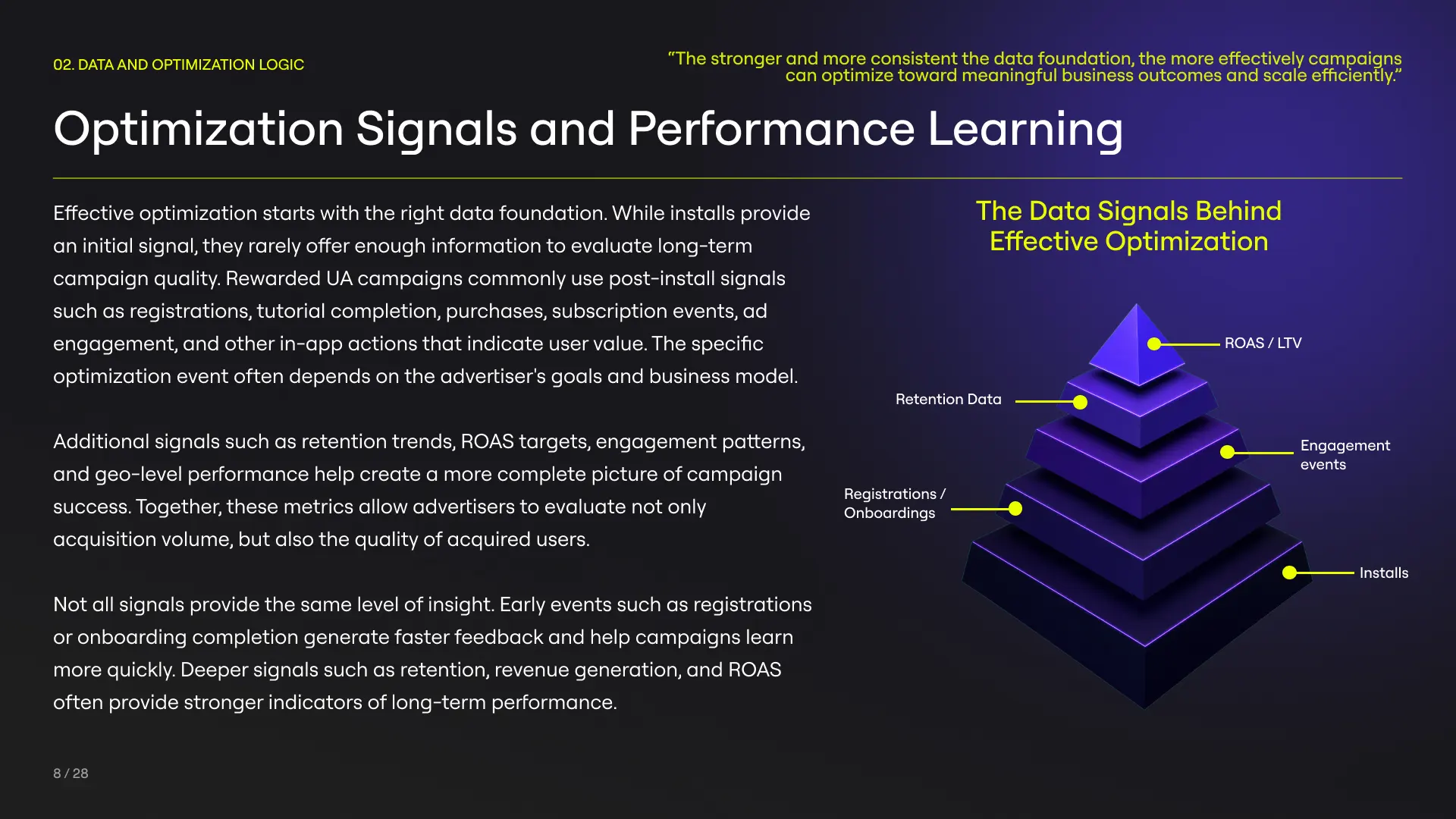
Effective campaign learning depends on selecting signals that match the advertiser's business objective. Early events such as installs, registrations, or onboarding completion arrive quickly and can give an optimization system enough feedback to begin learning.
Those early signals, however, do not necessarily indicate whether acquired users will create long-term value. Retention, revenue, engagement depth, ROAS, and LTV provide a deeper view of campaign quality and become increasingly important once enough data is available.
A stronger and more consistent data foundation allows optimization to move away from acquisition volume alone and toward the business outcomes that matter to the advertiser. The objective is not simply to generate more installs, but to keep attracting users who continue to engage and monetize after acquisition.
Transparency and What It Actually Means
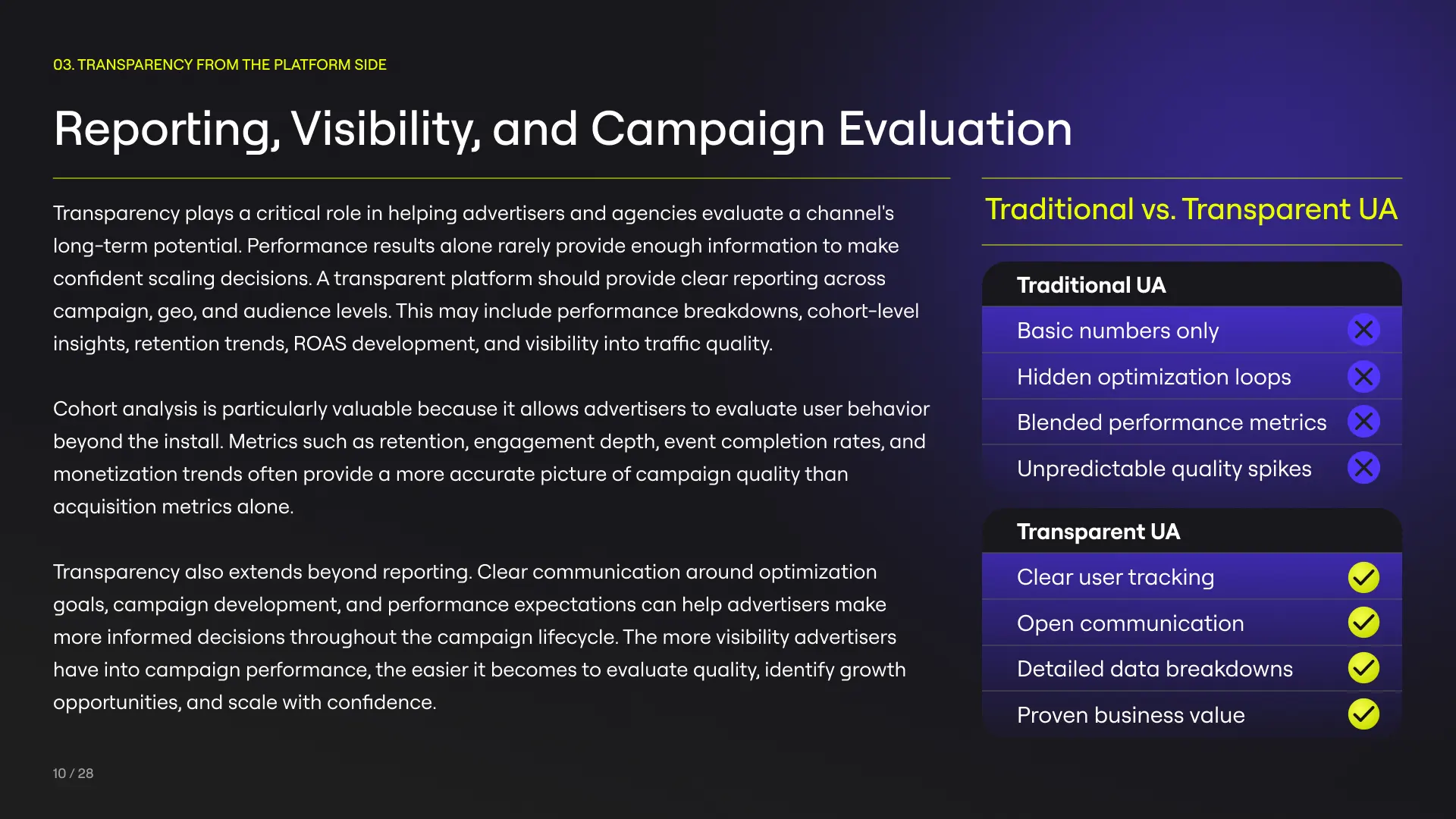
Transparency becomes increasingly important when a campaign moves from testing into scaling. Basic aggregate numbers may be enough to judge initial delivery, but they are usually insufficient for understanding how user quality changes over time.
A transparent UA setup should make it possible to examine traffic and performance at a more detailed level. That includes user tracking, cohort-level reporting, performance breakdowns, and clear communication around campaign optimization and expected outcomes.
Cohort analysis is particularly useful because it lets advertisers move beyond the install and study what acquired users actually do. Retention trends, engagement depth, event completion, and monetization behavior reveal whether a campaign is creating durable value or simply producing short-term acquisition volume.
How to Scale Without Losing Quality
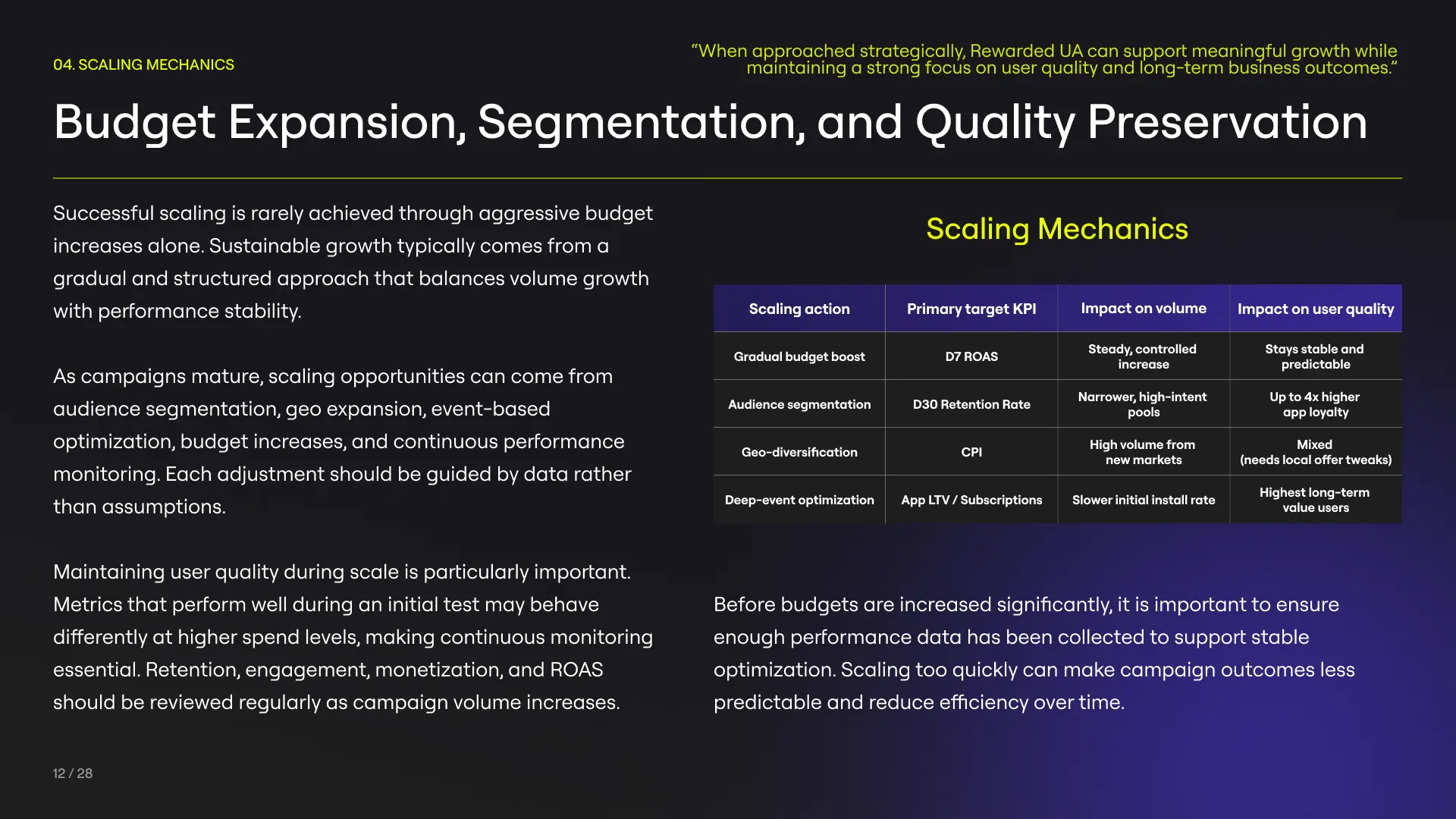
Sustainable scaling normally comes from a combination of controlled budget increases, audience segmentation, geographic expansion, and deeper event optimization rather than one aggressive increase in spend.
A gradual budget increase can be managed against metrics such as D7 ROAS, helping teams pursue growth while keeping performance predictable. Audience segmentation can prioritize smaller, higher-intent groups and evaluate whether stronger long-term retention offsets the reduction in available volume.
Geographic diversification can unlock additional traffic, although performance in a new market may require localized offers and campaign adjustments. Deep-event optimization can focus the algorithm on LTV, subscriptions, or other downstream outcomes even when the initial install rate is slower.
The important point is that every scaling action should have a corresponding KPI and an understood impact on both volume and user quality. Significant budget expansion should wait until the campaign has generated enough data to support stable optimization decisions.
The Agency Side: What Gets Checked Before a Source Is Recommended
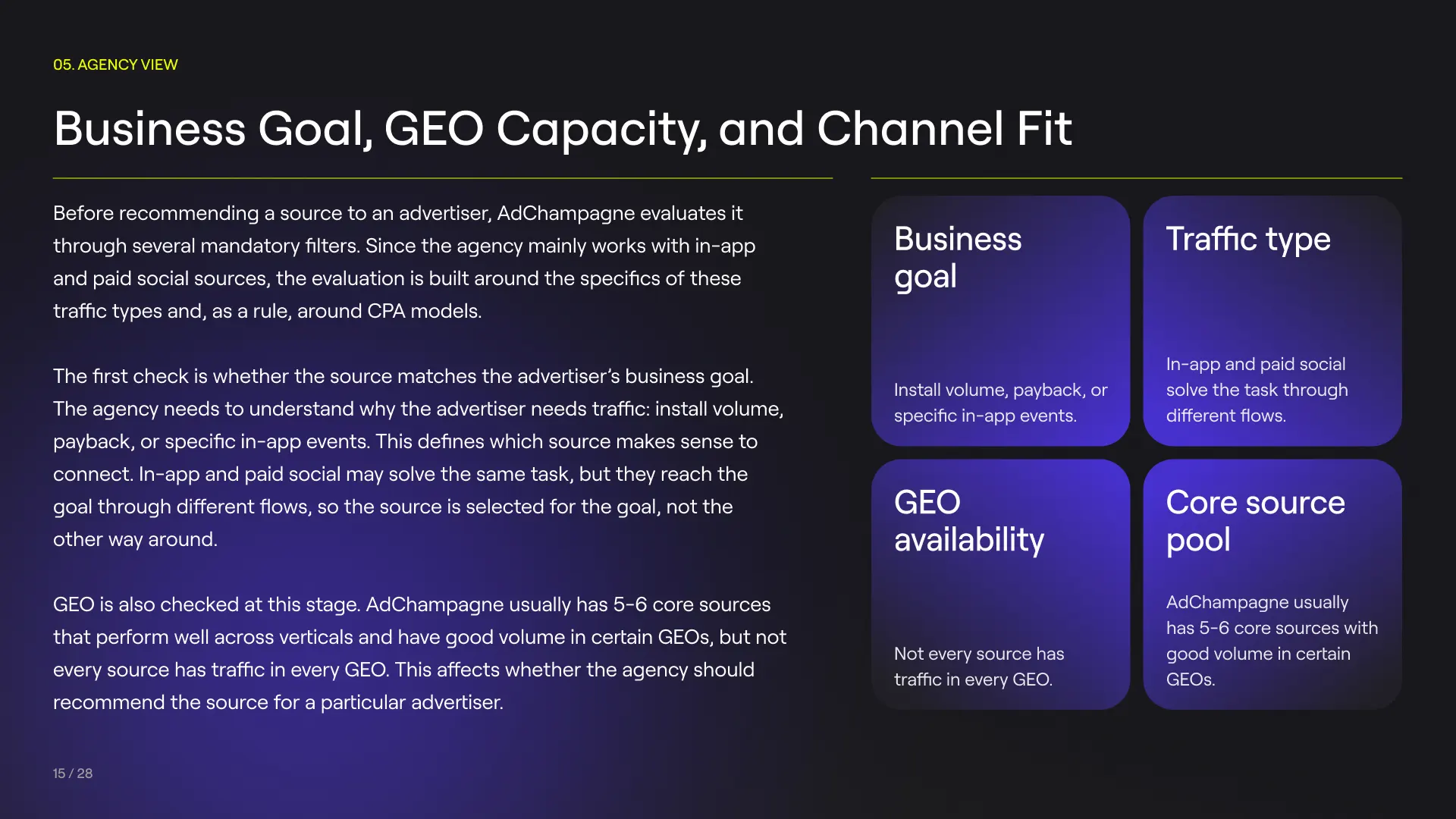
From AdChampagne's agency perspective, evaluating a source begins before any test budget is committed. The first question is whether the source is appropriate for the advertiser's real business objective.
An advertiser optimizing for install volume has a different requirement from one focused on payback or a specific in-app event. In-app and paid social channels can address similar goals through very different acquisition flows, so the source should be selected for the objective rather than forcing the objective to fit the source.
Geographic availability is another early filter. AdChampagne works with a core group of sources that can provide meaningful volume across multiple verticals, but individual sources do not necessarily cover every market equally well.
KPI relevance also needs to be established before launch. Some sources are built primarily around install optimization and may not support the deeper funnel signals required by a particular advertiser. Audience quality, risk, media-mix fit, and expected capacity all need to be considered before a source is recommended.
A strong test is therefore only the beginning. If the traffic source reaches its capacity immediately afterward, an encouraging test result does not automatically translate into a scalable channel.
Test Design and the Decision Framework
AdChampagne's testing process begins with measurement mapping and an initial conversion sample. The guide describes using roughly 100 to 150 install conversions before evaluating deeper post-install events.
Test budgets are based on the amount of conversion data needed to make a useful decision rather than simply running a source for a fixed number of days. The agency generally keeps the initial budget at no more than $1,500 per source and limits the first round to three creative hypotheses.
After the test, the source moves into one of three practical outcomes:
- Go: target KPIs are achieved and the economics justify further investment.
- Optimize and Retest: performance is close enough to target that changes to targeting, bids, or creatives have a credible chance of improving the result.
- No-Go: traffic quality or economics are materially weaker than existing channels and there is no obvious optimization path.
The final decision combines CPA, cohort quality, remaining traffic capacity, and fraud checks. A weak source is not kept alive by repeatedly adding budget in the hope that the economics will eventually improve.
Measurement: What Real Client Value Looks Like
Evaluation after the test focuses on user behavior rather than headline acquisition metrics. Retention is reviewed across D1, D3, D7, and D30 so that teams can see whether traffic continues to perform after the initial install.
Engagement depth and funnel conversion indicate whether users progress toward the advertiser's intended action. ROAS, LTV, and payback period should also be read together rather than in isolation. Strong short-term ROAS is less valuable if the underlying economics still require an unacceptable payback period.
Fraud control remains a mandatory part of measurement. Traffic should be reviewed for signals such as emulators, proxies, click injection, and abnormal conversion patterns. A source that appears inexpensive but produces invalid or manipulated traffic does not create genuine client value.
Scaling Strategy: Controlled Growth, Not Volume for Its Own Sake
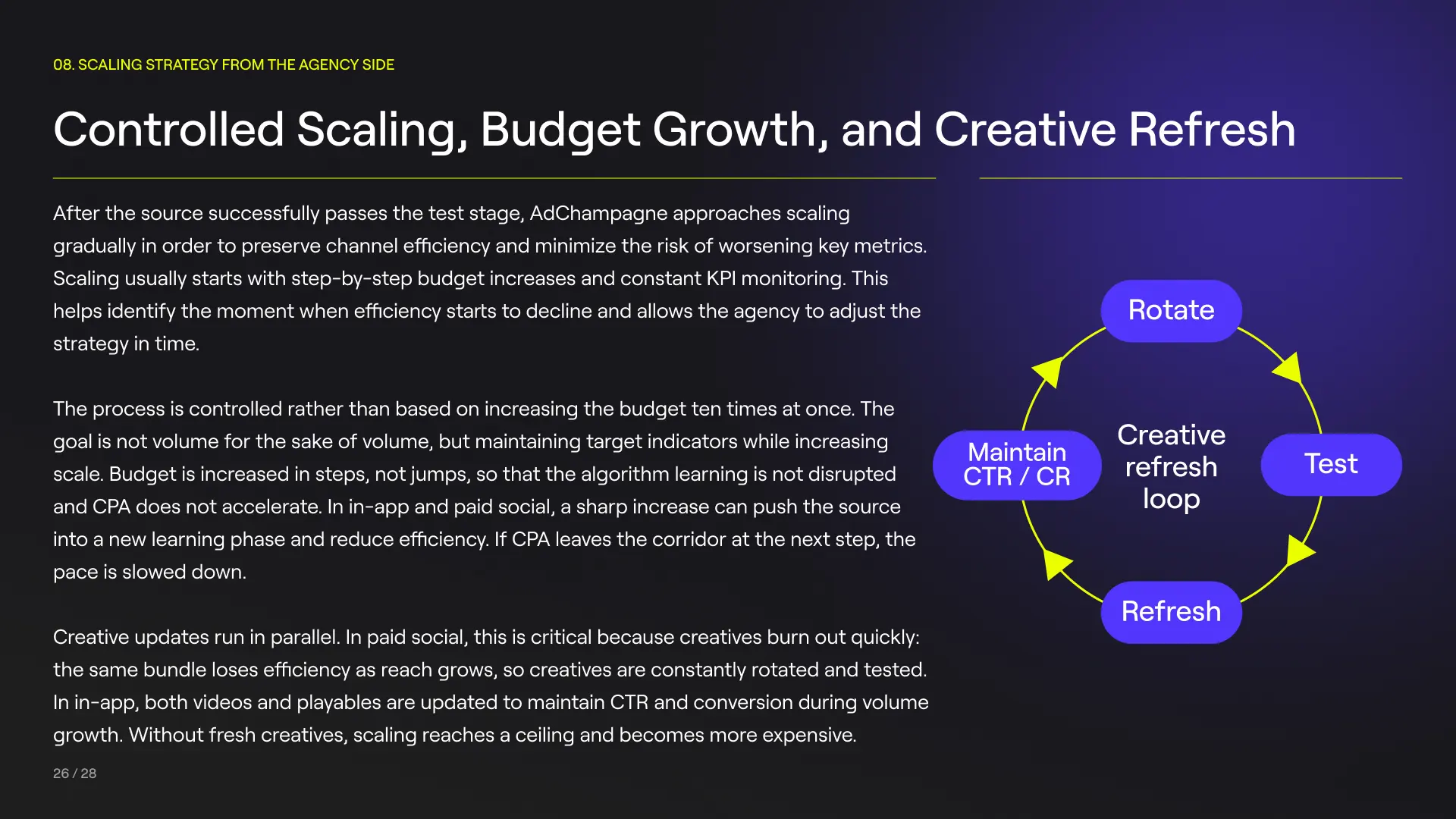
Once a source has passed testing, expansion should happen in controlled steps. Budgets can be increased gradually while key metrics are monitored at every stage, allowing the team to identify the point at which efficiency starts to deteriorate.
Large budget jumps can change the traffic being reached or push campaign algorithms into a new learning phase. If CPA begins moving outside the acceptable range, the pace of growth should be reduced rather than continuing to pursue volume at any cost.
Creative development needs to continue alongside budget expansion. Paid-social creatives can fatigue quickly as reach grows, while in-app campaigns also need updated video and playable assets to maintain click-through and conversion performance.
The media mix should be rebalanced continuously. More budget goes to sources that continue to deliver acceptable cohort quality and payback at higher spend, while investment is reduced when a source begins to deteriorate. Scaling is therefore an ongoing allocation process rather than a one-time budget decision.
Final Thought
The joint perspective from Gamelight and AdChampagne makes one principle especially clear: UA scale is not simply a budget problem.
The platform side determines whether the infrastructure, available traffic, measurement, and optimization system can support additional demand. The agency side determines whether the source actually demonstrates those capabilities when exposed to a controlled test and progressively larger budgets.
Combining both perspectives gives mobile marketers a more reliable framework for choosing channels that can grow beyond a promising initial experiment without losing the user quality that made the source attractive in the first place.