
2025 Productivity App Marketing Trends: Data & Ad Strategy
See 2025 productivity app marketing trends across 1.6B ad creatives, including advertiser shifts, regional growth, winning formats, and channel strategy.
The productivity app market is moving from feature-led competition toward value-led growth. For developers, growth teams, and user acquisition marketers, that shift makes advertiser activity, regional differences, creative formats, and channel strategy more important than simply adding more product features.
SocialPeta, together with Mega Digital, released the 2025 Report on Marketing Trends of Productivity Apps. The research draws on SocialPeta's database of 1.6 billion ad creatives and real-time data covering more than 70 countries to examine the changes shaping global productivity app advertising.
Mega Digital also published the report through its own research library as SocialPeta's co-publishing partner. The report combines market-level advertiser data, regional observations, creative analysis, and cross-platform marketing recommendations.
Data window: The source notes shown in the report charts below cover January 2024 through August 2025. The 2025 findings in this article therefore refer to the period covered by the report rather than a completed full-calendar-year dataset.

2025 Mobile App Advertising Market Snapshot
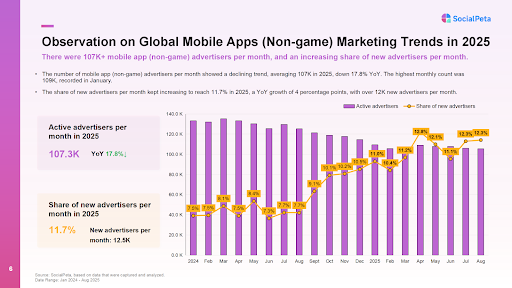
The broader non-gaming mobile app advertising market provides the baseline for understanding what happened in productivity apps. During the 2025 period covered by the report, non-gaming mobile apps recorded an average of approximately 107,300 active advertisers per month, representing a 17.8% year-over-year decline.
The decline in total advertiser volume did not mean that new competition disappeared. New advertisers represented 11.7% of the market, averaging more than 12,500 new advertisers per month. That was about four percentage points higher than in the comparable period a year earlier.
The share of new advertisers remained above 10% during the period and reached a peak of 12.8%. In other words, the non-gaming app advertising market was contracting in total volume while still seeing a meaningful flow of new entrants. That combination points to an environment characterized by portfolio optimization, replacement, and continuing market renewal rather than simple category-wide expansion.
Productivity App Advertisers Are Reshuffling
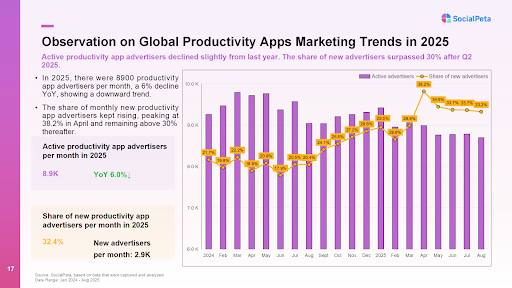
Productivity apps followed the broader cooling trend, but the category showed a much stronger influx of new advertisers. The number of active productivity app advertisers averaged about 8,900 per month during the period covered by the report, down 6% year over year.
At the same time, new advertisers became a much larger part of the category. From April onward, new advertisers consistently accounted for more than 30% of total productivity app advertisers. The share peaked at 38.2%, while more than 2,900 new advertisers entered the category each month.
This creates a different competitive picture from one in which a category is simply shrinking. Existing advertisers were consolidating and optimizing, but newcomers were continuing to test the market at a high rate. For productivity app marketers, the result was a reshuffling competitive landscape in which established positioning could be challenged quickly by new products, new creative angles, and new acquisition strategies.
Regional Productivity App Advertising Trends
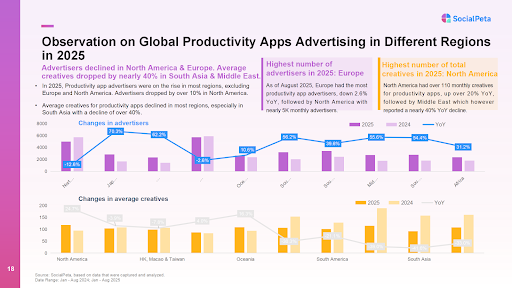
Regional divergence became increasingly visible in productivity app advertising. Europe remained the largest region by number of productivity app advertisers, although advertiser volume declined by 2.6% year over year.
North America showed a different pattern. The average number of ad creatives exceeded 110 per month, more than 20% higher year over year. The report therefore identifies North America as a particularly active showcase market for productivity tools even as advertiser counts in some mature markets softened.
Southeast Asia and Africa recorded growth in advertiser numbers. By contrast, creative volume fell sharply in South Asia and the Middle East, declining by 41.6% and 39.0%, respectively.
These differences make a single global acquisition playbook less useful. Productivity app teams need to compare advertiser activity, creative intensity, language, channel behavior, and product positioning by market before deciding where to scale. SocialPeta's utility app marketing intelligence workflow is designed around this type of country, channel, and competitive research.
Creative Formats and Messaging That Dominated
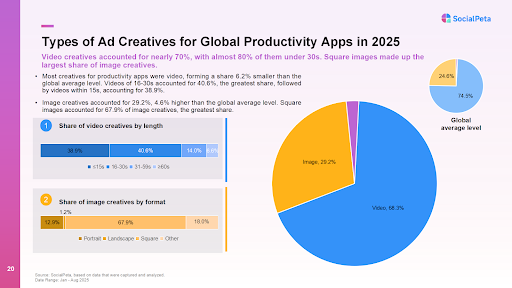
Creative execution was one of the clearest areas of concentration in the report. Video represented 68.3% of productivity app ad materials, making it the dominant format. About 80% of the video creatives were shorter than 30 seconds, reinforcing the importance of concise, high-impact product storytelling.
Static images remained important, but square images were the dominant static format. Their cross-platform adaptability makes them useful for campaigns that need to reuse or adapt assets across multiple placements.
English accounted for 72.7% of analyzed ad copy. Frequently used words included "time" and "free", reflecting two recurring productivity-app value propositions: saving users time and lowering the barrier to trying a product.
The report also found that 27% of analyzed ad copy used exclamatory language or emojis. Rather than treating that as a universal creative rule, marketers can use it as a benchmark to test how emotional tone, urgency, social proof, and product-focused messaging perform for their own audience.
Teams evaluating these patterns at the asset level can connect the report findings with SocialPeta's Creative Analysis workflow to compare hooks, formats, messaging, duration, and other creative signals.
Localization and Southeast Asia Growth
As a co-publisher of the report, Mega Digital highlighted Southeast Asia, and Vietnam in particular, as a region with significant productivity app growth potential.
Mega Digital's contribution to the report describes a regional digital economy expanding at more than 20% annually while also pointing to language barriers and AI adoption rates below 40% as challenges for productivity products. Those conditions create both friction and an opportunity for products that localize their value proposition instead of simply translating global campaigns.
The report cites Trello's "Ramadan Productivity Mode" as an example of culturally tailored product positioning. The broader lesson is that localization can extend beyond language: timing, cultural context, workflows, creative scenarios, and value propositions can all influence whether a productivity product feels relevant in a local market.
Cross-Platform Productivity App Marketing Strategy
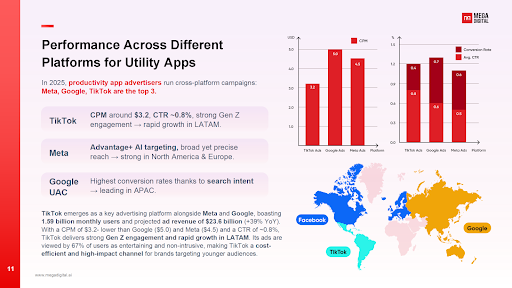
The report argues that productivity app advertisers should assign different jobs to different advertising platforms instead of expecting one channel to cover the entire acquisition funnel.
Google is positioned around users with clearer intent, Meta around audience targeting, and TikTok around creative engagement and dynamic storytelling. The report recommends combining these channel roles with video and interactive formats while using AI to support faster creative iteration and performance optimization.
- Run cross-platform campaigns and allocate budget according to the role and strength of each platform rather than splitting spend evenly.
- Prioritize video and interactive or playable formats where they are appropriate for the product and campaign objective.
- Use AI-assisted workflows to increase testing speed and refresh creative variations without losing control of the underlying product message.
- Keep creative concise, engaging, and easy to understand so the user can identify the product value quickly.
- Incorporate credible social proof, such as user reviews, and lifestyle-driven scenarios when they help demonstrate how the product fits into real workflows.
The goal is not simply to maximize installs. A sustainable strategy connects channel selection, creative testing, user intent, conversion quality, and ROI so that acquisition can support longer-term product growth.
What Productivity App Marketers Should Take Away
The 2025 data points to a market that is becoming more selective rather than simply smaller. Total advertiser counts declined, but productivity apps continued to attract a high share of new advertisers. That means incumbent products cannot rely on market maturity alone to protect their position.
Regional differences also matter more. Europe remained the largest advertiser market, North America maintained strong creative momentum, and emerging regions created new localization opportunities. Global teams therefore need to validate creative and channel assumptions market by market.
Finally, creative strategy is increasingly central to productivity app acquisition. Short-form video dominated the report's creative mix, while cross-platform distribution, rapid testing, social proof, and locally relevant messaging emerged as recurring themes.
For marketers, the practical implication is straightforward: treat market intelligence, creative intelligence, localization, and media buying as connected decisions. The strongest growth strategy is not simply to produce more ads, but to understand where competition is changing, which value propositions are resonating, and which channel is best suited to each acquisition job.