See the Market. Win the Store. Decode Paid Growth.
SocialPeta connects app market intelligence, ASO intelligence and advertising intelligence around the same app entity. Find competitors, evaluate demand, uncover keyword opportunities and understand how market leaders acquire users.
App intelligenceApp marketing intelligenceASO intelligenceCompetitor research
Unified App Profile
One research thread across store, market and advertising signals
#12
Store rank
+18%
Revenue
Rising
Ad activity
Market
Rankings, downloads, revenue and category movement
ASO
Keyword demand, difficulty and store visibility
Advertising
Creatives, channels, markets and audiences
Signals connected
01
Direct answer
App intelligence
is the practice of using app-store, market, competitive and advertising signals to understand how mobile apps are discovered, monetized and grown. Unlike product analytics, which measures behavior inside your own app, app intelligence benchmarks the external market and competing apps.
One app, three intelligence layers
Move from market discovery to measurable growth decisions
A useful app intelligence platform should not stop at a leaderboard. SocialPeta helps teams move from identifying an opportunity to understanding store visibility and validating the paid growth strategy behind it.
01
App Market Intelligence
Establish where demand, monetization and competitive momentum are moving across stores, categories and countries.
Top free, paid and grossing rankings
Download and revenue estimates and trends
New releases, ranking movers and niche markets
SDK adoption and App Store event research
02
ASO Intelligence
Turn keyword and store signals into a defensible organic-growth plan instead of optimizing metadata by intuition.
Keyword popularity, volume and difficulty
Related terms and ranking app discovery
Competitor store positioning
Country and category opportunity research
03
App Marketing Intelligence
See how competing apps create and distribute demand across channels, countries, publishers and creative formats.
Active ads and creative strategy
Channel, country and media mix
Copy, audience and creative analysis
Milestones linked to store and campaign movement
Performance context
Explain ranking movement with connected signals
A chart move is an investigation trigger, not a conclusion. Compare store performance with releases, events and observable advertising activity to understand what changed around the same period.
Distinguish acquisition scale from monetization quality
Check whether a launch, update or store event aligns with movement
Compare organic momentum with paid creative and channel activity
App growth timeline
Illustrative normalized signals for one competitor
DownloadsRevenueAd activity
Estimated downloads
1.8M+24%
Estimated revenue
$4.6M+18%
Observed ad activity
8.4K+31%
ASO intelligence
Find keyword opportunities competitors have not secured
Evaluate ASO keywords with demand, difficulty, related-term and competitor signals. Move beyond a list of popular terms to identify queries your app can realistically compete for in a specific market.
Use keyword intelligence as evidence for a testable store hypothesis. Store algorithms, available metrics and ranking factors differ between Apple App Store and Google Play, so validate changes by store and country.
Keyword opportunity map
Illustrative positioning by popularity and attainability
Opportunity zone
High demand · attainable
photo editor
AI portrait
face filter
image tools
Popularity →Attainability →
Prioritized keyword set
AI portraitPriority
Growing demand · lower relative difficulty
photo editorDefend
High demand · crowded result set
face filterTest
Relevant long-tail opportunity
Paid growth intelligence
Understand how leading apps manufacture demand
Store performance shows the outcome. Advertiser analysis reveals the acquisition system behind it: where competitors run ads, which creative narratives they repeat and which markets receive attention.
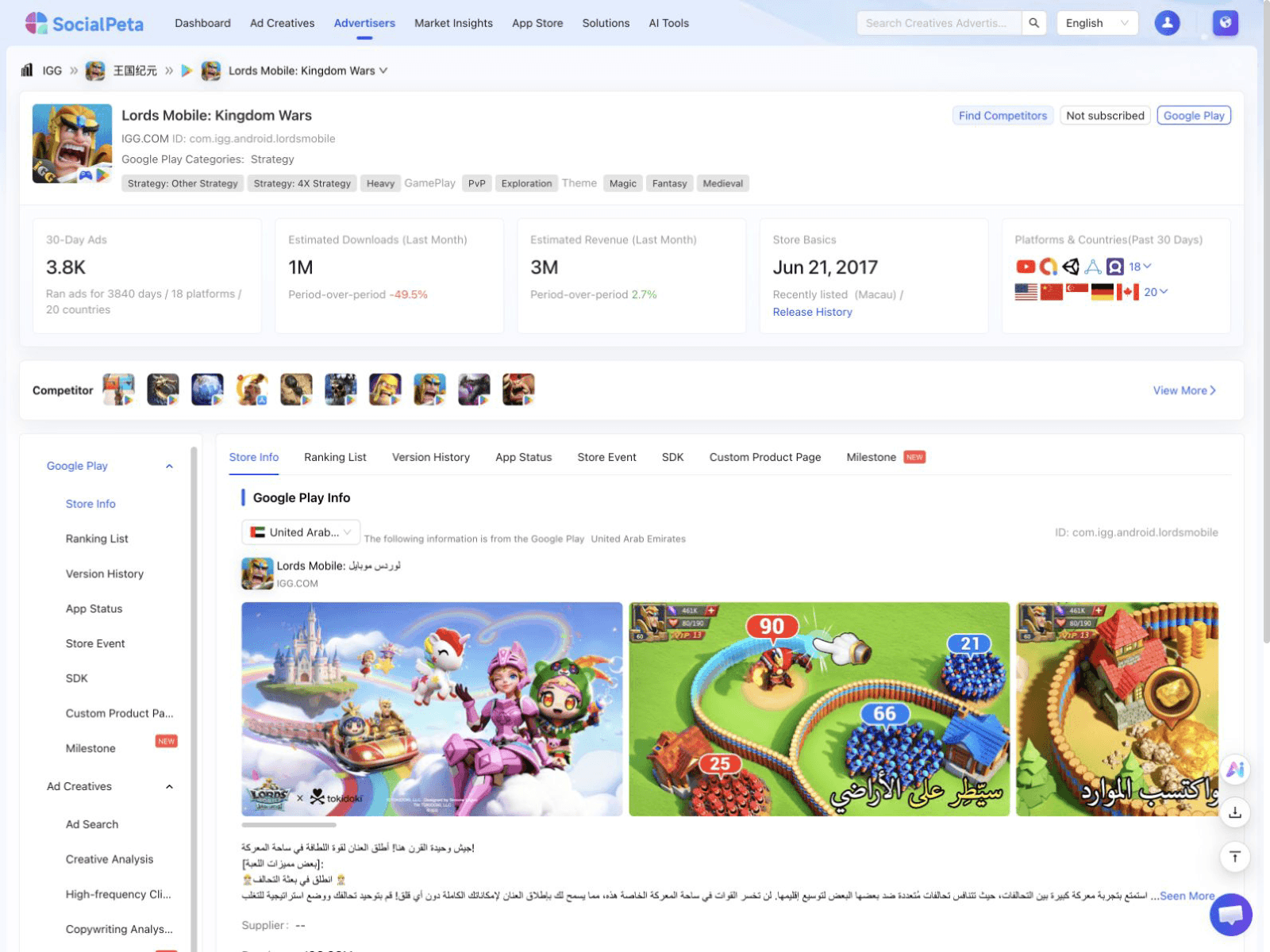
SocialPeta advertiser and app detail
A single app research context can connect store information, rankings, releases, events, SDKs, advertising activity and strategy analysis. Available modules vary by app and plan.
01
Channel and market allocation
Compare how an app distributes observable advertising activity across channels, countries and regions.
02
Creative and copy strategy
Inspect formats, themes, messages and refresh patterns instead of treating ad volume as the whole strategy.
03
Media and audience evidence
Review publishers, networks and available demographic signals to form better acquisition hypotheses.
04
Milestones and timing
Place campaign changes beside releases, rankings, store events, downloads and revenue movement.
Competitive benchmarking
Compare the decisions behind the numbers
Benchmark competitors across the same research dimensions so teams can see where an advantage comes from, not only who ranks first.
Research question
Your app
Competitor A
Competitor B
Store momentum
Rank rising · revenue steady
Downloads rising
Rank declining
ASO opportunity
Strong long-tail coverage
Owns head terms
Weak localization
Paid acquisition
Balanced channel mix
Short-form video heavy
Burst campaigns
Creative cadence
14-day refresh
7-day refresh
Event driven
Next action
Scale two markets
Monitor creatives
Test keyword gap
Built for mobile growth teams
Turn the same intelligence into role-specific decisions
Product, growth, ASO and research teams can work from one competitive evidence base while asking different questions.
Market and portfolio research
Size a category, find emerging apps and compare where downloads and revenue are concentrating.
Competitor monitoring
Track releases, ranking movement, store events and changes in advertising strategy.
ASO and launch planning
Prioritize keywords, countries and competitor sets before changing metadata or entering a market.
UA and creative validation
Connect performance movement with channels, media, audiences, creative formats and campaign timing.
Evidence, not false precision
Read app intelligence with the right level of confidence
Competitive intelligence is strongest when estimates and observed signals are used for direction, comparison and investigation—not treated as first-party financial or attribution records.
Separate estimates from facts
Downloads, revenue and other modeled values are estimates. Use them to compare direction and relative scale, then validate material decisions with first-party data.
Compare like with like
Keep store, country, category and time period consistent. Coverage changes can create apparent growth that is not a true performance change.
Correlation is not causation
An ad burst or store event can align with a ranking change without proving that it caused the result. Use connected signals to form and test hypotheses.
Explore public app data
Start with live market views
Use SocialPeta's public research pages to explore rankings, performance estimates and advertising examples before requesting a deeper workflow.
Clear answers about app intelligence, app marketing intelligence and ASO research.
What is app intelligence?+
App intelligence uses app-store, market, competitive and advertising data to understand how mobile apps are discovered, ranked, monetized and grown. It benchmarks the external market, while product analytics measures behavior inside an app you own.
What is app marketing intelligence?+
App marketing intelligence focuses on how apps acquire demand. It examines competitor advertising activity, channels, countries, publishers, creatives, copy, audiences and campaign timing, then connects those signals with store and market performance.
How does SocialPeta support ASO research?+
SocialPeta supports ASO research with app discovery, store rankings and keyword signals such as popularity, volume, difficulty, related terms and ranking apps. Available fields can vary by store, country and product access.
Can I analyze competitor app downloads and revenue?+
You can compare estimated downloads, estimated revenue, rankings and changes across apps and markets. These are modeled competitive estimates rather than first-party figures, so they are best used for benchmarking and directional analysis.
How is SocialPeta App Intelligence different from a standalone ASO tool?+
Standalone ASO tools primarily focus on store visibility and keyword workflows. SocialPeta connects store and ASO signals with advertising intelligence, including creatives, channels, countries, media and audience analysis around the same app.
Who uses app intelligence?+
Growth marketers, user-acquisition teams, ASO specialists, product teams, publishers, market researchers and investors use app intelligence to benchmark competitors, prioritize markets and investigate growth signals.
Build your next app growth decision on connected evidence
See how SocialPeta links market movement, ASO opportunities and competitor advertising strategy for the apps and countries that matter to your team.