
Playable Ads Marketing Guide: Formats, Games & Channels
Playable ads give mobile users a chance to interact with a game before deciding whether to install it. This guide examines why the format can attract attention, which types of games suit playable campaigns, and how marketers can approach creative formats and distribution.
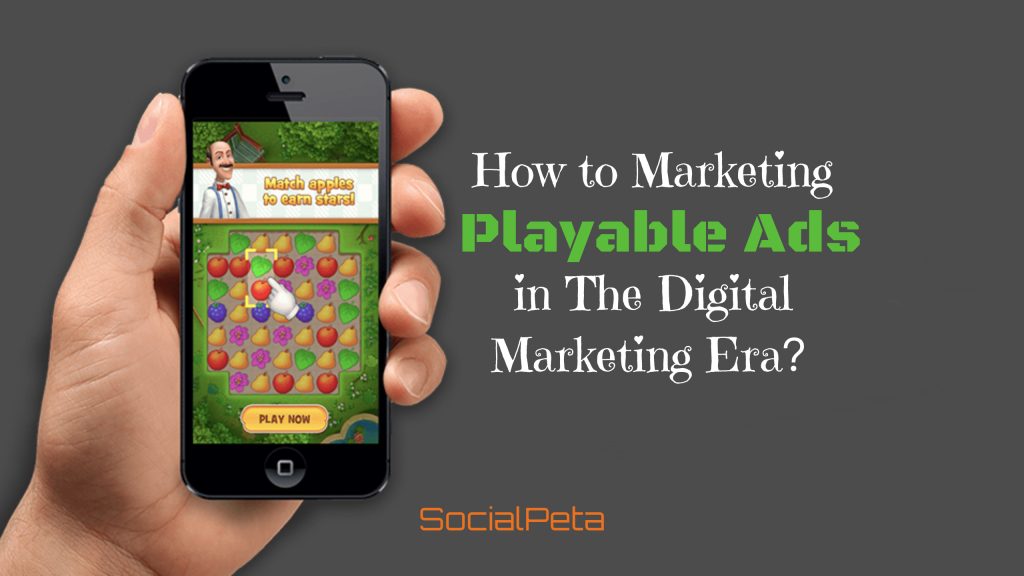
In the digital marketing era, social media and mobile apps have become major environments for advertising. As playable advertising gained traction, more game marketers began using interactive trial experiences to promote games and attract users.
Unlike a conventional video creative, a playable ad lets users interact with a simplified version of a game before downloading it. Understanding how this format works, which game concepts translate well into an interactive demo, and where those ads should be distributed can therefore be valuable for mobile game marketers.
Advantages of Playable Ads Over Video Ads
Playable advertising is already familiar to many performance marketers, but teams may still hesitate over whether producing a separate interactive experience is worth the additional effort. One way to evaluate the format is to compare the user experience with that of conventional video advertising.
Playable Ads Create a More Immersive Experience
Playable ads and video ads communicate game experiences in different ways. Video advertising is primarily explanatory: it uses recorded gameplay, demonstrations, editing, and creative presentation to show users how a game works. From the video, users may learn about the gameplay process, mechanics, visual style, and overall genre before deciding whether it interests them.
Playable ads add direct interaction to that experience. In addition to seeing information that might otherwise appear in a video, users can try a simplified version of the interaction themselves. This gives them an opportunity to judge whether the controls feel intuitive and whether the experience matches what they are looking for before downloading the full game.
Playable Ads Can Stimulate User Curiosity
Passive advertising is easy to skip. The original article describes this from a user's point of view: when encountering a standard sponsored video on social media, an uninteresting concept or weak creative can make it easy to swipe past the ad without giving it much attention.
A playable creative introduces another reason to stop: curiosity about the interaction itself. Users may try the ad simply to see whether the controls are smooth, how the game mechanic works, and whether the theme is appealing. Not everyone who interacts will ultimately install the game, but the format can turn an otherwise passive impression into a small product experience.
Which Games Are Suited to Playable Ads?
Not every mobile game needs to expose its complete gameplay loop in a playable creative. The original article highlights several categories where a simple, immediately understandable interaction can make the ad format particularly useful.
Gardenscapes: An Early Playable Advertising Case
The article uses Gardenscapes as a prominent example. After running a large volume of advertising, the game attracted substantial user attention and became highly visible in game rankings. The article argues that playable advertising played an important role in that marketing success.
An interesting aspect of the campaign was that some playable creatives did not attempt to reproduce the entire simulation and management experience of Gardenscapes. Instead, they focused on simple puzzle, rescue, and escape-style interactions that could be understood almost instantly.
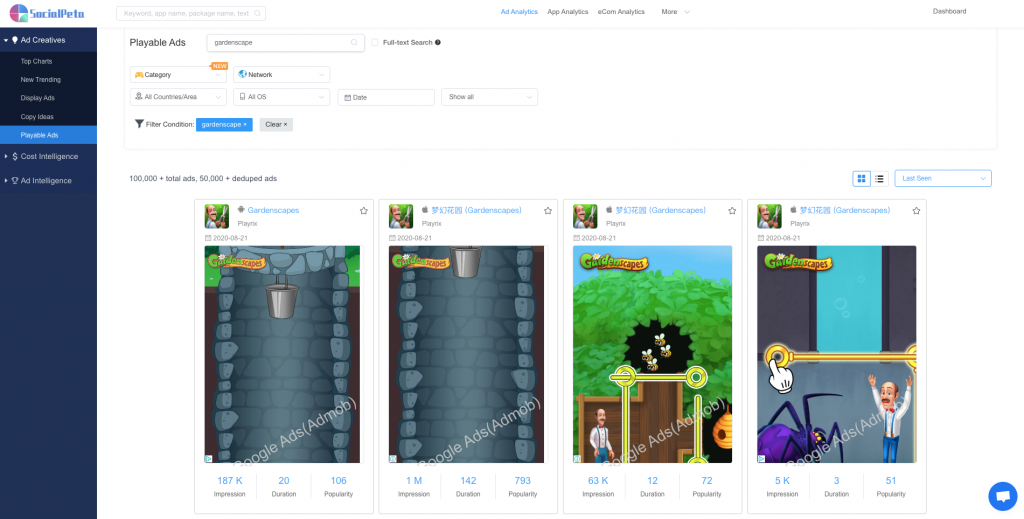
This illustrates one playable-ad creative strategy: identify a small, visually clear interaction rather than trying to compress every feature of the full product into an advertisement. A puzzle-solving or escape scenario can provide an immediate challenge and a clear action for the user even when the complete game contains a broader set of mechanics.
The article's original author also notes being personally attracted to the game through this type of trial creative, suggesting that puzzle and escape interactions can be effective at drawing attention from users who respond to short, challenge-based experiences.
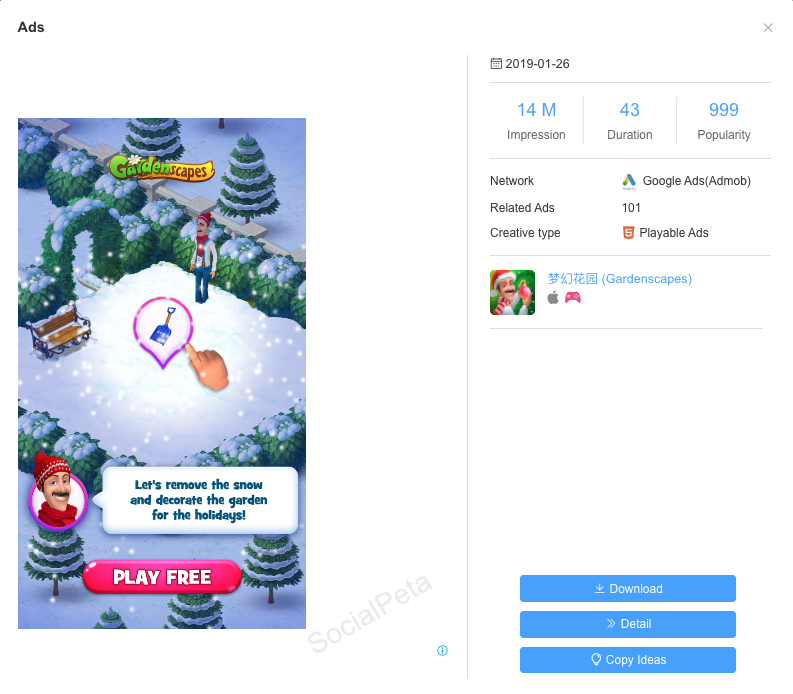
Gardenscapes did not rely exclusively on escape-style advertising. The historical creative above promotes another aspect of the game while still using a playable format. In the SocialPeta screenshot, the creative had accumulated substantial impressions and showed a running duration of 43 days.
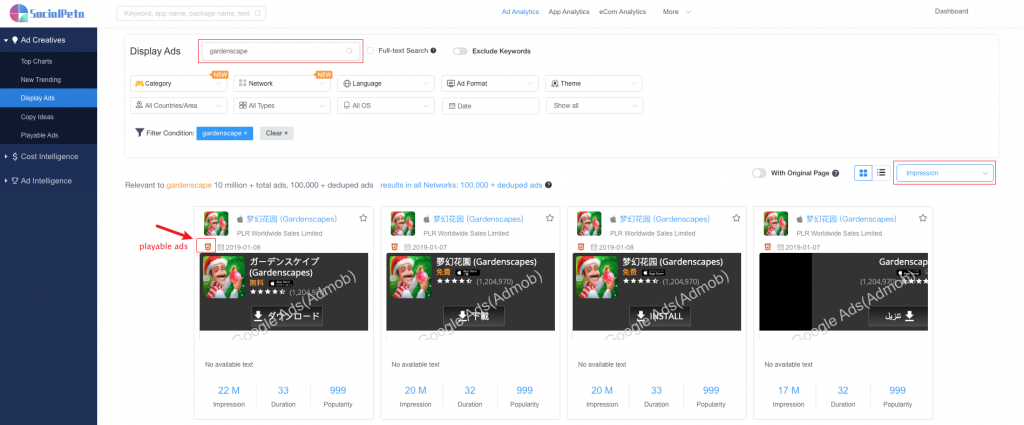
When the original article searched Gardenscapes creatives in SocialPeta and sorted them by popularity, many of the leading results were playable ads. The article therefore viewed the relationship as mutually reinforcing: playable creatives helped Gardenscapes attract traffic, while Gardenscapes itself became a prominent example of how playable advertising could be used in mobile game marketing.
Casual and Relaxing Games
Casual, relaxing, and so-called decompression games are another category highlighted in the original article. These games are generally designed for simple interaction, short sessions, and low-friction entertainment. A playable ad can demonstrate that appeal much more directly than a description alone.
Some users may have little reason to search for this type of game proactively. Giving them a brief trial inside the ad can expose the core interaction immediately and potentially motivate an install after they experience the mechanic firsthand.
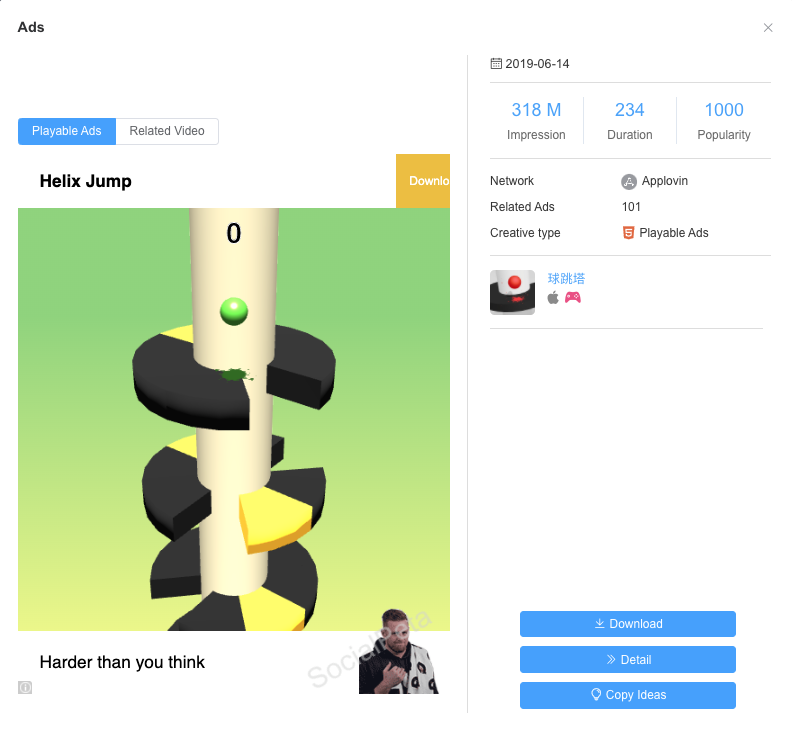
Helix Jump is used as a typical example. Its main interaction is simple to understand and users can become familiar with the controls quickly. For a game built around an immediately recognizable mechanic, playable advertising allows the creative itself to demonstrate why the interaction may be entertaining.
Users who were previously unfamiliar with the game or its category may therefore discover the title through the trial experience and decide to download it afterward.
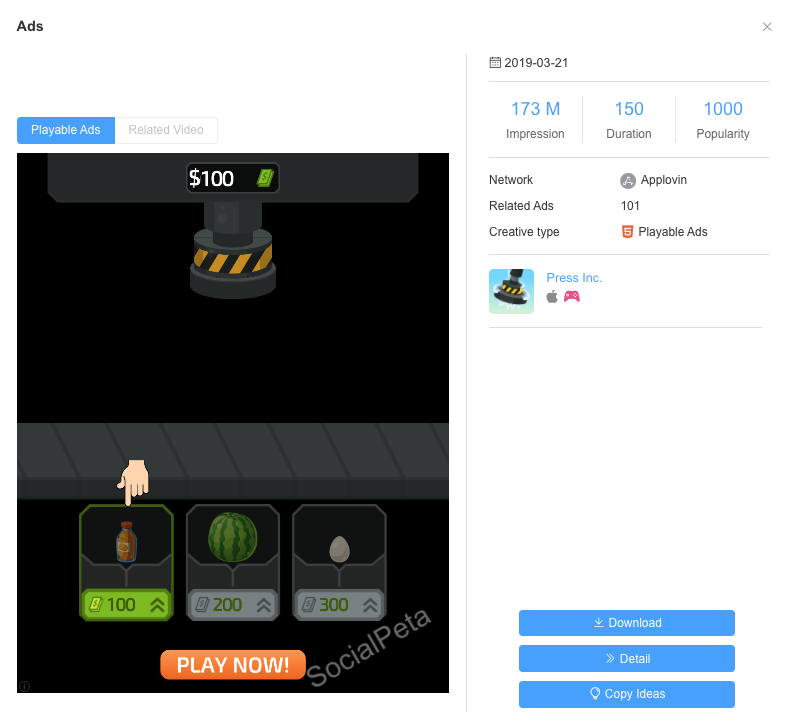
The article gives Press as another example of a casual decompression game. Its creative centers on interacting with and crushing different objects. The mechanic is visually understandable and produces an immediate reaction, which makes it easy to translate into a short playable experience.
The original article connects the appeal of these games with the way repetitive, simple actions can temporarily redirect a player's attention. Although individual casual titles may experience relatively short popularity cycles, periodic playable campaigns can give potential users another opportunity to experience the interaction directly.
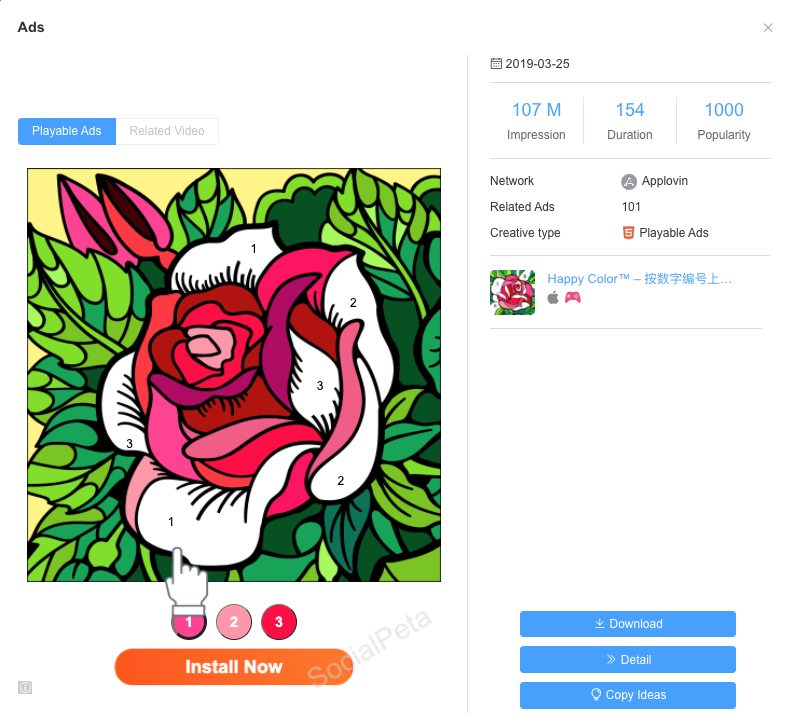
Coloring games provide a related example. An interactive paint-by-number experience can communicate the relaxing nature of the product inside the ad itself and then invite users who enjoy the interaction to continue with the full game.
Games That Struggle to Maintain Stable Traffic
The article also suggests playable advertising for games that have difficulty maintaining stable user traffic. Small mobile games can remain on a user's device for only a short period. Once the initial novelty or popularity declines, interest may fall and users may uninstall them.
Parkour-style and escape games are two categories discussed in this context.
Large early parkour titles such as Temple Run and Subway Surfers developed mature game concepts and long-lived audiences. Smaller parkour games, however, often compete for users who play in short periods of fragmented free time and may find it harder to sustain traffic for as long.
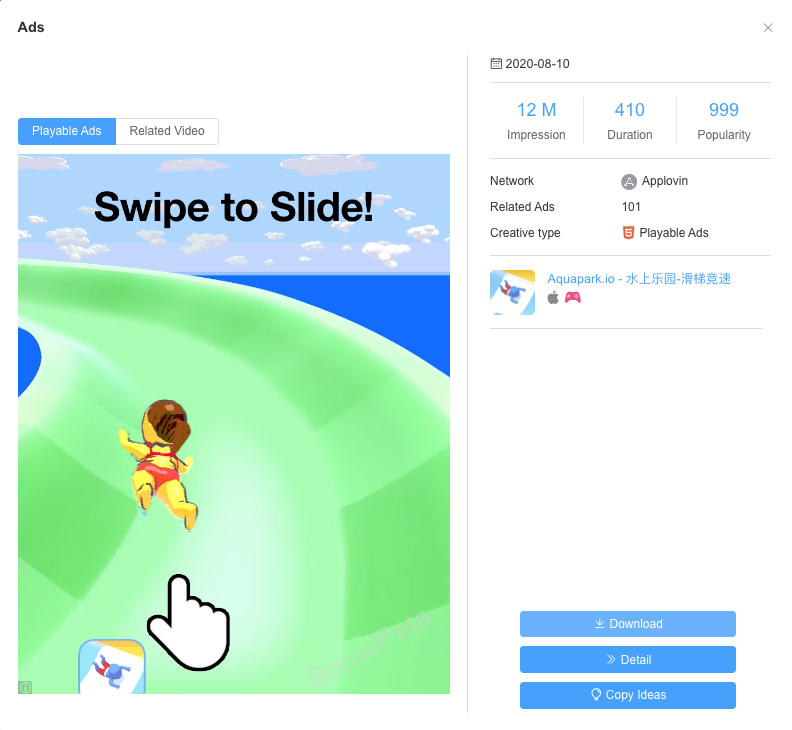
Aquapark.io is the article's example of this smaller parkour-style category. Because the core swipe-and-slide interaction can be experienced immediately, the article argues that a playable format can create a stronger short-term traffic opportunity than simply explaining the mechanic in a conventional advertisement.
For games whose commercial opportunity depends on generating a burst of users during a shorter popularity window, that ability to let the audience understand the mechanic immediately can be especially useful.
Escape games can also fit the format. Some escape and room-escape experiences have relatively limited replay value once their puzzles have been solved. That creates an incentive to continually reach new users, while the puzzle itself is often naturally suited to a short interactive advertisement.
The original article notes that escape-game playable advertising was less common at the time and often resembled the puzzle and rescue-style Gardenscapes creatives discussed earlier. It regarded that approach as a promising direction for playable advertising.
How to Choose Playable Ad Channels
For advertisers that already understand the potential advantages of playable ads, execution and distribution may be the harder problem. A playable ad is usually a simplified, independent demo rather than the complete game. It may include guided steps or an introductory tutorial, which means the campaign requires a separate creative production workflow.
Producing the demo is only part of the task. Marketers also need to decide how the interactive creative fits into the campaign and where it should be distributed.
Combine Short Video with a Playable Demo
Games that do not naturally fit a pure playable experience can use a hybrid format. One approach is to begin with a short video and then transition into the interactive trial.
The video can establish the theme, visual context, or broader game experience, while the playable section gives the user something concrete to do. The original article recommends treating formats flexibly rather than assuming every campaign must use only one type of creative.
Distribution Channels for Playable Ads
The article divides playable-ad distribution primarily between major social platforms and in-app advertising environments.
Social platforms can provide substantial traffic, but campaign costs must still be considered. In-app distribution introduces a different challenge: marketers need to identify suitable publisher apps, evaluate where their target users are likely to appear, and decide which placements are worth testing.
Selecting publishers is therefore an important part of the campaign. Rather than making that decision in isolation, marketers can analyze where similar advertisers are already placing creatives and compare publisher activity across the market.

SocialPeta's advertising intelligence can be used to examine advertising activity across publishers, networks, advertisers, and creatives. Comparing where competitors distribute ads can provide useful context when building a shortlist of channels and publisher environments to test.
The practical takeaway is that a playable creative should not be evaluated separately from distribution. The game mechanic, creative concept, publisher environment, audience, and campaign objective all influence whether the format can perform effectively.