
How Touka Games Uses API and AI to Improve Creative Production Efficiency
Touka Games connected SocialPeta API with its internal AI workflow to collect, understand, search, and reuse global game ad creative. This is the complete story of the system and the results it produced.
As mobile game expansion enters an era defined by creative efficiency, the ability to produce ad creative is gradually replacing budget size as a new variable in paid user acquisition growth. Touka Games has developed its own answer to that change.
Touka Games develops and operates games for global markets. In recent years, it has kept its main focus on midcore and hardcore mobile games. Rather than chase short bursts of traffic, the team puts more weight on improving content, gameplay, and long-term live operations. As overseas publishing conditions continue to change, the team has been looking for more accurate and efficient ways to express strong content and get it in front of the right players.
With that goal in mind, Touka Games combined its understanding of midcore and hardcore games with SocialPeta API and connected the data to its internal AI workflow. Step by step, it built a creative content system that covers ad collection, intelligent analysis, creative search, and asset reuse.
This article breaks down Touka Games' API and AI workflow and explains how it helps the team keep improving creative efficiency.
Paid UA competition is shifting from budget to creative efficiency
For the past few years, success in game user acquisition often came down to budget. Today, creative production efficiency matters more. It is the capability that connects product content, an understanding of players, and the results of global publishing.
Competitor ads in overseas markets now change every day, while players become familiar with common ad ideas faster than before. The teams pulling ahead are no longer simply those with the largest budgets. They are the ones that can spot a winning idea sooner and complete the next creative iteration faster.
Touka Games is a representative example of this trend.
Touka Games: a creative upgrade behind rapid growth
Founded in 2021, Touka Games is a boutique game developer and publisher for global markets. It is headquartered in Beijing, with teams in Guangzhou, Chengdu, and Chongqing, and an overseas operation in Singapore.
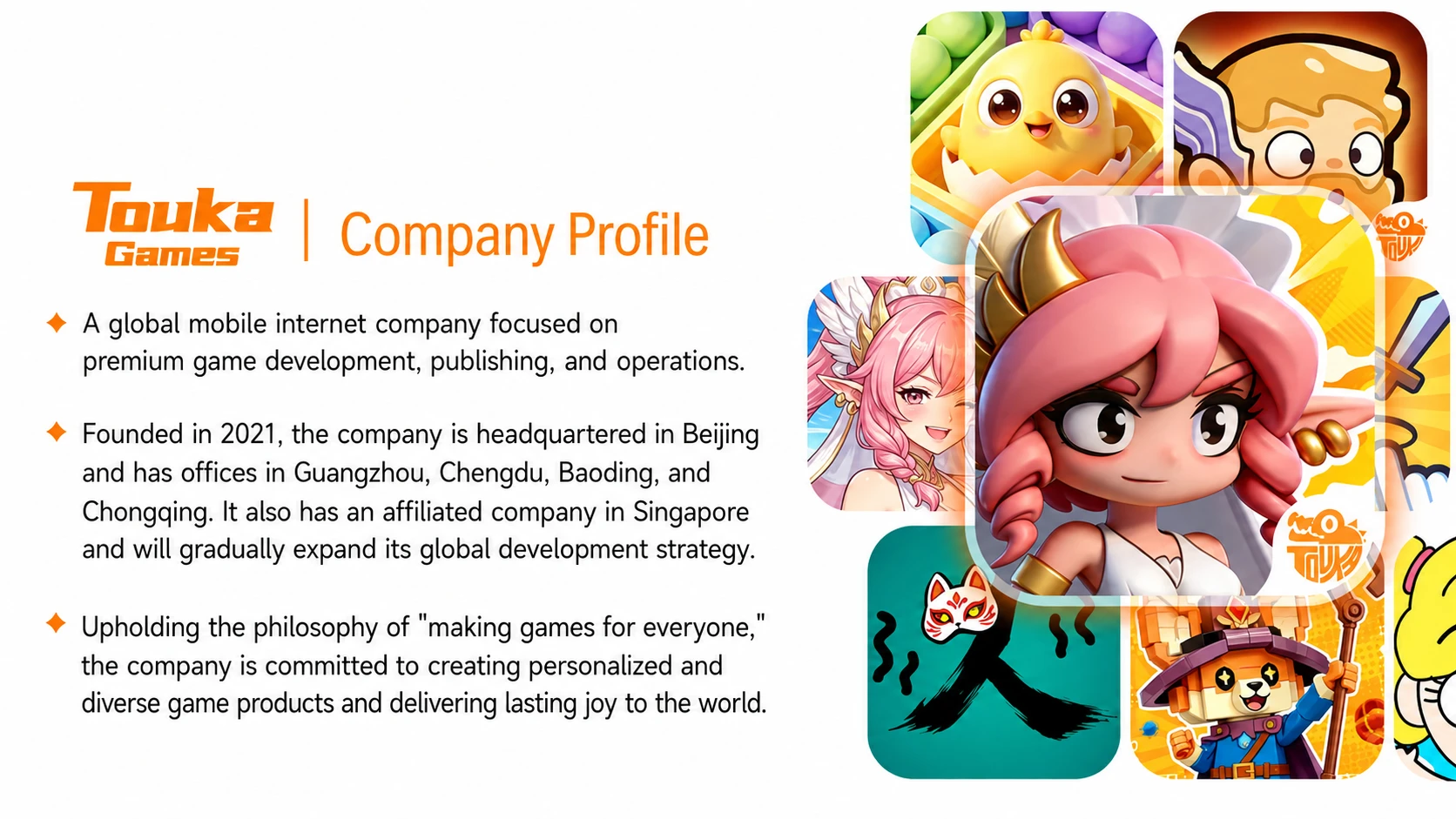
Core members of the team previously worked at ByteDance, Tencent, Mobvista, Alibaba, and Perfect World. They bring experience in game development, global publishing, and commercial operations.
In recent years, Touka Games has developed a diversified business spanning midcore and hardcore mobile games, web subscriptions, IAA casual games, and AI tool products, while maintaining rapid growth.
Its current mix includes web subscriptions, IAA casual games, midcore and hardcore mobile games, and AI products. In 2023, its portfolio exceeded 20 million downloads in a single month.
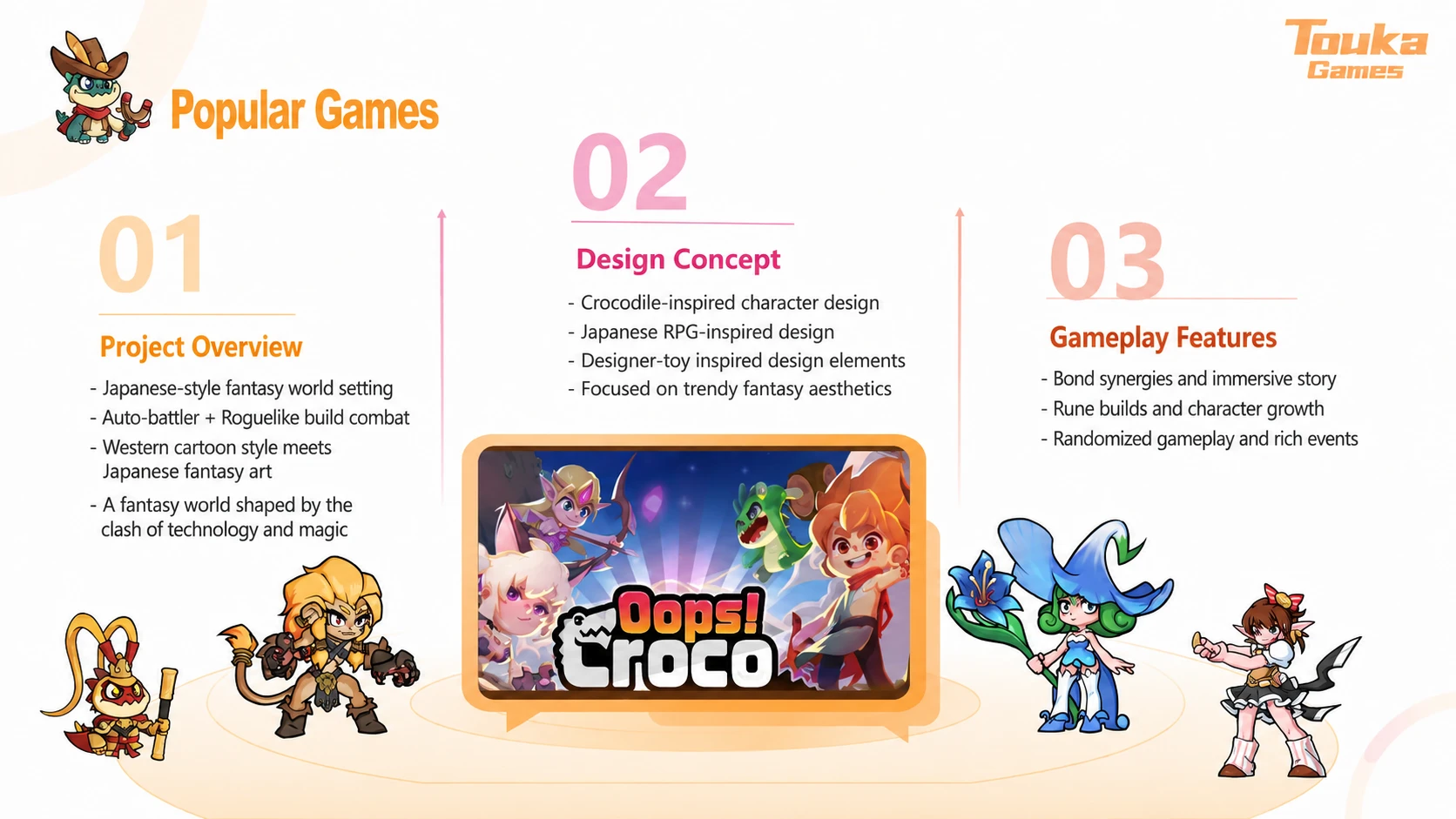
Expansion brought a new challenge. For the core title Oopsie Croco, the team needed to keep tracking competitor creative in overseas markets and turn around new iterations quickly. As media buying grew, the speed of sourcing, managing, and producing creative became an increasingly important factor in growth.
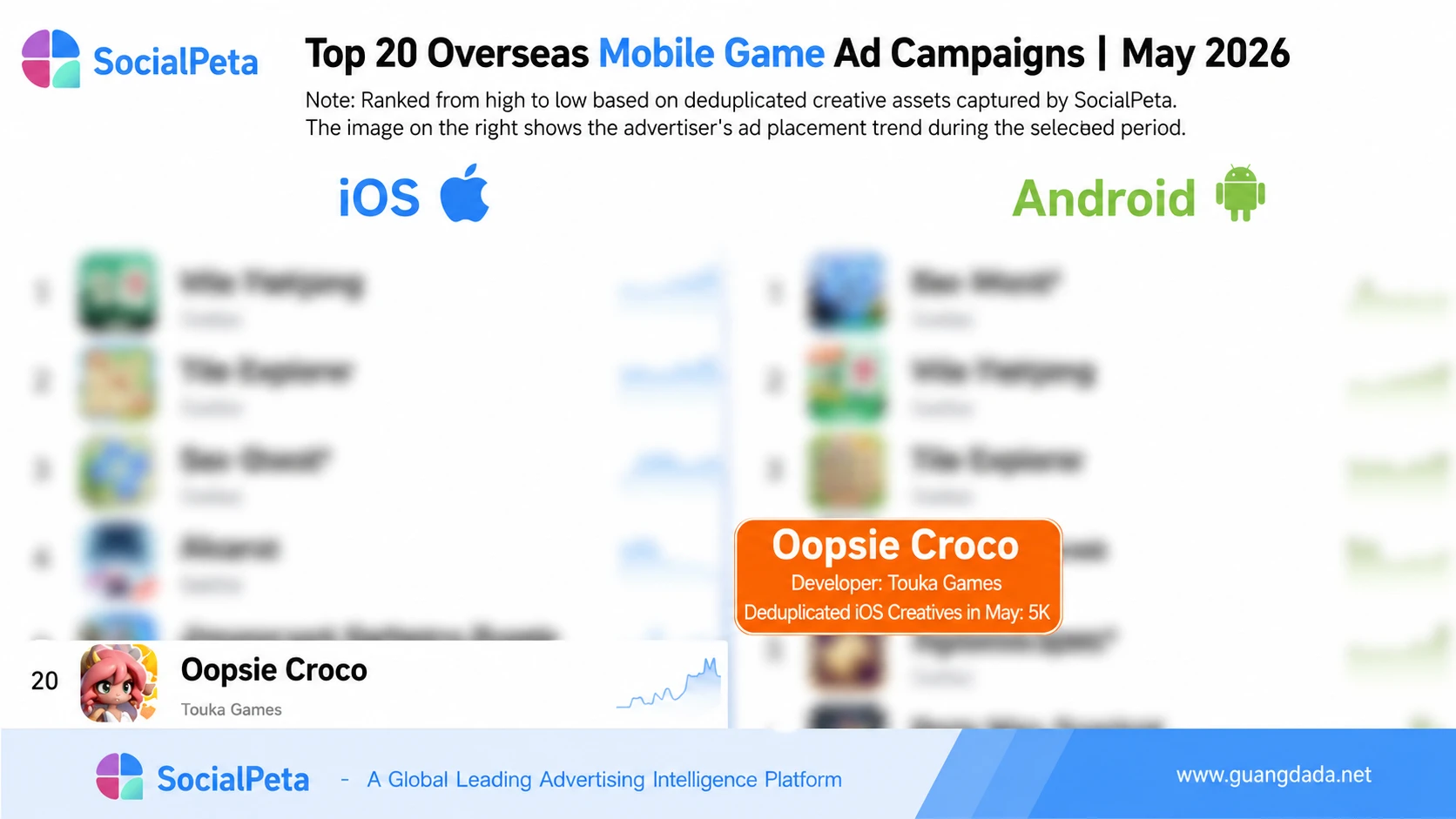
The number of Oopsie Croco creatives rose sharply in May 2026. The game entered SocialPeta's top 20 overseas mobile games by iOS advertising volume for the month, with 5,000 deduplicated iOS creatives recorded in the ranking graphic.
Creative mattered more, but the team's time went into finding material
Touka Games did not lack ideas. Its real problem was the speed at which ideas moved through the team.
Every day, the operations team had to monitor a large volume of ads across different countries and platforms. Staff searched, categorized, and archived the ads before screening them for ideas worth studying.
"Finding creative used to mean constantly switching platforms. TikTok, Meta, Google, YouTube. We might open more than a dozen websites in a single morning just to look for popular ads. The time left for analyzing the creative kept shrinking."
Touka Games team member
As the amount of material grew, other problems followed. Videos from different channels had no consistent tags, which made older ads hard to retrieve. Links from unofficial sources frequently expired. Team members saved and searched for the same ads more than once. Together, these problems disrupted the production pace and reduced efficiency.
Once creative becomes an important user acquisition asset, a traditional manual process can no longer support continuous iteration at this scale.
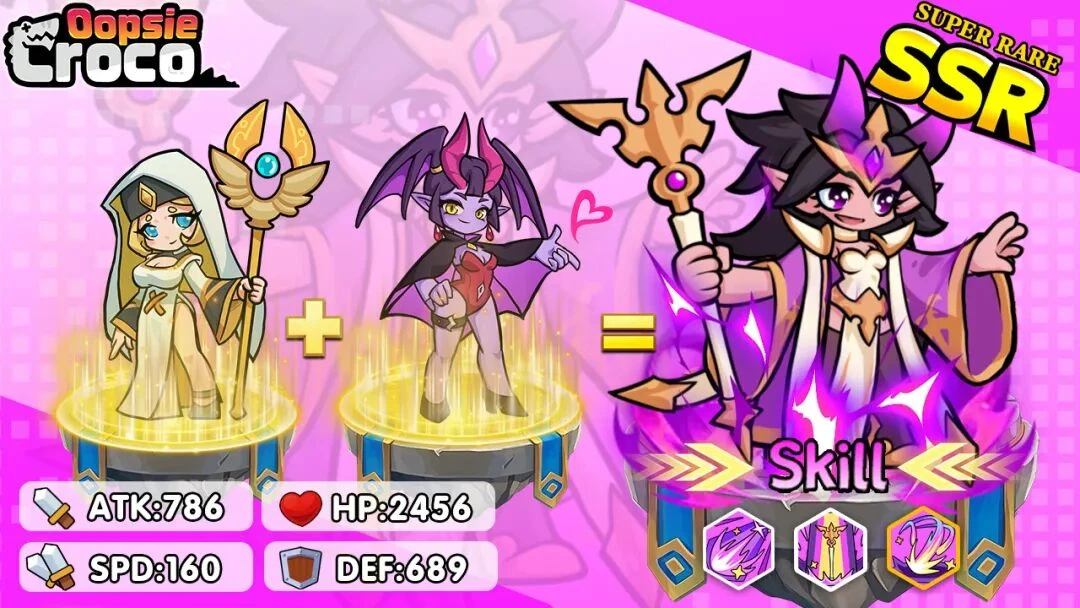
Touka Games realized that repeatedly tuning the manual process would not solve the underlying problem. The whole creative workflow needed to be redesigned.
Why Touka Games chose API and AI
The team evaluated several approaches, including manual maintenance and building its own collection program. As the library grew, however, data coverage, update speed, stability, and support for later AI analysis all became deciding factors.
Touka Games ultimately chose SocialPeta API as its source of global ad creative data and connected it to the company's internal AI system. A process that had depended on people to search, download, and organize ads began to run automatically. Overseas ads could enter the company library continuously, where they were managed under one standard and made available for later AI analysis and creative production.
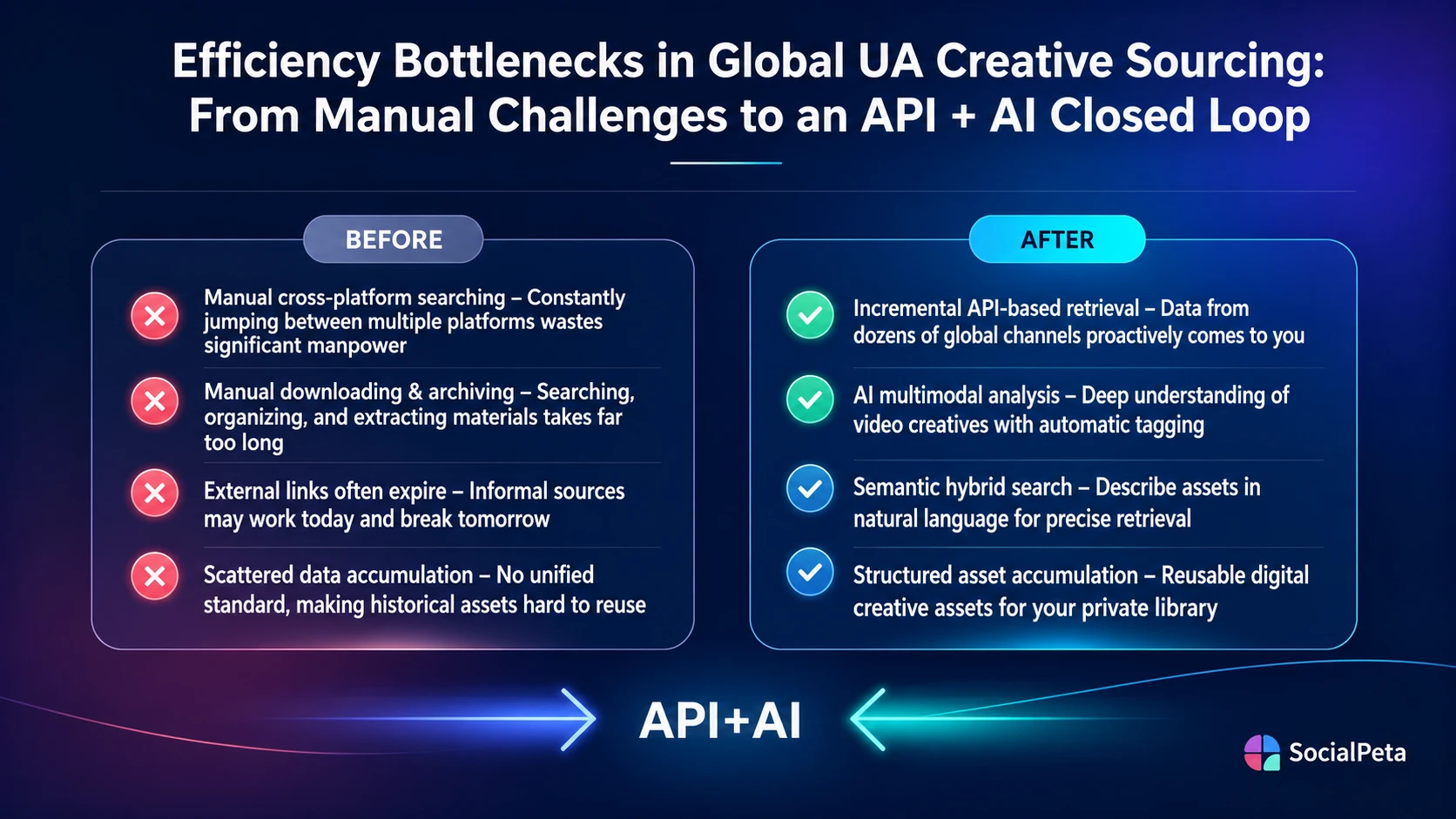
For Touka Games, the biggest change was not simply faster search. For the first time, the company had a data asset that could keep accumulating and be reused over time.
One workflow rebuilt the entire creative production process
Once the underlying data layer was in place, Touka Games gradually established a complete workflow covering creative collection, intelligent analysis, creative search, and production.
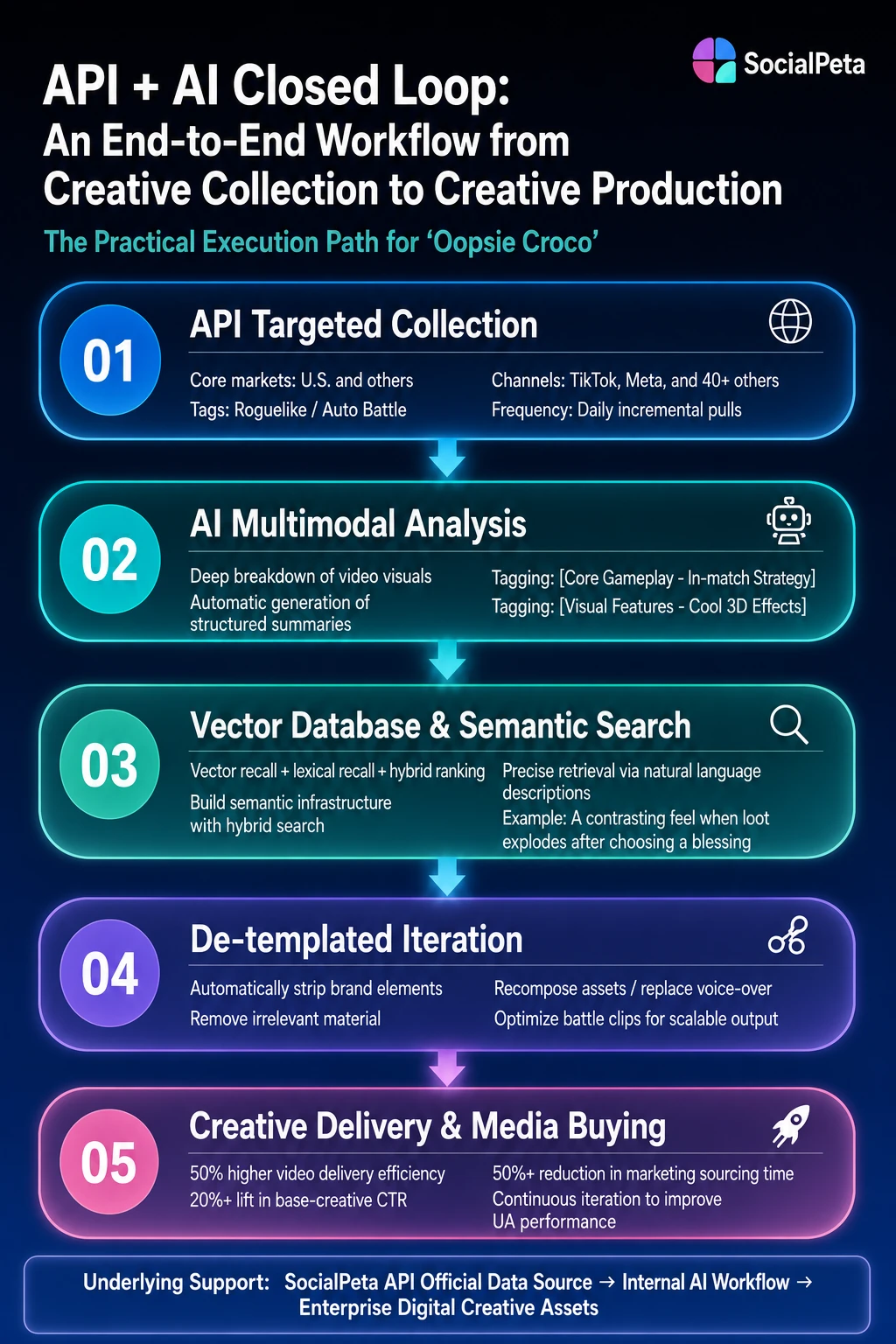
Step 1: let the creative flow into the system
The team set up automated creative collection. Based on predefined rules, the system continuously collects ads from priority overseas markets and standardizes them as they enter the library.
SocialPeta covers major advertising platforms around the world, allowing Touka Games to keep tracking competitors in its most important markets. When a new ad appears, it can enter the company library automatically. Material that employees once had to search for now comes directly into the system.
Step 2: AI watches the ads first
After an ad enters the system, AI identifies its video frames, subtitles, audio, and gameplay content. It then generates a Chinese summary and tags covering gameplay, selling points, and visual style.
Operators no longer need to watch every video from beginning to end. They can scan the AI summary and tags to decide whether an ad deserves further study. The system also applies the same tagging standard to material from different sources, creating consistent data for later retrieval and analysis.
Step 3: find the right creative with one sentence
Previously, operators could only search with keywords and then work through page after page of results. Now they can describe the idea they want in natural language. The system understands the meaning of the request and retrieves similar ads.
Creative search has moved from finding keywords to finding ideas.
Step 4: extract the pattern, then adapt it to the product
Finding a successful ad does not mean copying it. The system helps the team extract the creative logic behind the ad. Designers then develop the final execution around the characteristics of their own product.
The team used to spend a large share of its time searching for references, summarizing them, and breaking them down. The new process leaves more time for the creative expression that matters.
One workflow produced three measurable changes
For Touka Games, the main value of the redesign was not the introduction of another tool. It made creative production more efficient. The API and AI workflow improved three important metrics.
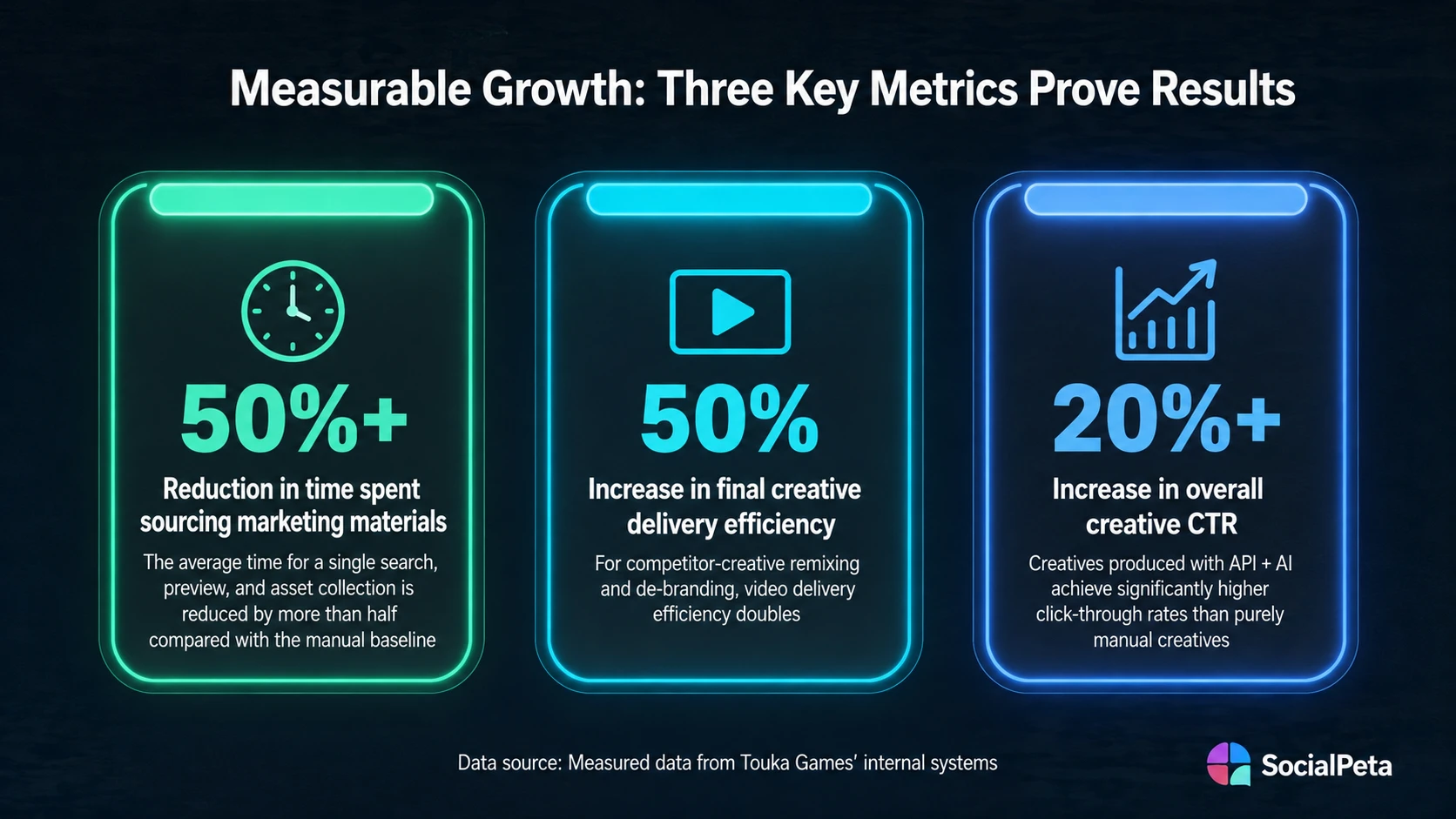
Creative sourcing became more than 50% faster
A single reference ad used to pass through search, download, preview, and screening, with operators moving back and forth between several platforms. Now ads enter the system according to preset rules, AI completes the first analysis, and operators use natural language to locate the right material.
Touka Games' data shows that the average time for one search, from preview through final selection, fell by more than 50%. More importantly, the team could move its time away from finding material and put it back into studying creative.
Video creative delivery became 50% more efficient
For designers, editing was not the biggest drain on time. The earlier work of finding references, breaking down ideas, and organizing content took longer. Once ads became easy to retrieve and AI could complete the first analysis, designers could begin secondary creation from a proven idea and spend more energy on expression instead of repetitive work.
Video creative delivery efficiency rose by 50%. With the same staffing, the team could test more ads and respond to market changes sooner.
CTR improved by more than 20% in related project tests
The efficiency gain also appeared in advertising performance. In the Oopsie Croco project, creative produced through this workflow delivered an overall CTR more than 20% higher than creative made through the traditional manual process.
A broader range of competitor ideas, faster iteration, and more precise creative positioning helped improve ad performance. For the user acquisition team, this established a different rhythm: instead of waiting for a hit, the aim is to keep producing them.
From one company's practice to a new way of running paid UA
The wider value of Touka Games' work goes beyond efficiency. It tested a creative production model that can be repeated over time.
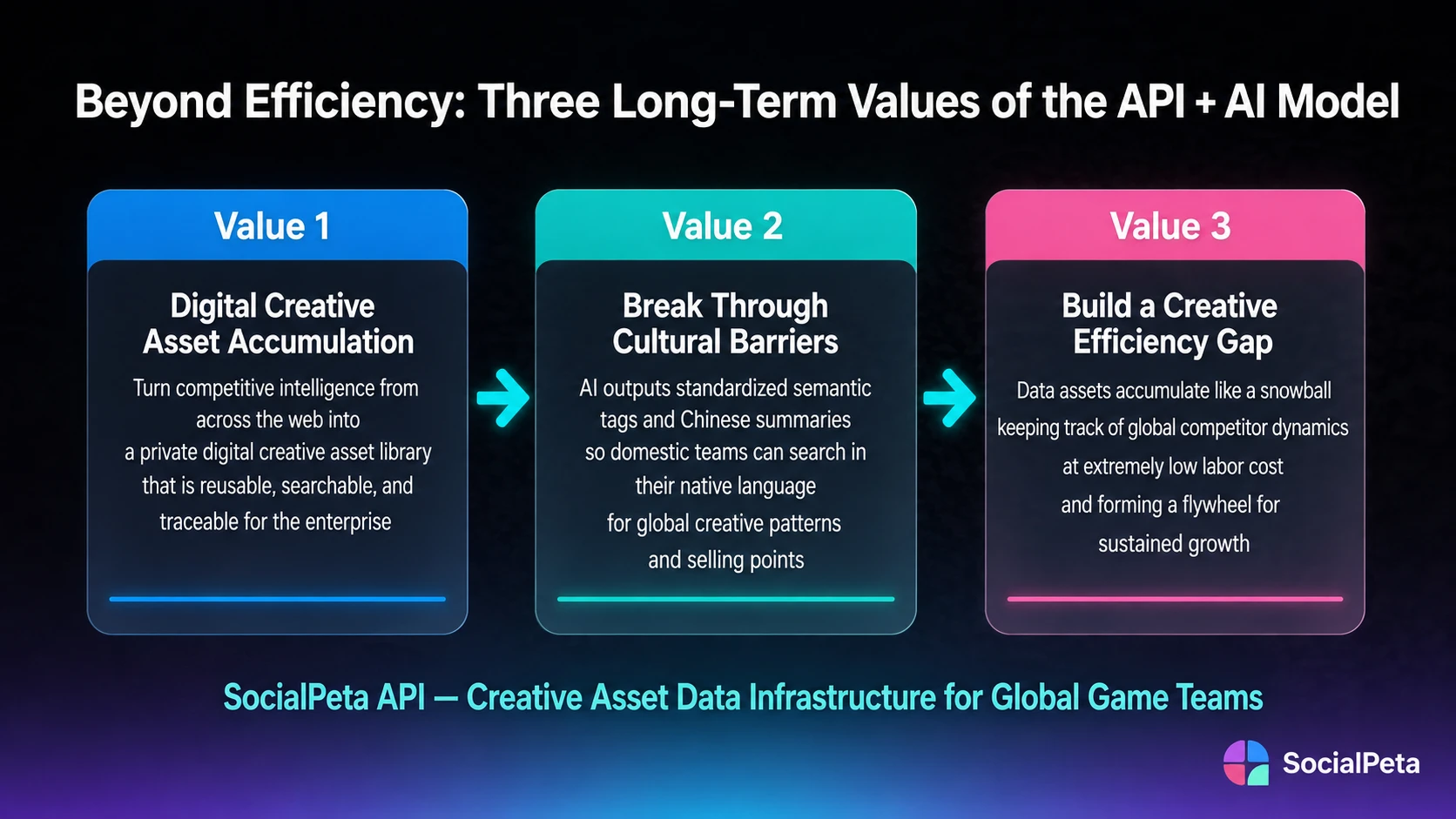
Creative becomes a company asset
Competitor ads used to be one-off references scattered across cloud drives, personal computers, and chat histories. They became difficult to use again as time passed.
Now every ad is managed, tagged, and indexed from the moment it enters the system. Over time, the material becomes the company's own creative asset. What accumulates is more than a video library. It is an expanding body of creative knowledge.
Creative capability begins to compound
The difference between teams increasingly comes from the ability to keep collecting and improving ideas, not from one successful ad. Data continues to accumulate, AI continues to learn, and each production cycle adds useful knowledge to the next one.
That capacity for continuous iteration is becoming a new source of competitiveness for more teams expanding overseas.
Creative infrastructure becomes a competitive barrier
Touka Games' experience shows how game user acquisition is changing. Competition once centered on budget. It later moved to creative volume. Today, more teams compete on the efficiency of creative production.
When data collection, asset management, AI analysis, and creative production form one closed loop, creative no longer depends only on individual experience. It becomes a capability the company can keep building and improving.
For teams going overseas, the important question is no longer limited to which single ad performs best. It is whether the team can build a system that keeps producing strong creative.
One case leaves more room to explore
Touka Games provides a representative example of an AI creative workflow. Other teams have different business models, products, and organizational processes, so the right implementation will vary.
Beyond automated creative production, the same data platform can support competitor monitoring, advertising analysis, and internal BI data enrichment. More overseas teams are now working out how to build a creative workflow around their own business.
Teams exploring AI creative production, competitor asset management, or advertising data infrastructure can speak with SocialPeta about other enterprise implementations and discuss a data solution suited to their business.