
Micro Drama Weekly Ranking: AI Leads the Way with Hyper-Real Characters and High-Impact Hooks
SocialPeta's March 30-April 5 weekly ranking highlights an increasingly competitive micro-drama market where revenge narratives, hidden identities, extreme emotional conflict, and AI-assisted visual production are shaping the creatives that attract attention.
Micro Drama Market Overview
According to SocialPeta data, approximately 18,400 short dramas were actively running between March 30 and April 5, 2026, representing a slight week-on-week decrease of about 1.79%.
Around 4,700 new titles were released during the week. New releases therefore accounted for approximately 25.59% of all active short dramas, showing that a steady flow of new content remained a defining feature of the market.
The weekly ranking also shows how fiercely producers are competing for attention. Female-oriented emotional stories and revenge-driven comeback narratives remained prominent, while AI-assisted production continued to appear in visually demanding scenes and environments.
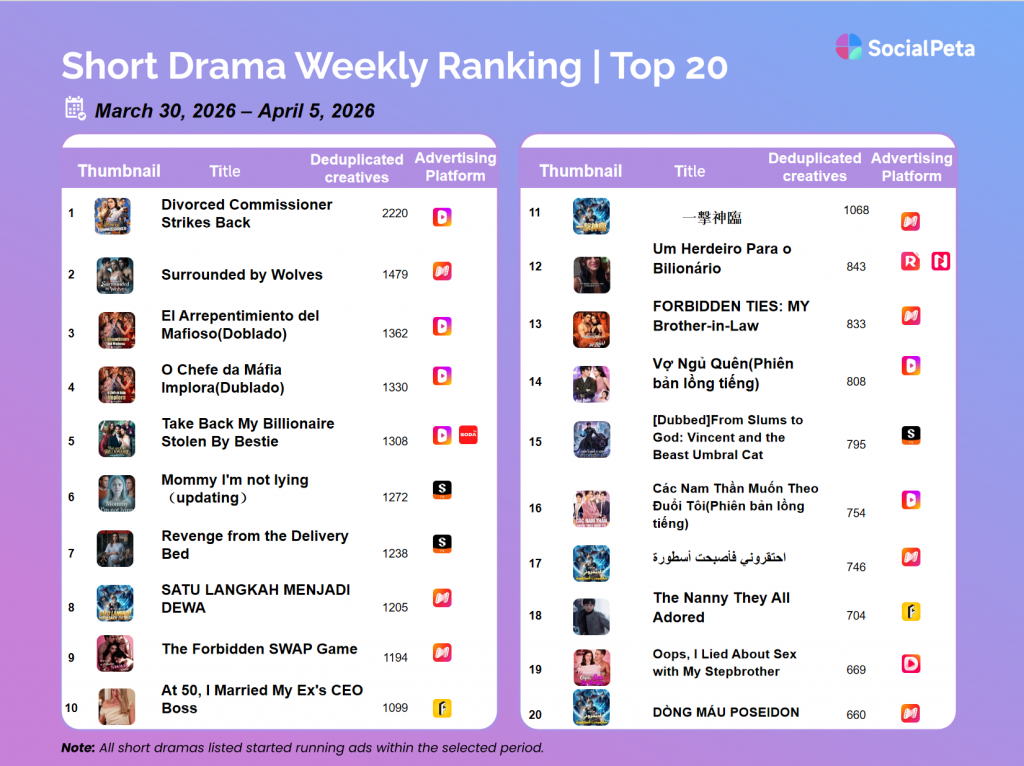
Market Snapshot: What Defined This Week
Several patterns stood out across this week's short drama rankings and advertising creatives.
- Female-led genres remain prominent. Emotion-heavy stories, revenge narratives, hidden identities, and comeback plots continued to occupy a significant share of the market.
- AI integration is becoming more visible. AI-assisted production is increasingly used for visual effects, environments, backgrounds, and scenes that would otherwise be difficult or expensive to produce.
- New releases continue to drive market churn. With new dramas accounting for roughly one quarter of active titles, frequent launches remain an important way for publishers to maintain visibility.
- High-impact emotional hooks remain central to advertising. Betrayal, humiliation, family conflict, hidden power, suffering, and revenge are repeatedly introduced early to create an immediate reason to keep watching.
Featured Title: Divorced Commissioner Strikes Back
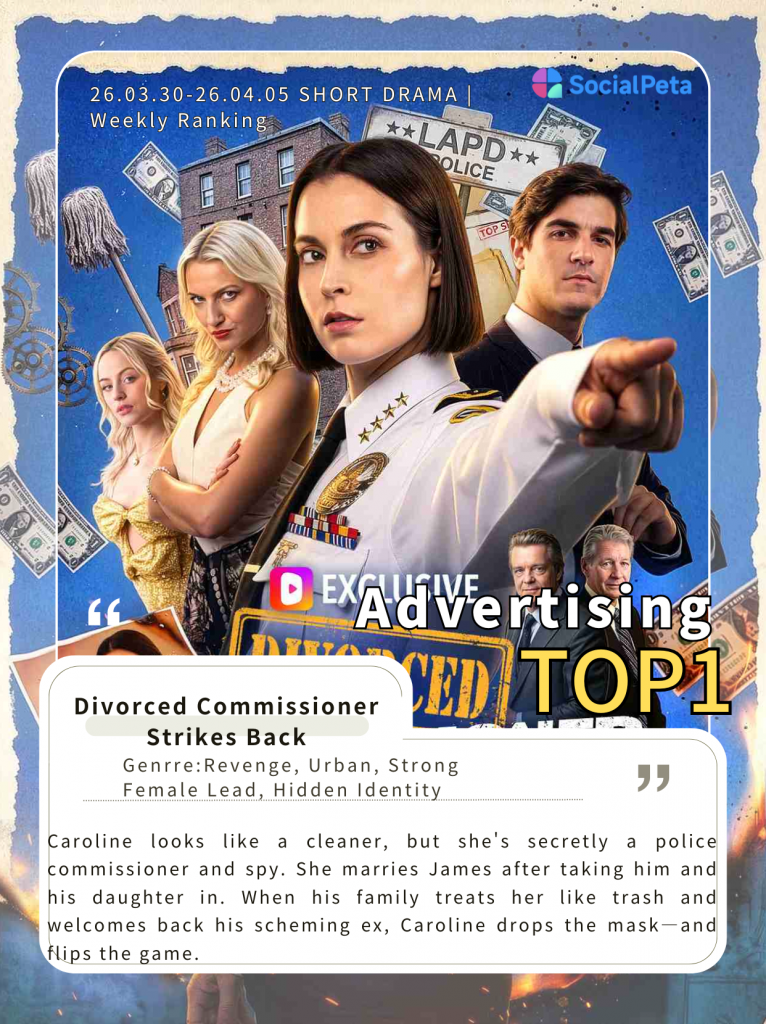
Divorced Commissioner Strikes Back took the No. 1 position in SocialPeta's Top 20 advertising creative ranking for the week, recording approximately 2.2K deduplicated ad creatives.
The drama combines two familiar short-drama devices: hidden identity and a dramatic comeback.
Caroline initially appears to be an ordinary cleaner, but she is secretly a police commissioner and agent. She takes in James and his daughter, only for his family to belittle her and welcome back a scheming former partner. Once Caroline is pushed out, the story shifts into a revenge-driven reversal as her real identity and abilities begin to surface.

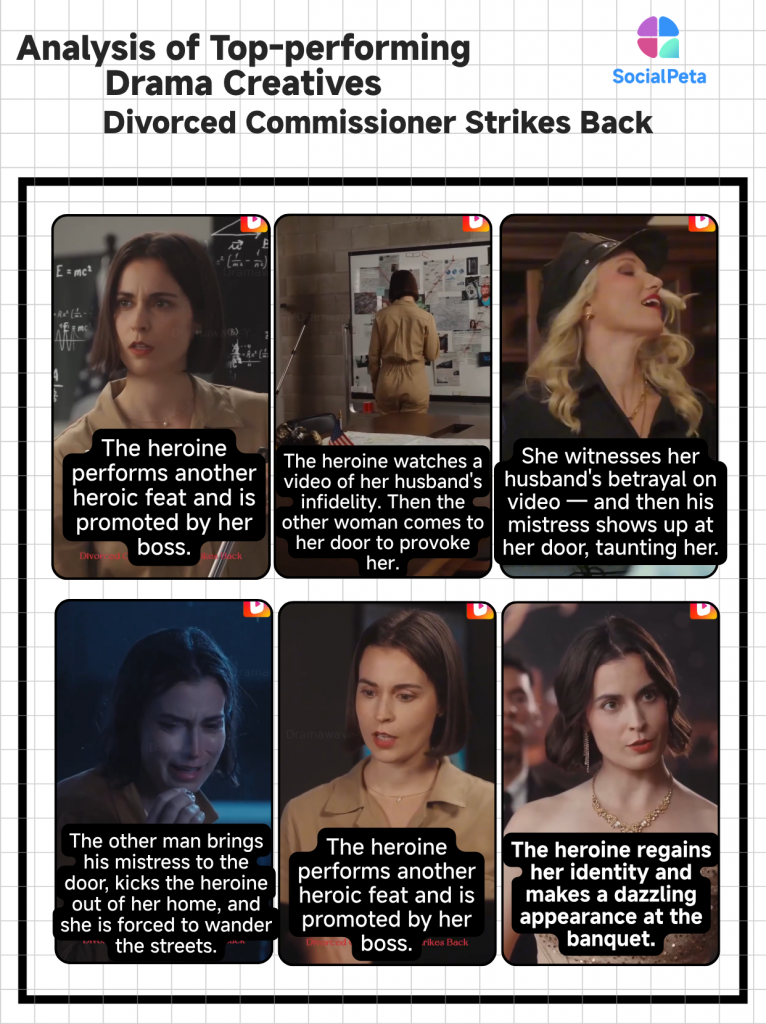
The most satisfying reversal scenes focus on Caroline's professional competence. The creative first positions her as someone others underestimate, then repeatedly reveals that she is far more capable than the people around her assume.
Her investigative skills allow her to help identify the real killer, while physical confrontations create another layer of contrast: the male lead initially believes she is only a cleaner before discovering that she can easily overpower him.
From an advertising perspective, this structure creates a clear escalation loop: humiliation → hidden ability → revelation → payoff. Each reversal gives the viewer another reason to wait for the next reveal.
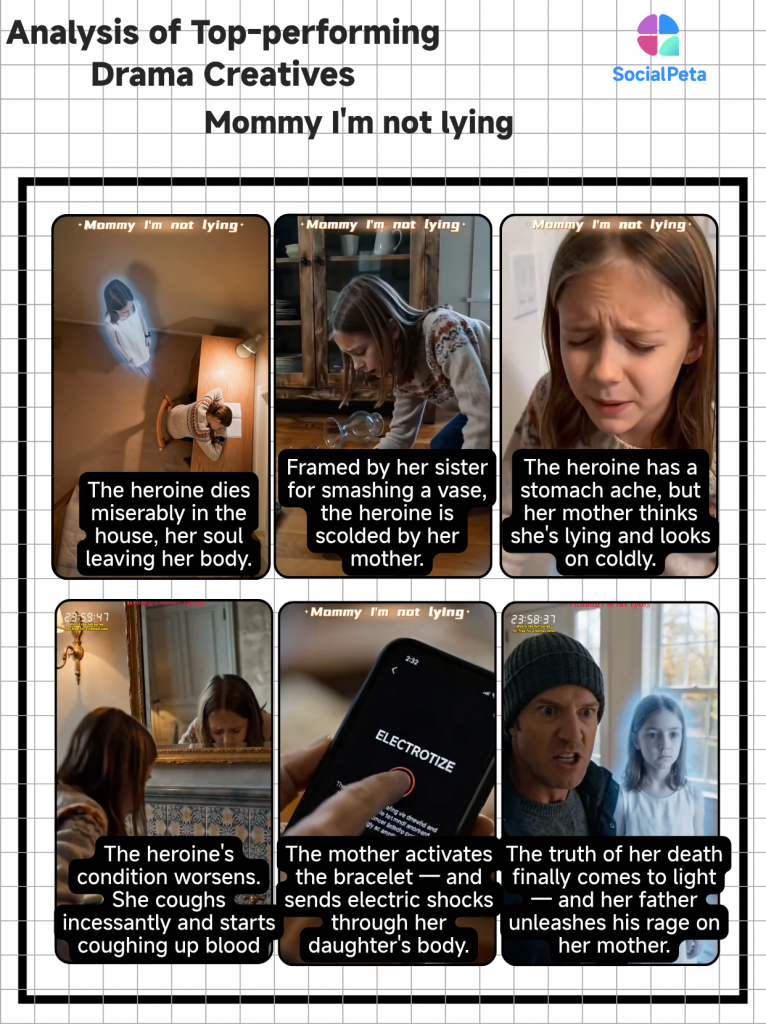
Featured Title: Mommy, I'm Not Lying
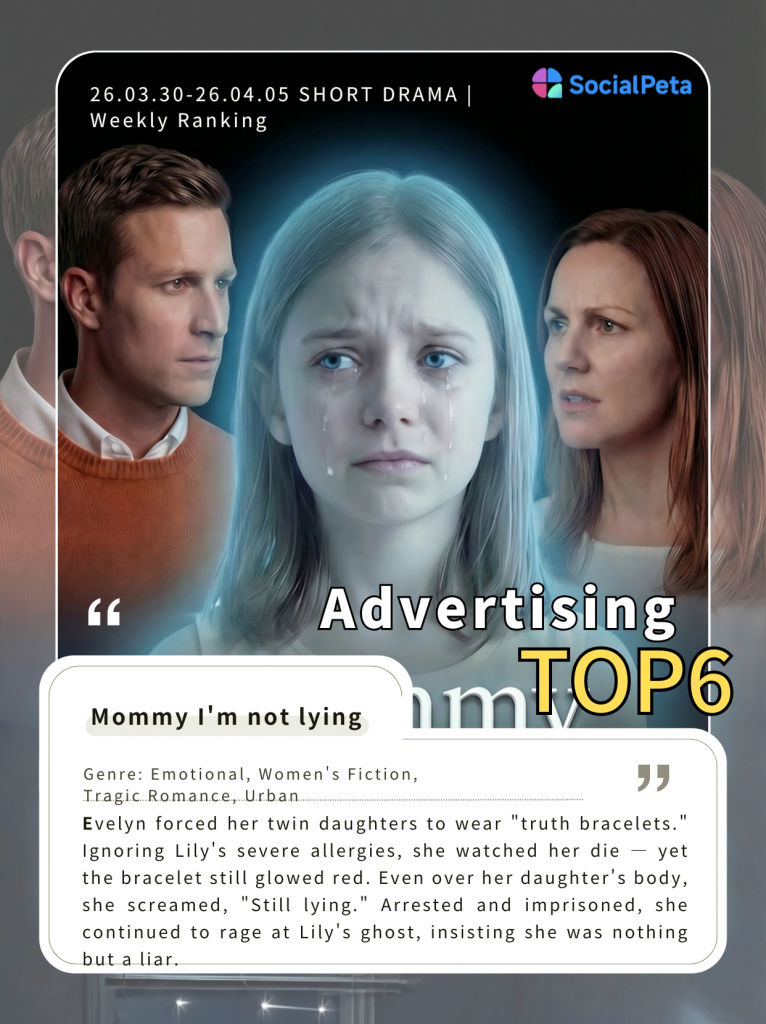
Mommy, I'm Not Lying ranked No. 6 in the Top 20 advertising creative chart, with approximately 1.27K deduplicated creatives.
The story relies on parental favoritism, family conflict, and a "truth bracelet" device that turns the relationship between a mother and her twin daughters into an increasingly disturbing emotional hook.
Lily is the less-favored twin. Her mother, Evelyn, treats her coldly while favoring her sister. When the sister breaks a vase and frames Lily, the contrast between a child's outward innocence and calculated cruelty immediately establishes the story's antagonistic dynamic.

Evelyn's obsession with the truth bracelet intensifies the conflict. She trusts the device rather than her daughter, allowing the drama to push the idea of parental mistrust to an extreme.
The creatives rely heavily on emotionally distressing scenes to create immediate sympathy for Lily and anger toward Evelyn. Lily is shown being blamed, neglected while sick, and ultimately dying after an allergic reaction. The story then continues from Lily's ghost perspective.
This approach is deliberately confrontational. Instead of slowly establishing family relationships, the creative gives viewers a morally unambiguous conflict almost immediately: a vulnerable child, an unjust accusation, and a parent who refuses to believe her.
Featured Title: Revenge from the Delivery Bed
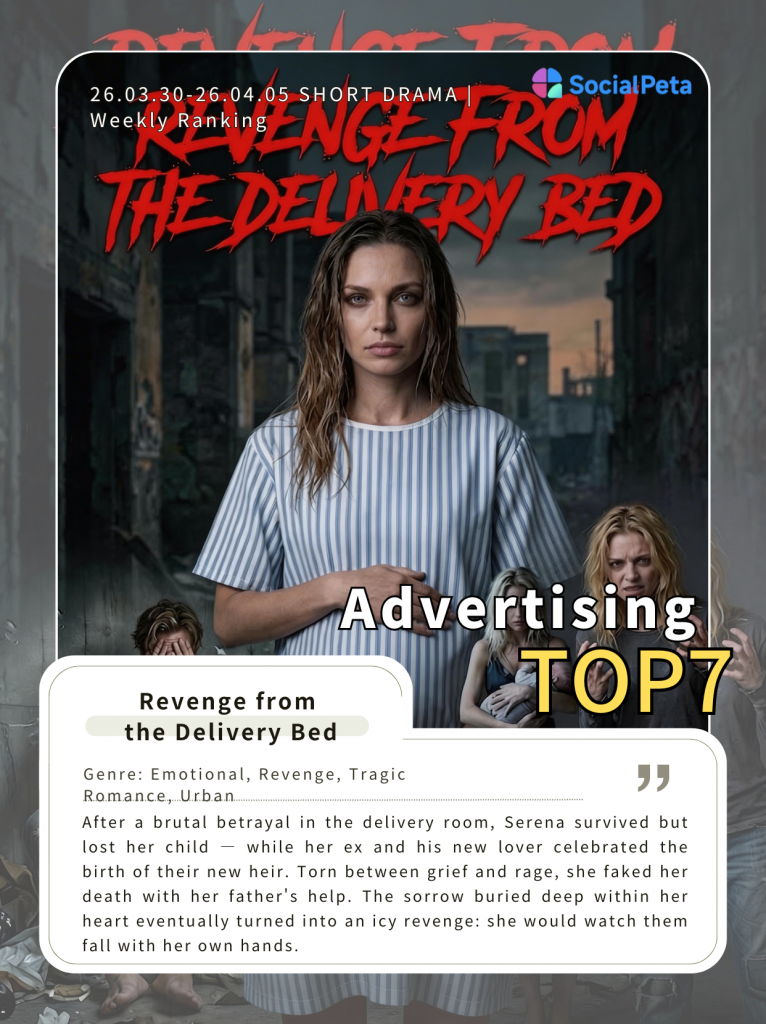
Revenge from the Delivery Bed ranked No. 7 in the weekly Top 20 advertising creative chart with approximately 1.24K deduplicated creatives.
Its premise begins at one of the heroine's most vulnerable moments. She is betrayed during childbirth, faces a life-threatening emergency, and loses her child while her former partner and romantic rival celebrate the arrival of another heir.
With help from her father, she survives, disappears, and begins preparing a calculated revenge.

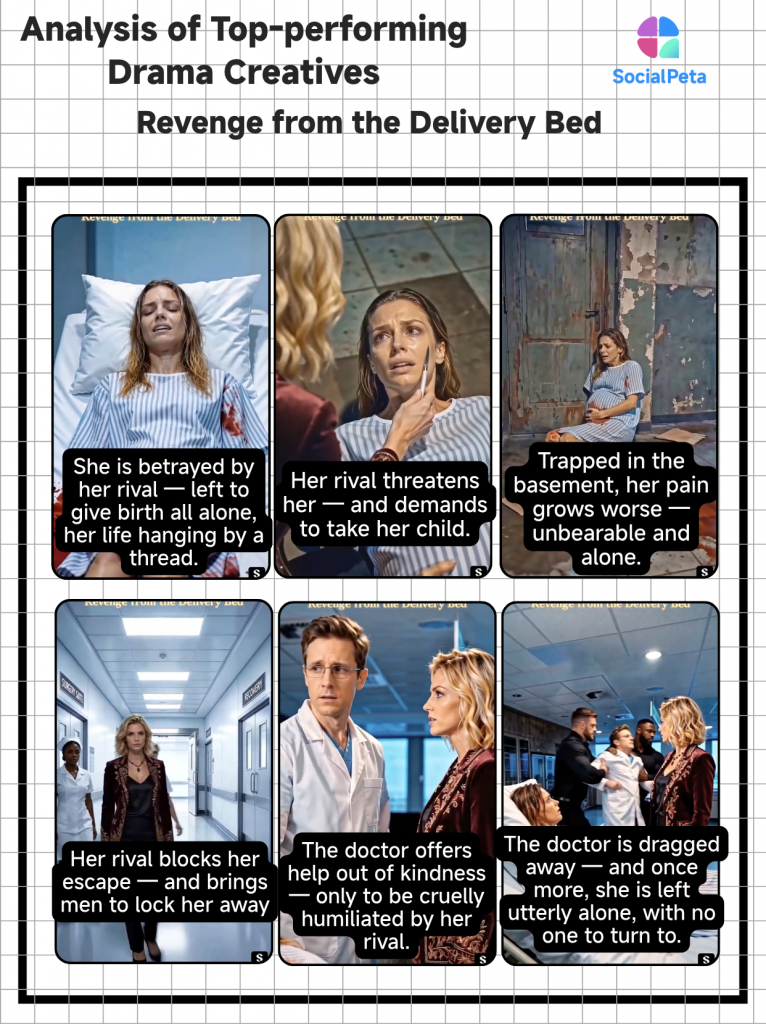
AI-assisted production is particularly visible in the drama's high-impact scenes. Blood and injuries are used to intensify the childbirth sequence and communicate the heroine's desperation, while the presentation remains stylized enough for short-form advertising.
Environment design also plays an important role. When the heroine is trapped in a basement, damaged walls and cracked surfaces reinforce danger and isolation. Hospital corridors use stark white surfaces and cold lighting to create a contrasting sense of medical urgency.
The result shows one of AI production's clearest advantages for micro dramas: producers can exaggerate locations, atmosphere, injuries, and other visually demanding moments without relying entirely on conventional live-action production.
What the Top Creatives Reveal
Looking across the three featured titles, the strongest creatives do not rely on story premise alone. They translate the premise into a visual hook that can be understood within seconds.
1. Start with injustice
Betrayal, humiliation, false accusations, abandonment, and parental favoritism quickly establish who the audience should sympathize with and who they should dislike.
2. Promise a reversal
Hidden identities and underestimated heroines work because the audience knows a satisfying payoff is coming even if the characters on screen do not.
3. Compress emotion visually
Tears, confrontation, injury, threatening environments, and visible power imbalances communicate emotional stakes faster than exposition.
4. Use AI where spectacle matters
AI-assisted production is especially useful when a scene depends on unusual environments, heightened atmosphere, visual effects, or situations that would be expensive or difficult to shoot conventionally.
For UA teams, this means the creative opportunity is not simply to summarize the entire drama. The more effective approach is often to identify the moment with the clearest emotional imbalance, introduce the conflict quickly, and leave the reversal unresolved.
Key Takeaways from This Week's Short Drama Rankings
- Hidden identity and comeback narratives remain effective hooks. Divorced Commissioner Strikes Back builds its payoff around an underestimated heroine repeatedly revealing abilities others did not know she possessed.
- Extreme family conflict creates immediate emotional alignment. Mommy, I'm Not Lying uses favoritism, false accusations, and a vulnerable child to generate both sympathy and controversy.
- AI is expanding the visual vocabulary of micro dramas. High-impact environments, stylized injuries, dramatic lighting, and other production-heavy scenes can be produced with greater visual freedom.
- Creative hooks are increasingly designed around immediate emotional impact. Betrayal, humiliation, danger, confrontation, and unresolved revenge give viewers a clear reason to continue watching.
- A high rate of new releases keeps competition intense. With around 4.7K new dramas entering the market during the period, publishers must continuously test new concepts and creatives to maintain visibility.
This week's ranking reinforces a broader shift in global micro-drama marketing: storytelling formulas remain important, but the ability to turn those formulas into visually immediate, emotionally charged advertising creatives is becoming just as critical.
To explore the broader strategies behind global micro-drama acquisition, localization, creative scaling, and IP development, see SocialPeta's Global Micro Drama App Marketing for 2026 report.