
Micro-Horror Games in Vietnam (Part I): User Acquisition Creatives, Localization Opportunities, and Market Expansion Strategies
A strategic analysis of category growth, gameplay mechanisms, creative and user acquisition frameworks, and the localization potential of the Vietnamese mobile game market.
Vietnam's Mobile Game Market and the Micro-Horror Opportunity
This content was co-authored by the Funtap Games R&D team in collaboration with the SocialPeta Data Research Institute.
At the Google Apps Summit 2025 held in Vietnam, a striking dataset captured widespread market attention: Vietnam's in-app purchase (IAP) revenue for mobile apps and games surged by 65% year-over-year, positioning the country among the fastest-growing markets in the Asia-Pacific region.
Behind this rapid growth lies a deeper structural shift. The Southeast Asian mobile gaming market is transitioning away from a growth phase reliant on low-cost traffic dividends. Instead, it is entering a new era where content quality, creative execution, and localization capabilities serve as core competitive advantages.
For publishers, the challenge is no longer simply having a sufficiently powerful product or an ample user acquisition budget. It increasingly hinges on the ability to consistently create content that resonates with the behavior and emotions of local users.
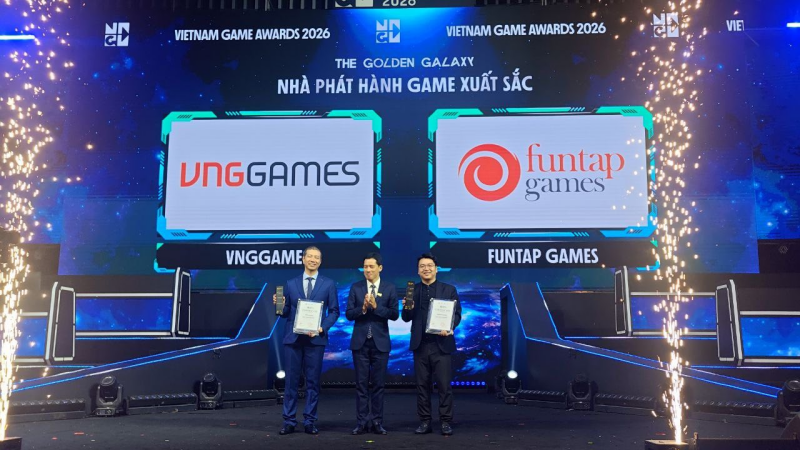
Recently, Funtap Games, one of Vietnam's leading mobile game publishers, was honored with the title of Outstanding Game Publisher at the Vietnam Game Awards 2026. This represents both a major brand milestone and recognition of its publishing capabilities, community operations, and product commercialization expertise in an increasingly competitive market.
Deeply rooted in the industry for more than a decade, Funtap Games holds the largest number of game publishing licenses in Vietnam and has established a strong position in the domestic SLG market. The company has co-published games including Genshin Impact, Mobile Legends: Bang Bang, Arknights: Endfield, Last War: Survival, Song of Kingdoms: Heroes and Conquest, Dark War: Survival, and Honor of Kings, among others.
It partners with more than 150 global collaborators and reaches a monthly active user base of 9.4 million.
Against this backdrop, SocialPeta has collaborated with Funtap Games' MR (Market Research) and UA (User Acquisition) teams to continuously track growth signals across the Chinese, Vietnamese, and broader Southeast Asian markets.
By dissecting product models, creative strategies, UA logic, and player behavioral patterns, the partnership aims to identify product categories with strong expansion potential in Vietnam.
Micro-horror is one of the most noteworthy tracks in the current global mobile gaming market.
When Micro-Horror Steps Beyond Its Niche
For years, the global mobile gaming market has been dominated by familiar categories such as MOBA, Battle Royale, SLG (4X Strategy), and Casual/Match-3.
However, as user acquisition costs rise, creative fatigue accelerates, and traditional core gameplay becomes increasingly difficult to differentiate, studios and publishers are being pushed to search for a new layer of player experience—one that is highly accessible while still capable of triggering strong emotional resonance within a short period of time.
Micro-horror sits precisely at this intersection.
Unlike traditional horror games on PC and console that immerse players in heavier frightening experiences, micro-horror creates a moderate sense of tension, curiosity, and unease. The emotional intensity can be strong enough to make people stop scrolling, keep watching, invite friends, or share a short video, while remaining accessible enough not to exclude casual players from the conversion funnel.
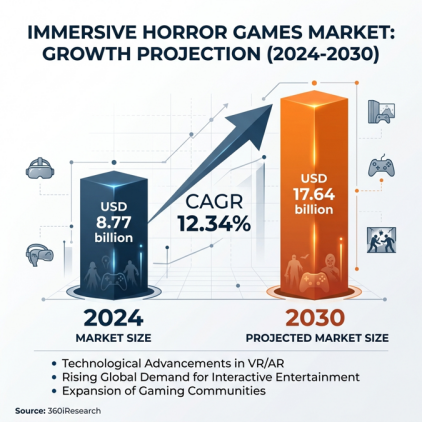
In China, micro-horror products are demonstrating expansion potential that exceeds the category's traditional niche stereotype.
Newer titles no longer cater exclusively to audiences seeking pure thrills. Instead, they integrate suspense, supernatural themes, mystery, and social stimulation into core mechanics that players already understand. As a result, micro-horror is evolving from "games for horror enthusiasts" toward mass-market games with a horror emotional layer.
A prime example is Supernatural Task Force, launched by Giant Network. The title combines a search-loot-extract mechanic with a Chinese supernatural setting, producing dual pressure from monsters and from the risk of losing acquired assets.
This is a representative example of horror being used as an emotional amplifier for gameplay instead of becoming the entirety of the product.
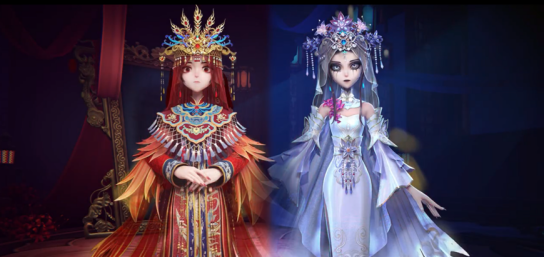
Micro-horror does not simply sell fear. It sells an emotional state: tense yet entertaining, scared yet eager to play, uneasy yet still inside a controllable comfort zone.
That emotional balance allows the category to reach Gen Z, casual players, and female audiences that may be especially receptive to suspense, distinctive character design, mysterious aesthetics, and highly shareable social content.
Publishing Capability Is Content Understanding Capability
Insights from rapidly growing Southeast Asian markets suggest that publishing capability can no longer be defined only by launching products, buying traffic, and operating live events.
For live-service games, long-term growth increasingly depends on deeply understanding the product, understanding local players, and restructuring how the product's content is expressed within each market.
This is the logic Funtap Games applies while expanding a product matrix spanning Xianxia MMORPGs, Wuxia, Three Kingdoms strategy, SLGs, esports, midcore and hardcore games, and community-driven products.
Each category has its own hierarchy of user motivations, but they share a common requirement: the product must be translated into a content language that fits the cultural context of Vietnamese players.

For micro-horror, this capability becomes particularly important. Generic horror scenarios may trigger initial curiosity, but they struggle to sustain long-term engagement and viral discussion when the content fails to connect with local cultural memories and entertainment habits.
By contrast, highly specific local details—rented rooms at the end of narrow alleys, weathered apartment complexes, student dormitories, communal housing, nighttime street vendors' calls, midnight corridors, and urban folklore—can create an experience that feels simultaneously familiar and uncanny.
That familiarity is a natural advantage for localized horror content.
From a publisher's perspective, micro-horror is therefore not only a product-selection question. It is fundamentally a challenge of content expression.
Publishers must deliberately choose which visual motifs to use, where to set the story, which creative hooks to deploy in the first three seconds, how to build suspense, and how to give the player community enough raw material for reactions, memes, livestreams, short videos, and user-generated content.
Emerging Gameplay Models: When Fear Becomes the Seasoning for Core Mechanics
The value of micro-horror does not lie in creating the most terrifying visual presentation possible. Its broader opportunity comes from embedding tension directly into core gameplay loops that have already been widely validated.
This is why the category can potentially be tested across a broad range of product formats.
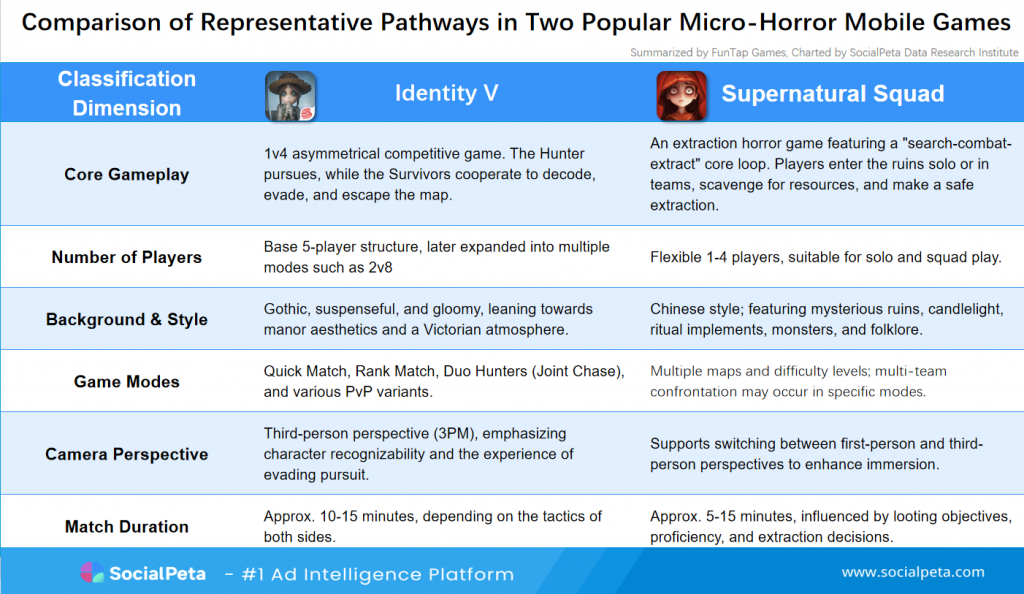
Horror does not necessarily need to function as a standalone genre. It can become an aesthetic layer, a pressure mechanic, or a behavioral motivator placed on top of otherwise very different gameplay structures.
The critical principle is that the emotional experience of fear should serve the core gameplay loop rather than exist independently of it.
Co-op Horror: Scared Yet Satisfied
Products inspired by Steam hit Lethal Company demonstrate how effectively horror can function as a social experience.
Players enter dangerous areas with friends, scavenge for resources, communicate through proximity voice chat, and repeatedly face unexpected emergencies. When a teammate screams in the dark and suddenly disappears from voice communication, the moment produces not only fear but also laughter, memes, and a reason for the squad to continue playing.
This kind of social stimulation fits short-session team-based play as well as modern habits around sharing short-form clips on TikTok and Reels.
For publishers, the value of co-op horror is that every game session can spontaneously produce user-generated content, potentially reducing total dependence on paid ad creatives.
Merge Horror: Injecting Freshness into a Saturated Casual Track
Merge is easy to understand, but products built only around familiar settings such as home decoration, restaurant renovation, or everyday item combinations can begin to feel repetitive.
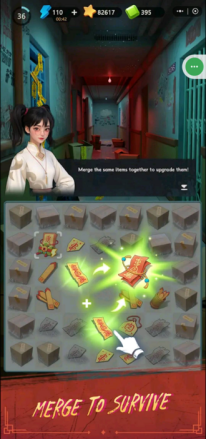
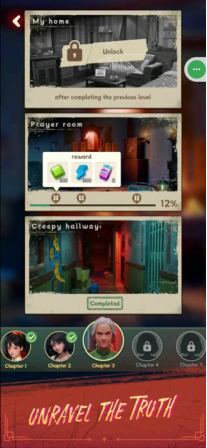
Introducing abandoned houses, talismans, red candles, family secrets, or trapped souls into a merge loop gives the product an additional layer of exploration and natural narrative hooks.
Taking Haunted Merge — known domestically as Who Can Save Me — as an example, players do more than combine items to complete tasks. They progressively unlock fragments of a larger story.
The narrative horror layer provides an additional reason to return to the casual gameplay loop and can support retention and monetization more effectively than a generalized setting alone.
Roguelike Horror: Short-Session, High-Pressure, and Fast-Paced
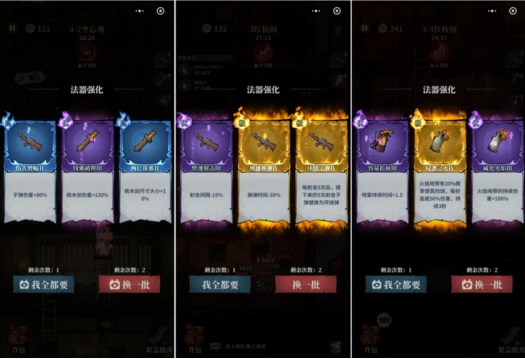
Products such as Infinite Loop demonstrate how well micro-horror can pair with fast-paced roguelike mechanics.
Players begin with limited abilities, fight waves of supernatural monsters, and select random skills after each wave. Individual sessions last only a few minutes while still providing tension, replayability, and opportunities to optimize different builds.
Within mobile casual games and mini-game ecosystems, this structure offers several advantages: short sessions, instant feedback, explicit pressure, and strong replay motivation.
Horror is not the ultimate objective. It is the seasoning that gives emotional weight to otherwise compact play sessions.
Extraction Horror: Using Loss Aversion to Amplify Tension
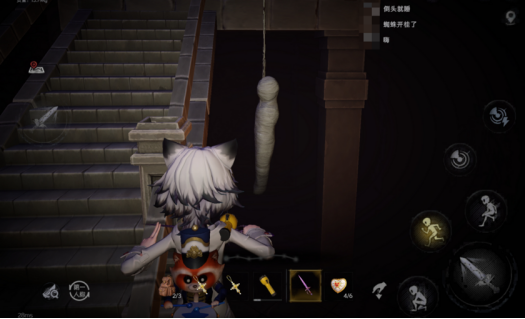
The extraction model is fundamentally built around entering a map, looting resources, and reaching a safe evacuation point.
When that model is combined with supernatural themes—as seen in titles such as Supernatural Action Squad—pressure no longer comes only from monsters. It also comes from the possibility of losing all collected assets after death.
The closer players move toward extraction, the higher their anxiety becomes. The more valuable their inventory is, the harder it becomes to decide whether to keep pushing forward or retreat.
Horror makes this loss-aversion mechanic tangible, transforming each session into a series of trade-offs between ambition and safety.
Room Defense and Idle Horror: Simple Rules and Easy Scalability
Room-defense and idle mechanics are another viable direction for casual mobile players.
The rules are usually intuitive: choose a room, lock the door, upgrade defensive installations, and survive the night. Players face a minimal learning curve while experiencing mounting pressure and clear reward mechanisms that continually encourage upgrades.
Haunted Room is a representative example. Experience publishing Haunted Room: Ngôi Nhà Hắc Ám in Vietnam creates a practical foundation for monitoring player feedback, validating the market fit of room-defense and idle mechanics, and evaluating localized advertising creatives.
If Funtap Games continues expanding its presence in Vietnam's micro-horror market, this experience can become a valuable operational data asset.
Why Micro-Horror Holds Massive Potential for Scaling
The growth of micro-horror is not driven by novelty alone. The category also aligns with several major conditions shaping today's mobile market: short-form content consumption, rising user acquisition costs, social platforms rewarding high-emotion reaction content, and younger players seeking intense yet controlled experiences.
- Low Barrier to Entry: Mobile micro-horror typically uses intuitive controls and short sessions, without requiring deep role-playing investment. Players can quickly experience emotional peaks during fragmented periods of free time and leave the session without sustained pressure.
- Natural Virality on TikTok and Reels: A well-timed jump scare, a teammate's mistake, an unexpected chase, or a dramatic player reaction can immediately become short-form video material. Products with strong social design allow players to become both users and content-distribution channels.
- Safe-Fear Mechanism: Players can enjoy tension inside a controlled environment. Micro-horror creates curiosity, suspense, and surprise without necessarily pushing the experience into psychologically heavy territory. When tension is released through laughter, rewards, or the relief of survival, the resulting emotional loop can become more satisfying than fear alone.
- Strong Fit with Gen Z and UGC Culture: Micro-horror naturally produces highlight moments that are easy to record, turn into memes, transform into fan art, discuss in reaction videos, or extend through community-created lore.
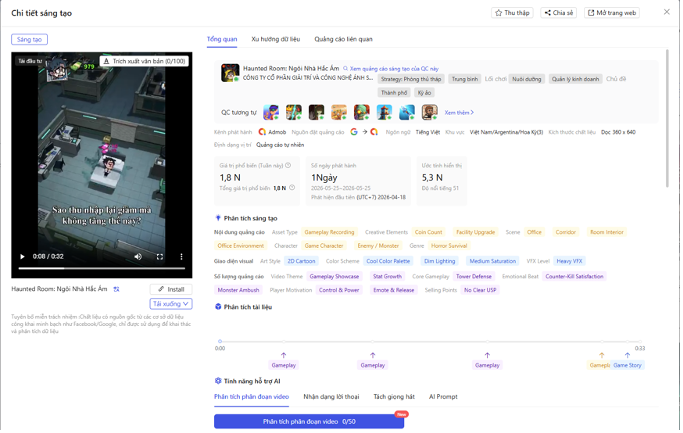
From a user acquisition perspective, one of micro-horror's defining advantages is its ability to generate an immediate emotional peak.
Many game ads need several seconds to introduce a character, feature, combat system, or progression loop. Horror content can instead open directly with a single anomalous signal: a knock on the door at midnight, a shadow appearing on a security camera, or a subtle inconsistency inside an otherwise familiar space.
A single signal can be enough to immediately place one question in the viewer's mind: What just happened?
From Category Strategy to User Acquisition
That concludes Part 1 of the Micro-Horror Special Feature.
By breaking down category trends, publishing logic, and multiple gameplay models, the value of micro-horror becomes broader than simply "scaring" players.
Horror can function as an emotional amplifier—a layer that can be grafted onto multiple validated gameplay mechanics while maintaining a relatively low barrier to entry and strong viral potential.
The next question is how that positioning translates into actual user acquisition and creative production. How can micro-horror creatives hook viewers within the first three seconds, and how can those hooks be deeply connected to Vietnam's local cultural context?
Part 2 focuses on:
- The natural creative advantages of micro-horror in performance advertising.
- The market window of opportunity shifting from China to Vietnam.
- Local cases validated by titles such as The Scourge (Tai Ương) and The Shaman (Thần Trùng).
- Strategic insights from Funtap Games.
The vacuum in the Vietnamese market is opening up, and the answer might just lie beneath that flickering light in the midnight hallway.
Continue with Micro-Horror Games in Vietnam (Part 2): UA Creatives, Localization Opportunities, and Market Expansion Strategies.