
Product-Led Growth for Small Game Studios Without a Data Team
A guest post from ThinkingAI on how small mobile game studios can run product-led growth without a data team — tracking the right events, separating acquisition from retention, and treating every live event as a small, measurable bet.
At 2,000 installs a day, a mobile game needs about ten days of traffic before an A/B test can tell whether day 1 retention moved from 40% to 42%. A test stopped after a long weekend cannot see that change, and a team that reads it anyway is acting on noise. The hard part for a small studio is knowing which questions it can answer with its player numbers.
Free-to-play games are product-led by design. A player installs, tries a few levels and decides whether the game deserves a second session. The tools for reading that decision were built for publishers with a data team. Now a studio can sign up for analytics itself and let agents handle much of the routine analysis. The team still has to read its player data every week.
What product-led growth means for a studio
Product-led growth means basing retention, monetization and LiveOps decisions on what players do in the game. The people who make the game make those calls, with tools they can set up without a data hire.
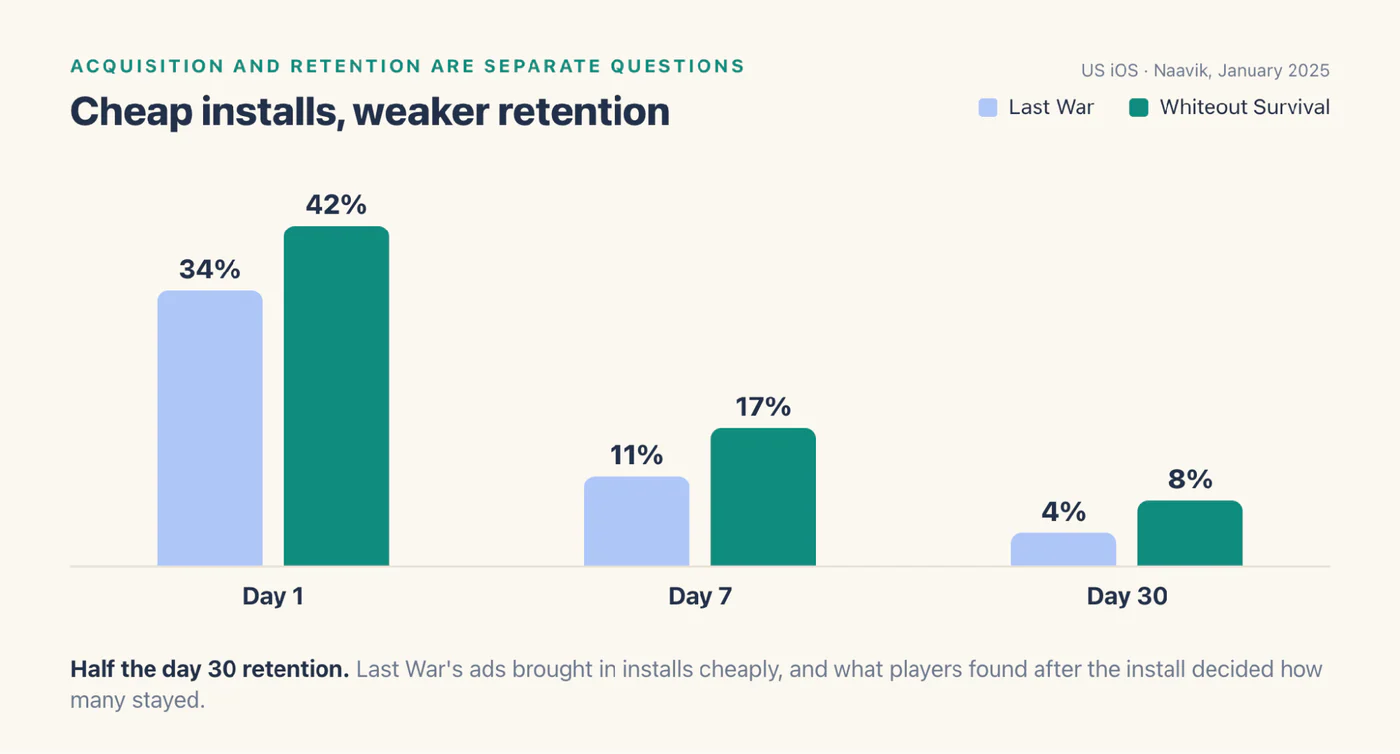
Acquisition and retention are separate questions, as Naavik showed in its January 2025 analysis of Last War. Last War's broad ad creative brought in cheap installs, yet its US iOS retention on days 1, 7 and 30 was 34%, 11% and 4%. Whiteout Survival, its closest rival, held 42%, 17% and 8%. Our creative testing guide covers the ad side. With dashboards or automations, a person still picks the change and decides what counts as a win.
Start with about fifteen events
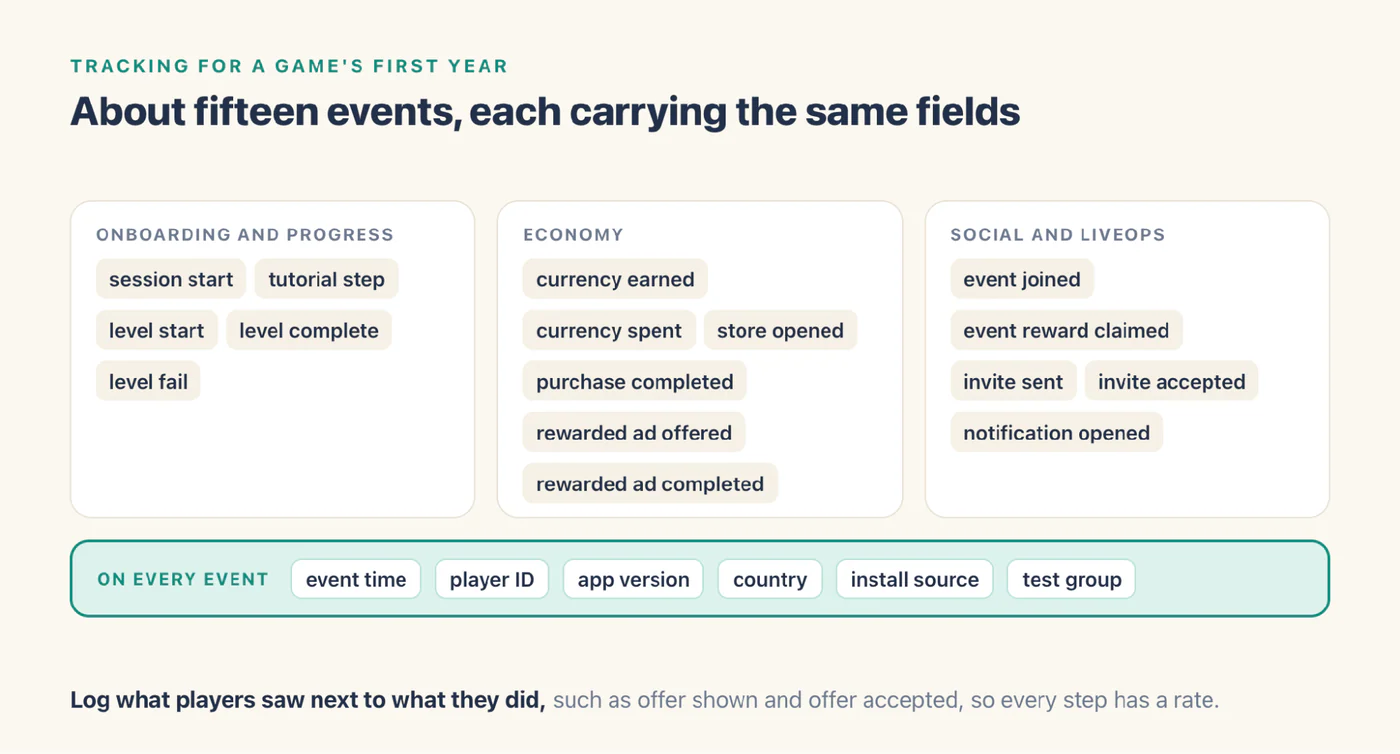
Some studios log only installs and revenue, and others log hundreds of events nobody reads. About fifteen events cover most decisions in a game's first year.
For onboarding and progress, track session start, each tutorial step, level start, level complete and level fail. For the economy, track currency earned and spent, store opened, purchase completed, and rewarded ad offered and completed. For social and LiveOps, track event joined, event reward claimed, invite sent and accepted, and notification opened.
Log what the player saw next to what they did, such as offer shown and offer accepted, so every step has a rate. Give every event the same fields, including event time, player ID, app version, country, install source and test group. App Store Connect and Google Play Console already report install source, so your events can match it.
Ask three questions every week
Where do players stop? Build a funnel from first open through each tutorial step to the first real level. Once the tracking checks out, fix the point where far more players leave than anywhere else.
Who comes back? Compare day 1 and day 7 retention for each install week, by source and platform. When Supercell cancelled Clash Quest after 16 months in soft launch, its developers blamed retention. They put retention at 1, 3 and 7 days among the numbers that matter most. If your curve flattens after the first week, the players who stayed have likely found a reason to return. If it keeps falling, progression and the core loop are the first places to look.
What changed after the last update? Compare similar groups of new players before and after the release. A new campaign or a holiday can shift the numbers by itself, so leave a random set of players without the change.
Only test what your traffic can measure
How many players a test needs depends on how small a change you want to detect. Here is the arithmetic for a game with 40% day 1 retention.
| Goal | Players per group | Days at 2,000 installs a day |
|---|---|---|
| Day 1 retention from 40% to 42% | About 9,500 | About 10 |
| Day 1 retention from 40% to 44% | About 2,400 | About 2.5 |
| Payer conversion from 3% to 3.5% | Close to 20,000 | About 20 |
Assumes an even split, 95% confidence and 80% power.
The games team at a16z puts typical payer share at 2% for casual games and 5% for midcore, so a monetization test measures a small group inside a small group. Decide the smallest change worth acting on before you build the test, and spend traffic on changes that move a frequent number such as tutorial completion. When a test is too small to read, ship a reversible change, mark the release date on your charts and treat the result as a hint. For prices, hold back a random group of players on the old version and agree on the stopping rule before launch.
Run each live event as a small bet
Naavik reports large revenue lifts from Last War's first two seasons, in May and September 2024. A small team can borrow the habit one event at a time, aiming each event at one player problem and writing down what it expects.
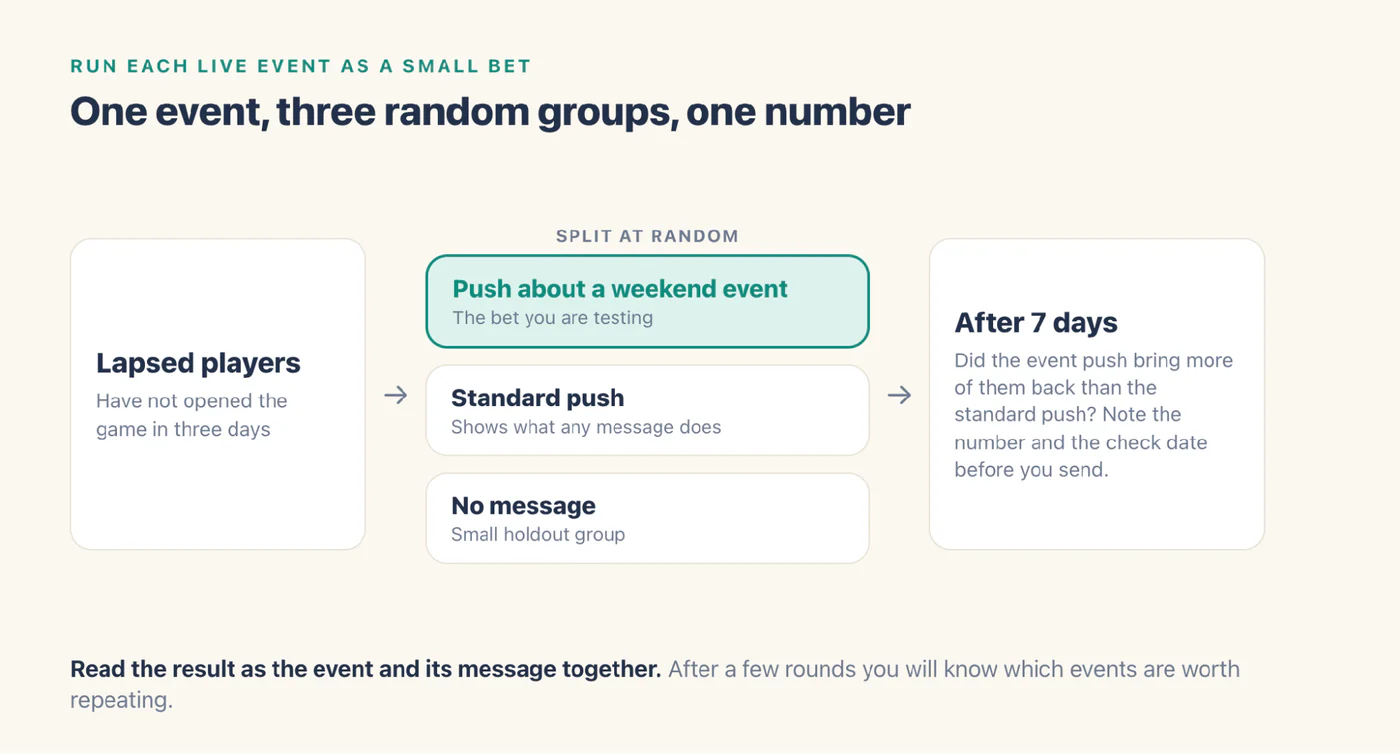
For example, take players who have not opened the game in three days. Split them at random between a push about a weekend event, a standard push and a small group that gets neither. After seven days, check whether the event push brought more of them back. Note who gets each event, one number to watch and a check date. After a few rounds you will know which events are worth repeating.
Teams skip this loop because an analyst used to spend an afternoon on each step. Agents can now prepare the work for a person to review. In a live demo at our Istanbul summit in October, an agent on a real game with 77 healthy-looking dashboards traced a currency surplus to players who had left. It drafted a reversible message with a comparison group, and the team kept the campaign in draft until a person approved it.
When the core loop is the problem
During Clash Quest's soft launch, the team added clans, side activities, upgrade systems and new troops. Deconstructor of Fun argues in its postmortem that none of it changed the core experience enough to lift retention. If the core loop is not fun, players keep leaving however closely you read the data, and taste still comes from the people making the game.
A week of data from 300 players can show a pattern that is gone the next week, so check the sample, the tracking and the control group before you act.
The studios that grow without a big team read their player data every week, and they turn what they find into one measured change at a time.
ThinkingAI serves over 1,500 companies across more than 8,000 mobile games with an agentic analytics and engagement platform, which studios can start on the free plan or explore for games.