
SocialPeta vs AppMagic: Which Mobile Game Intelligence Tool Is Better in 2026?
Both platforms cover mobile game advertising, app performance, and competitor research. SocialPeta is organized around creative and advertiser workflows. AppMagic is organized around market, product, genre, monetization, and LiveOps research.
The short answer
SocialPeta is the stronger starting point for mobile game teams whose weekly bottleneck is competitor ad discovery and creative strategy. AppMagic is the stronger starting point when the decision begins with a genre, market, product, monetization, or LiveOps question. Neither is limited to that one job, so the right test is a shared research brief, not a generic feature count.
SocialPeta vs AppMagic: Quick verdict
Choose SocialPeta when your team starts with observable advertising activity. You want to find a clean set of competitor creatives, narrow it by channel, market, format, category, and time, then move into advertiser-level analysis. That is a natural fit for UA managers, creative strategists, publishers, and agencies that need a repeatable path from research to a test brief.
Choose AppMagic when the first question is about the game business itself. Which subgenre is expanding? How concentrated is the market? Which publishers are gaining ground? How do top games structure LiveOps or IAP offers? AppMagic pairs those questions with downloads, revenue, classification, active-user and retention signals where available, plus its own Ad Intelligence.
The easy comparison, creative data versus market data, is no longer accurate. SocialPeta now includes downloads and revenue estimates, app search and detail, rankings, market insights, and ASO-related research. AppMagic has ad creative intelligence alongside its market charts. The products diverge most clearly in how research begins: with the ad and advertiser in SocialPeta, or with the app, publisher, and market segment in AppMagic.
What this comparison actually covers
Mobile game intelligence is an umbrella term. It can mean creative discovery, media and channel research, market sizing, store performance, competitor tracking, ASO, monetization, player behavior, or product operations. A vendor can support several of these jobs without being equally deep in all of them.
SocialPeta's public mobile game solution leads with ad creatives, competitor UA activity, global market signals, and AI-assisted creative research. Its product also connects ads with app-store and advertiser context. You can review the current scope on the mobile game intelligence page and the App Intelligence page.
AppMagic's current product overview emphasizes app and publisher metrics, detailed game classification, Ad Intelligence, LiveOps analysis, trend discovery, and Apple Ads keyword research. Its site describes more than 250,000 titles tagged by genre, setting, and art style. That taxonomy is a meaningful product advantage when the research question begins with a game mechanic or market niche rather than a named advertiser.
AppMagic was acquired by Sensor Tower in May 2026 and is now positioned as its dedicated SMB market intelligence solution. The official AppMagic announcement makes that positioning explicit. Buyers should ask how contracts, roadmap, support, API access, and product boundaries work today. The acquisition itself does not prove that any AppMagic feature has changed.
SocialPeta vs AppMagic at a glance
| Decision area | SocialPeta | AppMagic |
|---|---|---|
| Best starting question | What are competitors running, where, and how is their creative strategy changing? | Which game segments, products, and publishers are growing, and why might they be growing? |
| Ad intelligence | Cross-channel creative search, advertiser analysis, creative attributes, copy, media, markets, and campaign signals | Mobile game creative research tied to app, genre, market, and top-grossing context |
| Market intelligence | App rankings, market insights, app and advertiser detail, and download and revenue estimates | A core workflow built around app, publisher, segment, taxonomy, market, and monetization analysis |
| Game product research | Creative themes, gameplay signals, competitors, store events, versions, SDKs, and advertiser milestones | Detailed game classification, LiveOps, IAP offers, retention and active-user metrics where available |
| ASO and discovery | Store rankings, rank movement, releases, app search, keyword research, and store-event monitoring | Apple Ads and semantic-core analysis, app discovery, store and market research |
| Typical owner | UA, creative strategy, growth marketing, publishing, and agency teams | Market research, product, strategy, publishing, investment, and game design teams |
| Best final output | A creative test brief or competitor advertising readout | A market-entry, portfolio, product, LiveOps, or monetization decision |
This is a comparison of product emphasis, not a claim that either column is exclusive. Coverage, historical depth, exports, API access, and available metrics can vary by module and contract.
1. Ad creative and UA research: SocialPeta has the cleaner starting point
A useful creative search starts by defining a comparable set, rather than collecting whichever ads look interesting. SocialPeta's Display Ads workflow combines advertiser or keyword search with game categories, ad networks, countries, languages, material types, creative attributes, time ranges, sorting, and deduplication. Game-specific filters can narrow the corpus by gameplay, theme, and IP. Playable ads are also a first-class format rather than an afterthought.
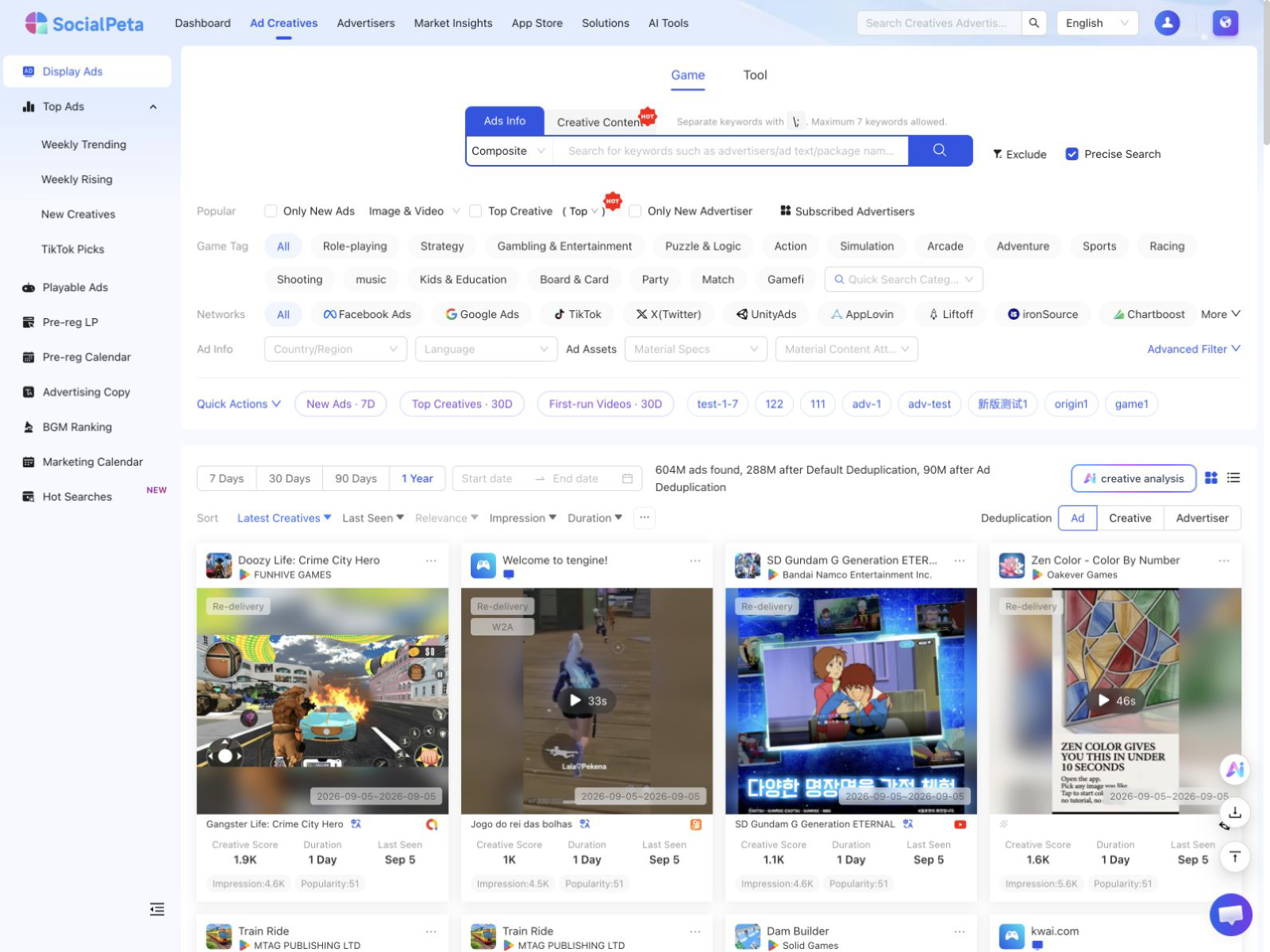
This matters because creative volume can mislead. One advertiser may upload many small edits of the same concept. A simple feed can make that concept look more diverse or more important than it is. Filtering and deduplication help a strategist compare like with like, then inspect longevity, estimated exposure, format, messaging, and related advertiser activity without treating any one metric as proof of performance.
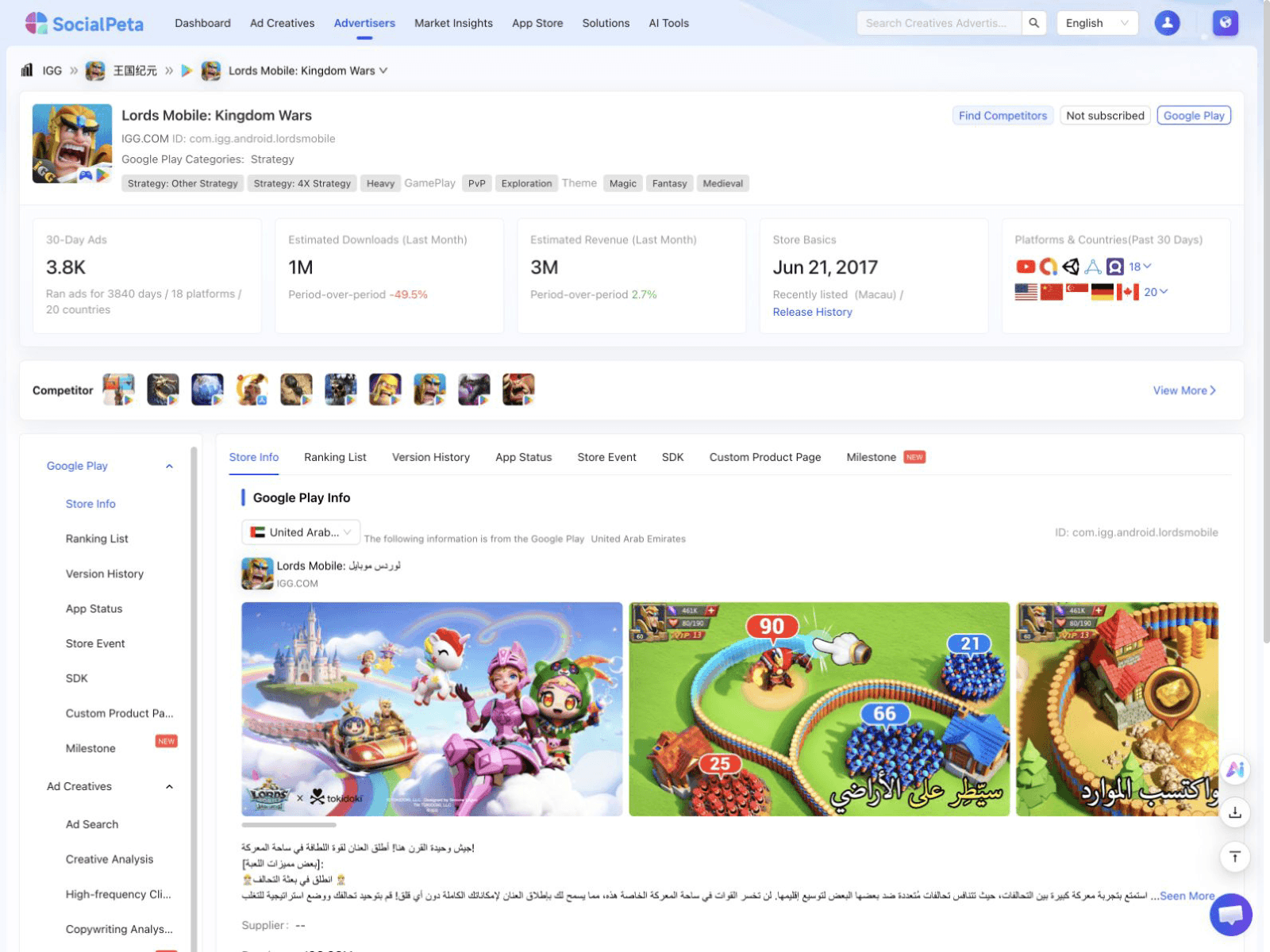
SocialPeta's advertiser detail expands the workflow beyond a swipe file. The same game can be studied through store information, estimated downloads and revenue, competitors, versions, SDKs, creative search, copywriting, channels, countries, media, audiences, and campaign milestones. The research object remains the advertiser, which keeps the path useful for a UA or creative team.
AppMagic is still a credible option for ad research. Its Ad Intelligence is positioned around finding creatives used by successful mobile games and studying advertising within a market segment. That can be especially useful when a researcher wants to begin with a finely defined game subgenre, then inspect the creatives associated with its leaders. The A good demo should test whether its searchable fields, channels, countries, history, and creative details match your weekly brief as closely as SocialPeta's.
2. Market, genre, and product research: AppMagic has the stronger center of gravity
AppMagic's clearest advantage is the way it organizes the mobile game market. Its classification can separate games by genre, subgenre, setting, art style, and other product traits, which supports questions that ordinary store categories handle poorly. A product team can use that structure to examine market size, concentration, new entrants, and established leaders before choosing a concept or launch market.
LiveOps is another meaningful distinction. AppMagic describes analysis of event cadence, diversity, mechanics, reskins, innovation, and the relationship between events and game metrics. That is closer to product and game design research than conventional ad spying. Its market reports also demonstrate analysis of IAP offers, retention, and genre economics. For a studio deciding how to operate a live game, those product signals can matter more than an additional creative filter.
SocialPeta can still contribute to market and product research. App rankings, niche-market views, downloads and revenue estimates, store events, versions, SDKs, competitor discovery, and advertiser milestones help explain what changed around a title. The difference is that these signals are especially useful when the team wants to connect the market move back to advertising activity. AppMagic is more naturally suited to a broader market-entry or product-strategy question.
A sensible split is easy to picture. A studio strategy lead might use AppMagic to shortlist a genre-country pair and examine its leaders. A UA and creative team might then use SocialPeta to study how those leaders advertise, which creative patterns repeat, and how activity differs by channel and market. Running both only makes sense if these are genuinely separate recurring decisions, not two subscriptions producing the same slide.
3. Downloads, revenue, ASO, and app analysis: compare depth, not checkmarks
Both platforms now support app intelligence. SocialPeta includes app search and detail, store rankings, download and revenue estimates, ranking movement, release monitoring, ASO keyword research, market segments, SDK rankings, and store events. That makes it inaccurate to describe the product as an ad library with no app-market layer.
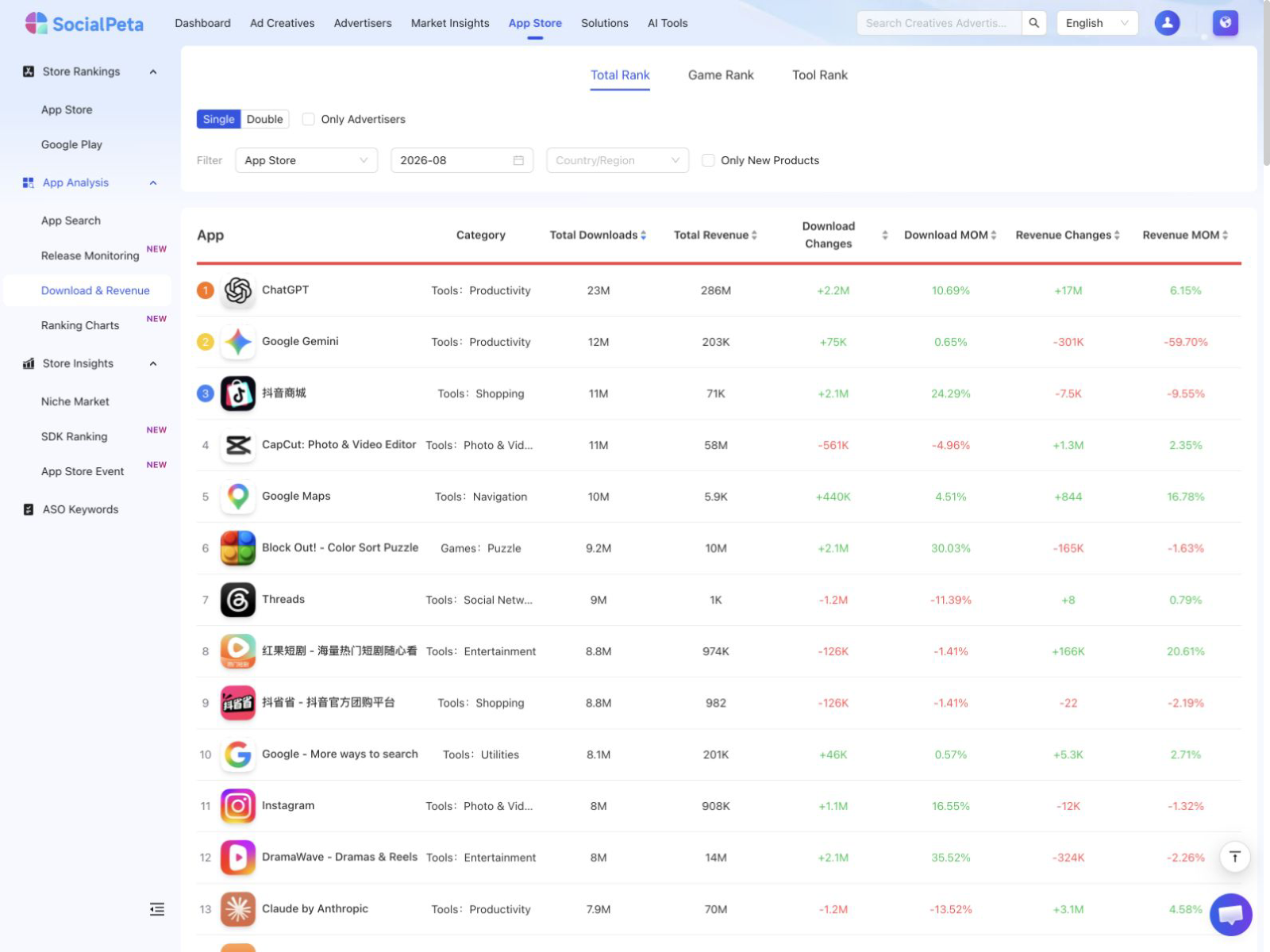
AppMagic remains more deeply identified with this category. Its app and publisher analysis, advanced search, market segments, taxonomy, IAP research, retention and active-user metrics where available, and Apple Ads semantic-core analysis form a broader product and market research workspace. The homepage describes comparing paid and organic keyword traffic and finding competitor Apple Ads keywords, which gives ASO and paid search teams another way to study discoverability.
Do not compare two dashboard screenshots and stop there. Ask each vendor to show the same five games, two stores, three countries, and 12-month period. Check how app identities are joined across stores, what revenue includes, whether estimates can be revised, how missing markets appear, which metrics can be exported, and whether the app result connects to the creative or product question your team needs to answer.
AppMagic is unusually clear about part of its modeling inputs. Its data collection note says its models use revenue and downloads for Android and iOS, retention data for iOS, and DAU and MAU for Android from participating partners, combined anonymously with other sources. That disclosure is useful, but it does not make every number a first-party actual for the app being viewed.
4. What the data can and cannot prove
Intelligence tools mix three kinds of evidence. Observed evidence includes a creative file, copy, advertiser identity, format, or store listing. Modeled evidence includes estimated impressions, downloads, revenue, spend, active users, or retention. Owned evidence is your own campaign delivery, attribution, margin, cohort retention, and product analytics. Strong analysis labels each kind instead of flattening them into one confidence level.
Observed
Useful for confirming that an ad, message, format, app update, or store event was visible in a covered source.
Modeled
Useful for direction, ranking, and comparison when the method, coverage, and uncertainty are understood.
Owned
Required to judge profitability, incrementality, payback, retention quality, and whether your own test worked.
AppMagic's 2026 Mobile Market Landscape report states that its revenue analysis covers IAP revenue from the App Store and Google Play and excludes webshops and other alternative monetization. That boundary is important for games with meaningful direct-to-consumer sales or advertising revenue. SocialPeta likewise describes its app downloads and revenue figures as modeled competitive estimates for benchmarking and directional analysis.
The same caution applies to creative rankings. A long-running ad, high impression estimate, or repeated concept deserves investigation. It does not reveal the competitor's acquisition cost, payer mix, retention, margin, or incrementality. Use the pattern to write a hypothesis, then test an original execution with your own measurement stack.
5. Run this proof-of-work test before buying
The fastest way to compare SocialPeta and AppMagic is to make both tools answer the same real decision. A 90-minute test with known competitors usually reveals more useful differences than a polished vendor tour.
- Set one creative brief. Find 30 relevant ads from five puzzle-game competitors in the United States and Japan over the last 90 days. Include video and playable ads, remove near-duplicates, and identify three recurring hooks.
- Set one market brief. Size a defined puzzle subgenre across iOS and Android, identify its top publishers, compare download and IAP revenue direction, and note how concentrated the segment is.
- Set one explanation brief. Pick a known game with a recent shift. Use only traceable evidence to explain whether creative activity, store updates, LiveOps, rankings, or another factor changed around the same period.
- Audit the evidence. Label every important field as observed, modeled, or owned. Record missing competitors, source coverage, history, estimate definitions, and any result that cannot be reproduced after changing filters.
- Ship one page. Export a short decision memo with three findings, two alternative explanations, one recommended action, and links back to the source records. Time the whole process.
Score relevance, coverage, traceability, research time, estimate clarity, exports, collaboration, and access restrictions. If SocialPeta wins the creative brief and AppMagic wins the market brief, you have learned more than a single weighted score can tell you. Buy for the bottleneck that occurs most often.
6. Pricing and procurement: price the workflow, not the logo
Public pricing references age quickly, and third-party articles often mix old plans, promotional trials, and different module combinations. Request a current written quote from each vendor. Confirm seats, data history, markets, channels, tracked apps, exports, API access, alerts, saved lists, support, onboarding, and contract term.
AppMagic's acquisition adds a few practical questions: which company contracts and supports the account, whether the requested modules remain inside AppMagic, and how future packaging relates to Sensor Tower. For SocialPeta, confirm that the quote includes the creative, advertiser, app, ASO, and market views used during the proof-of-work test. Do not assume a demo login and a production seat expose the same scope.
Finally, calculate cost per completed decision. Include analyst time, manual cleaning, exports, integrations, onboarding, and any tools that the purchase can actually replace. A cheaper subscription that leaves the weekly report manual may cost more. A broad market suite is equally hard to justify if the team only needs a reliable creative research workflow.
Which platform fits your mobile game team?
SocialPeta is the better starting point if
- Competitor ad discovery is a weekly UA or creative task.
- You need detailed creative, advertiser, channel, country, format, and time filters.
- Playable ads and cross-channel mobile game research matter.
- App estimates and ASO context should connect directly to advertiser activity.
- The expected output is a creative brief, competitor ad readout, or campaign hypothesis.
AppMagic is the better starting point if
- Game taxonomy and segment sizing drive the decision.
- Product, strategy, or publishing teams own the research.
- LiveOps, IAP offers, monetization, retention, or active-user analysis is central.
- Apple Ads keyword overlap and market discovery matter.
- The expected output is a market-entry, portfolio, product, or operations decision.
A larger studio may use both. The cleanest division is AppMagic for market and product intelligence, and SocialPeta for competitor advertising and creative execution research. Assign each platform a specific owner and output. If both teams send leadership the same competitor chart, the stack is duplicating cost rather than adding evidence.
Frequently asked questions
Is SocialPeta or AppMagic better for mobile game ad creative research?
SocialPeta is the better starting point when the recurring job is finding competitor ads across channels, filtering a usable creative set, and connecting creatives to advertiser, country, media, copy, and audience analysis. AppMagic also has Ad Intelligence, especially for researching ads within mobile game market segments, so teams should test coverage for their exact genre, countries, and networks.
Is AppMagic only a downloads and revenue tool?
No. AppMagic combines app and publisher intelligence with game taxonomy, Ad Intelligence, LiveOps analysis, IAP and monetization research, active-user and retention metrics where available, and Apple Ads keyword analysis. Its center of gravity is mobile market and product research, not downloads and revenue alone.
Does SocialPeta include app intelligence and ASO data?
Yes. SocialPeta includes app search and detail, store rankings, download and revenue estimates, ranking movement, release monitoring, ASO keyword research, market-segment views, SDK rankings, and store events. It also connects app information with advertiser and creative research.
Can either tool prove that a competitor ad is profitable?
No. Ad longevity, impressions, creative volume, estimated downloads, and estimated revenue are useful signals, but they do not reveal a competitor's full spend, attribution, margin, retention, or incrementality. Use intelligence data to form hypotheses, then validate them with your own campaign and product data.
How should a mobile game team test SocialPeta and AppMagic before buying?
Give both vendors the same three-part brief: find relevant creatives for a known competitor set, size a specific game segment by country and store, and explain a recent competitor change using only traceable evidence. Score coverage, workflow time, estimate definitions, exports, collaboration, and the modules included in the quote.
Final verdict: choose the research anchor
SocialPeta and AppMagic overlap across ads, competitors, apps, downloads, revenue, and market research. Their clearest dividing line is the research anchor.
Choose SocialPeta when the work starts with an ad, advertiser, channel, or creative question and must end in an executable UA or creative test. Choose AppMagic when the work starts with a game segment, publisher, product, monetization model, or LiveOps question and must end in a market or product decision. If the choice still feels close, run the same briefs in both tools. The one that produces a clearer, traceable answer with less manual work is the better platform for your team.