
SocialPeta vs Sensor Tower: Which Ad Intelligence Platform Is Better in 2026?
Both platforms now cover advertising, app research, download and revenue estimates, and ASO-related workflows. SocialPeta connects those signals closely to competitor creative and advertiser analysis, while Sensor Tower extends into a wider set of audience, web, gaming, and brand media products.
Accuracy note
Sensor Tower does offer advertising intelligence and creative data. Any comparison that marks those capabilities as absent is outdated. This guide compares the platforms by workflow, product scope, and evidence type rather than repeating old feature checklists.
SocialPeta vs Sensor Tower: Quick verdict
Choose SocialPeta when your recurring job starts with competitor ads: finding relevant creatives, narrowing them by category, country, channel, format, and time, studying an advertiser's creative mix, and converting visible patterns into a test brief.
Choose Sensor Tower when the purchase is driven by a wider intelligence suite that combines app performance with engagement and retention, audience overlap, web behavior, brand advertising spend estimates, or PC and console game analysis. Its value is the breadth of the suite, but that also means a buyer must identify which Sensor Tower product is actually being compared.
This is not a creative tool versus an app data tool. SocialPeta also has app search and detail, store charts, download and revenue estimates, ASO keywords, ranking movement, release monitoring, niche-market analysis, and SDK and store-event views. The decision is whether the team benefits more from SocialPeta's connection between app, advertiser, and creative analysis or Sensor Tower's wider audience, web, brand-media, and gaming product family.
First, define what 'Sensor Tower' means
A fair SocialPeta vs Sensor Tower comparison cannot treat Sensor Tower as a single ad spy tool. Its public product suite separates several jobs. App Advertising Insights covers mobile paid acquisition research, including share of voice, impression trends, ad networks, creative formats, and messaging. Pathmatics focuses on digital ad spend and impression estimates, channels, advertisers, publishers, creatives, and share of voice. Other products cover app performance, audiences, websites, retail media, and games.
SocialPeta is organized around advertising research workflows. Its creative library supports ad information and creative-content search, category and channel filters, country and language filters, material types, time windows, sorting, deduplication, saved filters, and advertiser drill-downs. Advertiser views connect the ad corpus to creative mix, copywriting, media, channel, country, audience, store, and milestone analysis. The product is broader than a gallery, but most research paths still begin with an ad, advertiser, or creative question.
SocialPeta vs Sensor Tower at a glance
| Decision area | SocialPeta | Sensor Tower |
|---|---|---|
| Best starting point | Competitor ad discovery and creative research | App, audience, web, gaming, and digital market intelligence |
| Creative workflow | Search, filter, inspect, save, and compare observed creatives | Mobile creative gallery and tactics, plus Pathmatics creative and media analysis |
| Mobile app intelligence | App search and detail, download and revenue estimates, store rankings, rank movement, release monitoring, ASO keywords, and market insights | App performance, downloads, revenue, engagement, retention, ratings, reviews, keyword rankings, and market analysis |
| Digital ad intelligence | Centered on ad activity, creatives, advertisers, channels, and market patterns | Pathmatics emphasizes spend and impression estimates, share of voice, channels, brands, and publishers |
| Audience and web behavior | Supporting audience and advertising views in relevant workflows | Dedicated Audience Insights and Web Insights products |
| Typical buyer | UA, creative, marketing research, publishing, and agency teams | Market intelligence, strategy, product, media planning, investment, and enterprise research teams |
| Public pricing | Confirm current package, seats, exports, history, and modules with sales | Customized plans; confirm which products and add-ons are included |
This table describes product emphasis, not an exclusive feature list. Availability, coverage, history, exports, and user access can vary by contract and module.
1. Ad creative research: SocialPeta has the sharper focus
Creative research begins before creative analysis. A team needs to build a comparable corpus: the right competitors, market, period, channels, formats, and product category. SocialPeta's Display Ads search is built around that retrieval problem. Researchers can combine keyword and advertiser criteria with categories, networks, countries, languages, material attributes, time ranges, and deduplication rules. They can then move from the result set to individual ads or an advertiser-level view.
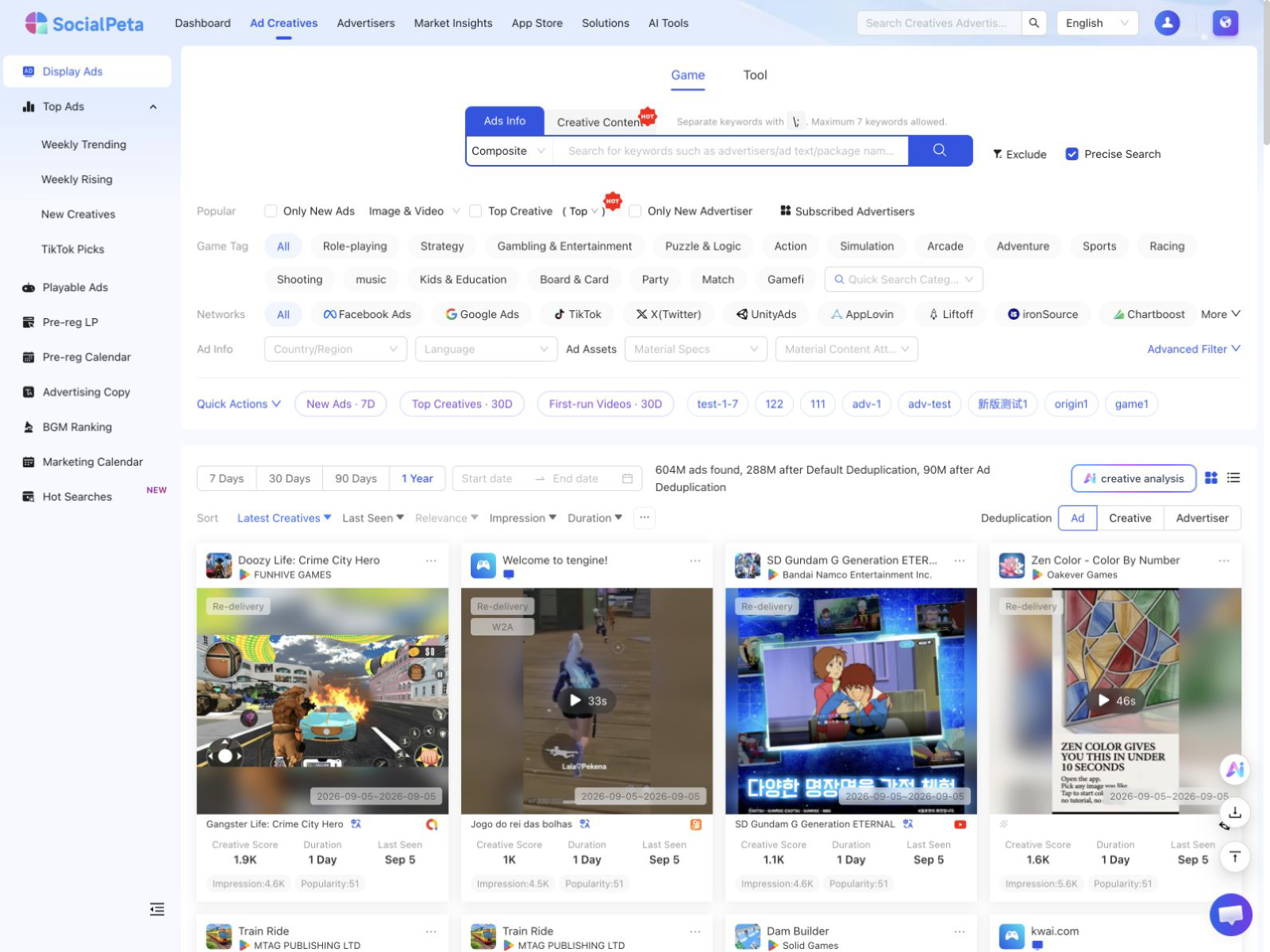
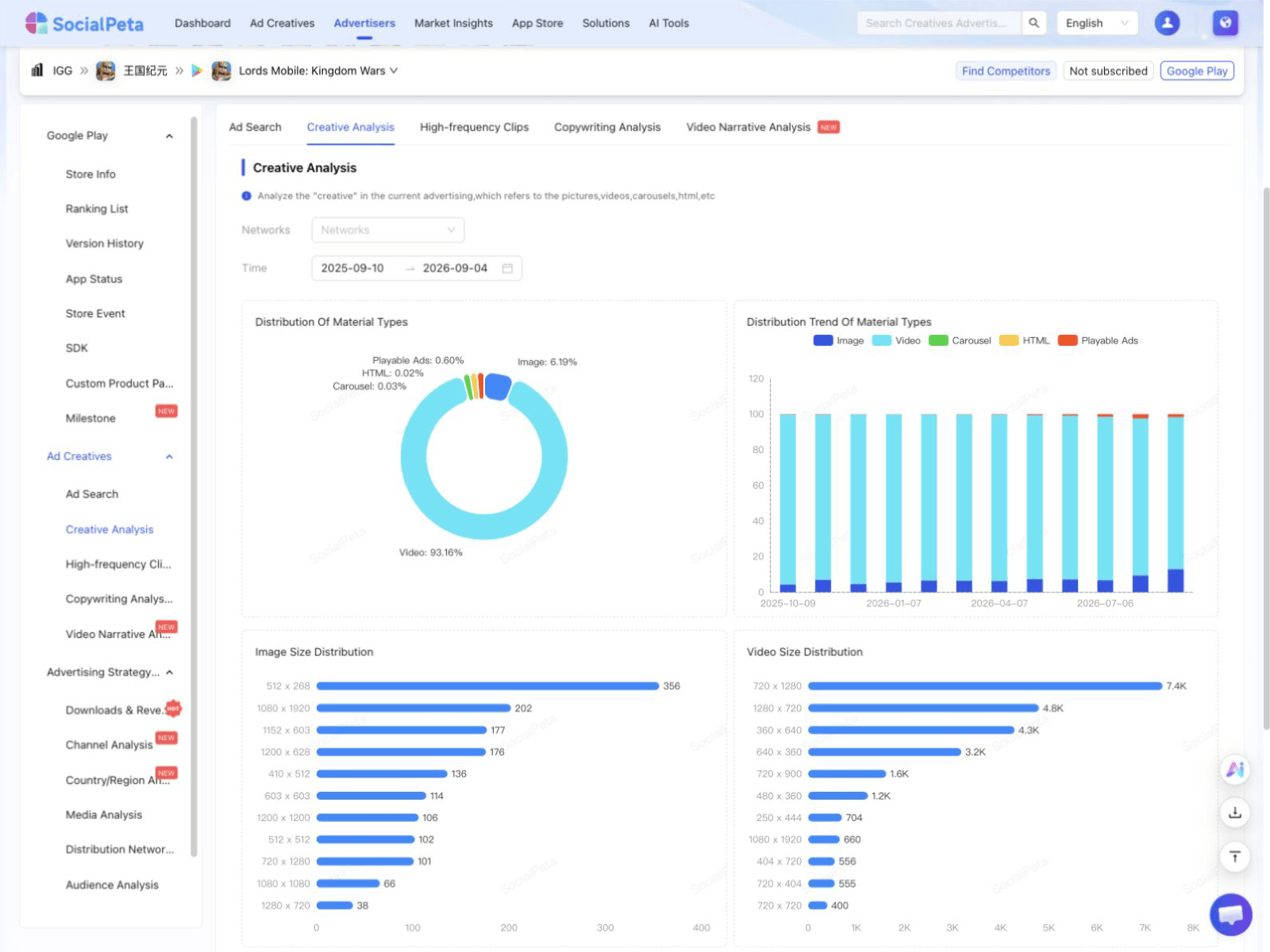
A long feed of interesting ads may inspire a designer, but it does not support a defensible comparison. Search precision and deduplication help prevent one prolific advertiser or dozens of near-identical edits from distorting the pattern. SocialPeta also supports advertiser-level creative analysis, where teams can examine material-type distribution and changes over time rather than treating each file as an isolated winner.
Sensor Tower is not absent from this workflow. Its official App Advertising Insights materials describe a Creative Gallery, creative tactics, messaging, CTAs, formats, networks, flighting, and market trends. Pathmatics also supports creative and channel analysis for brand and media intelligence. The practical difference is emphasis: SocialPeta leads with creative discovery and competitor advertising activity, while Sensor Tower often connects creative signals to a larger mobile or media-market view.
Neither product can tell you that a visible competitor ad is profitable. Use the corpus to form hypotheses, then apply a disciplined creative analysis workflow and validate the next test with your own delivery, conversion, retention, and margin data.
2. App and market intelligence: both platforms now compete here
Sensor Tower's app intelligence is a central part of its positioning. Its public suite spans app downloads and revenue estimates, active users, sessions, time spent, retention, ratings, reviews, keyword rankings, web traffic and engagement, audience behavior, digital advertising, and PC and console games. A strategy, product, or investment team can use that range to study the market from several angles without making advertising activity the only organizing signal.
Sensor Tower says its platform combines samples of app and digital ad activity from a first-party consumer panel with app store APIs before transforming that data into reported insights. That does not make every output ground truth, but it explains why the platform is often evaluated for modeled market size, app performance, and audience behavior rather than creative discovery alone. Its product overview is useful for identifying the module that owns each metric.
SocialPeta is no longer only a supporting source for market selection. Its App Store area includes App Store and Google Play charts, app search and detail, download and revenue rankings, ranking movement, release monitoring, subscribed apps, ASO keyword research, niche-market analysis, SDK rankings, and store events. Its advertiser detail can also bring store information, estimated downloads and revenue, rankings, version history, SDKs, competitors, ad search, creative analysis, copy, channels, countries, media, and audience views into one entity-level workflow.
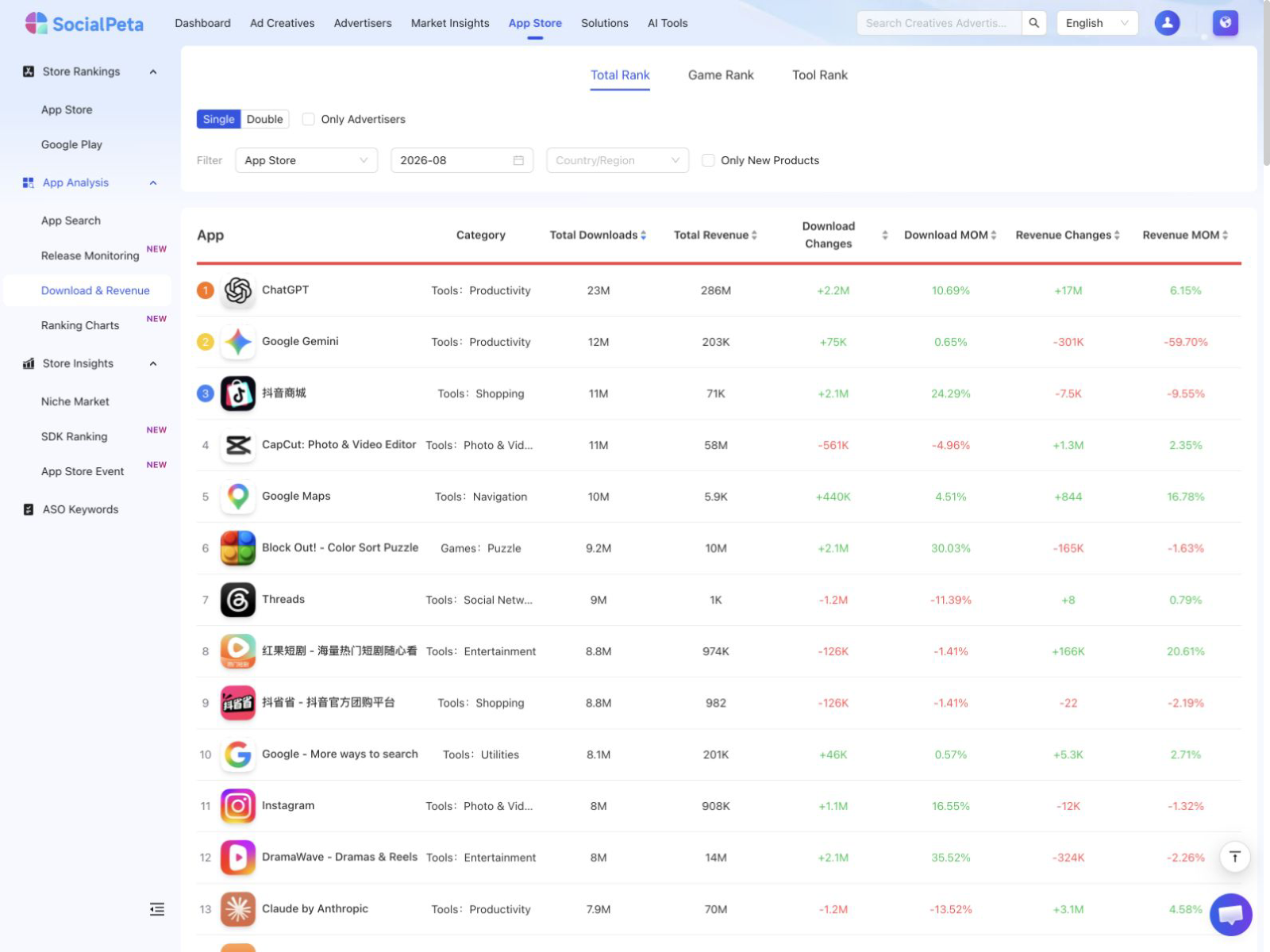
The comparison therefore turns on depth and connection, not basic feature presence. Ask both vendors to show the same app, country, month, and store; explain estimate definitions; trace an app from ranking to detail; run the same ASO keyword task; and connect the result to advertiser and creative activity. Sensor Tower may still be the better fit when engagement, retention, web, or audience products are essential. SocialPeta may be the better fit when app estimates and ASO research need to feed directly into competitor advertising and creative decisions.
Teams evaluating keyword research should also separate discovery, conversion, and paid acquisition. The metrics and handoffs are different. Our ASO workflow guide explains how store keywords, product-page conversion, paid UA, and retention fit together.
3. Advertising and audience intelligence: compare the right modules
There are two different Sensor Tower advertising comparisons. For mobile app UA, compare SocialPeta with App Advertising Insights. For brand-level spend, publisher, channel, and omnichannel media research, compare it with Pathmatics. Combining those products into one undifferentiated checklist makes both the feature comparison and the quote difficult to interpret.
App Advertising Insights reports share of voice, impression trends, networks, creatives, messaging, formats, and regional activity for mobile acquisition. Pathmatics is positioned around spend and impression estimates, category and advertiser benchmarking, channel allocation, publishers, and creative strategy across a wider digital ad ecosystem. Sensor Tower also offers a dedicated Audience Insights product that links app engagement with ad exposure patterns.
SocialPeta's advertiser workflow is useful when the team wants to move between an advertiser's ads, creative formats, copy, channels, markets, media, audiences, store context, and milestones. That continuity matters to UA and creative teams because the research object remains the advertiser and its observable campaign behavior. Sensor Tower becomes more compelling when the research object is the entire app category, consumer audience, media market, or brand advertising market.
4. Data quality: ask what is observed, modeled, or owned
Third-party intelligence platforms mix evidence types. An ad creative may be directly observed in a monitored environment. Spend, impressions, downloads, revenue, audience composition, or engagement can be estimates produced from samples and models. Your own campaign results, attribution, CRM, finance, and retention data are first-party evidence. Those categories should never be presented as interchangeable.
Observed
Creative file, copy, format, advertiser, placement, first-seen or last-seen labels, and other visible campaign details.
Modeled
Spend, impressions, downloads, revenue, audience, or performance estimates whose coverage and methodology require review.
Owned
Your delivery, conversion, attribution, margin, retention, customer research, and controlled test results.
During a demo, ask where each metric comes from, what the geographic and channel coverage is, how often it updates, how historical values can change, and how missing data is represented. Check several apps or brands whose behavior you already know. A tool is useful when its error and coverage are understood, not when every estimate is treated as exact.
The same discipline applies to top-creative labels. Longevity, reach, repetition, or engagement may justify investigation, but they do not prove profitability. Our ad research workflow shows how to separate collection, interpretation, and validation.
5. Run this 60-minute proof-of-work test
Feature pages rarely reveal how much analyst time a platform saves. Give both vendors the same brief and score the output before discussing a long contract. A useful test is specific enough to expose coverage gaps but broad enough to resemble weekly work.
- Define one decision. Example: identify three creative angles worth testing for a puzzle game launch in the United States and Japan.
- Use a known benchmark set. Provide five competitors, two channels, two formats, and a fixed 90-day window. Include one advertiser you expect the platform to find.
- Build and clean the corpus. Record query steps, duplicate handling, missing competitors, source labels, historical depth, and time to reach 30 relevant examples.
- Move from ads to context. Compare advertiser activity, channel and country patterns, app movement, and any audience or market estimates included in the licensed module.
- Export a decision-ready artifact. Produce a one-page brief with three observations, two alternative explanations, one recommended test, and links back to the evidence.
Score relevance, traceability, estimate clarity, export quality, workflow time, collaboration, and module access. The winner is the platform that makes the recurring decision faster and more defensible, not the one that creates the longest demo checklist.
6. Pricing and procurement: compare the complete research unit
Public list prices are a weak basis for this comparison because packages, modules, seats, history, exports, API access, support, and contract terms can change. Sensor Tower states that it customizes plans for each customer. Buyers should request a written module map rather than assume that App Performance, App Advertising, Pathmatics, Audience, Web, and Gaming data are bundled together. SocialPeta buyers should likewise confirm the exact modules, data history, export limits, seats, tracked entities, and service level included in the quote.
Calculate cost per completed research decision, not cost per login. Include analyst time spent finding and cleaning examples, separate tools the team can retire, onboarding, API or export work, and the number of teams that will use the output. A lower quote can be expensive if analysts still build the report manually. A broad enterprise suite can be wasteful if only one creative researcher uses it.
Which platform fits your team?
SocialPeta is the better starting point if
- Competitor creative discovery is a weekly task.
- UA, designers, and strategists need the same ad evidence.
- Mobile games, apps, ecommerce, short drama, or web-to-app advertising are central use cases.
- Download and revenue estimates, ASO, app details, and advertiser details need to connect with creative research.
- The team needs fine-grained creative, advertiser, channel, country, and format filters.
- The desired output is a creative brief or campaign hypothesis.
Sensor Tower is the better starting point if
- App market size and competitor performance estimates must connect with engagement and retention analysis.
- Engagement, retention, ASO, audience, or web behavior are required.
- Brand spend, publisher, share-of-voice, or omnichannel media questions matter.
- Leadership wants a broad market intelligence suite across several research teams.
- The desired output is a market, portfolio, audience, or media-allocation decision.
Some larger organizations may use both. Sensor Tower can frame category, app, audience, and media opportunity, while SocialPeta can give creative and UA teams a more focused workspace for competitor advertising research. That pairing only makes sense if the outputs are assigned to different decisions and the overlap does not create duplicate subscriptions.
Frequently asked questions
Is SocialPeta better than Sensor Tower for ad creative research?
SocialPeta is the more focused choice when the daily job is discovering competitor ads, narrowing creatives by market, channel, format, and time, and turning observed patterns into creative hypotheses. Sensor Tower also offers creative and advertising analysis, especially for mobile apps and through Pathmatics, so the better choice depends on the markets and evidence your team needs.
Is Sensor Tower better than SocialPeta for app market intelligence?
Not automatically. Both platforms now cover app research, download and revenue estimates, rankings, and ASO-related workflows. Sensor Tower also markets dedicated engagement, retention, audience, web, and gaming products, while SocialPeta connects app and store intelligence closely with advertiser and creative analysis. Test the exact metrics, markets, history, and exports required by your team.
Does Sensor Tower have ad intelligence and creative data?
Yes. Sensor Tower publicly offers App Advertising Insights for mobile paid user acquisition research, while Pathmatics covers digital advertising intelligence such as spend and impression estimates, share of voice, channels, and creatives. Claims that Sensor Tower has no ad intelligence or no creative data are outdated.
Can either platform prove that a competitor ad is profitable?
No. Third-party intelligence can show observed ads, modeled estimates, relative activity, formats, messages, markets, and other public signals. It cannot reveal a competitor's complete spend, attribution, margin, retention, or incrementality. Treat competitor evidence as a source of hypotheses and validate decisions with first-party campaign and business data.
How should a team test SocialPeta and Sensor Tower before buying?
Run the same short research brief in both products. Use known competitors, countries, channels, date ranges, and creative formats; record whether the tool finds expected examples; inspect source labels and estimate definitions; export a sample; and time how long it takes to produce a decision-ready report. Score the workflow before discussing contract length or add-on modules.
Final verdict: buy for the bottleneck
In 2026, it is inaccurate to say that one platform has ads and the other does not. Both support advertising, app, market, and creative research. They organize those capabilities around different workflows.
SocialPeta is the stronger fit for teams that want creative, advertiser, app, download and revenue, ASO, and market signals in one advertising-led workflow. Sensor Tower is the stronger fit when the required scope extends further into engagement, retention, audience, web, gaming, or enterprise brand-media intelligence. Write down the decision, run the proof-of-work test, inspect the evidence boundaries, and buy the smallest module set that solves the recurring job.