Puzzle Game Ad Creatives: 4 Strategies That Drive Downloads
Puzzle games are easy to start but increasingly difficult to market in a crowded category. SocialPeta analyzed advertising creatives from four representative puzzle-game formats to understand how their opening hooks, gameplay demonstrations, failure moments, and visual structures attract mobile users.
Puzzle Game Advertising Overview
Puzzle games are easy for players to pick up and can support a wide variety of gameplay mechanics, which has helped the category build a large user base. As competition among leading puzzle games becomes more intense, however, the quality of advertising creatives becomes almost as important as the quality of the game itself when acquiring new users.
SocialPeta researched the gameplay mechanics used across existing puzzle games and grouped representative titles into four broad categories: exploration puzzles, jigsaw-style puzzles, physics puzzles, and brain teasers.

For several representative games, SocialPeta selected advertising creatives with relatively high estimated impressions and analyzed their design characteristics. Because the first three seconds of a video creative are especially important for capturing attention, the analysis also breaks down the information shown immediately after each ad begins.
Exploration Puzzle Ads: Highlight the Result
Scavenger Hunt is built around finding hidden objects and differences. Players must locate every item on a task list, and a single list can take time to complete because the scenes contain many objects and rich colors.
At the time of the original analysis in 2022, the game had launched in March and accumulated more than 10 million downloads. SocialPeta selected the following creative as a representative example.
- Video length: 28 seconds
- Video dimensions: Vertical, 406 × 720
- Advertising platform: Google Ads
- Duration: 24 days
- Estimated impressions: 139.8K
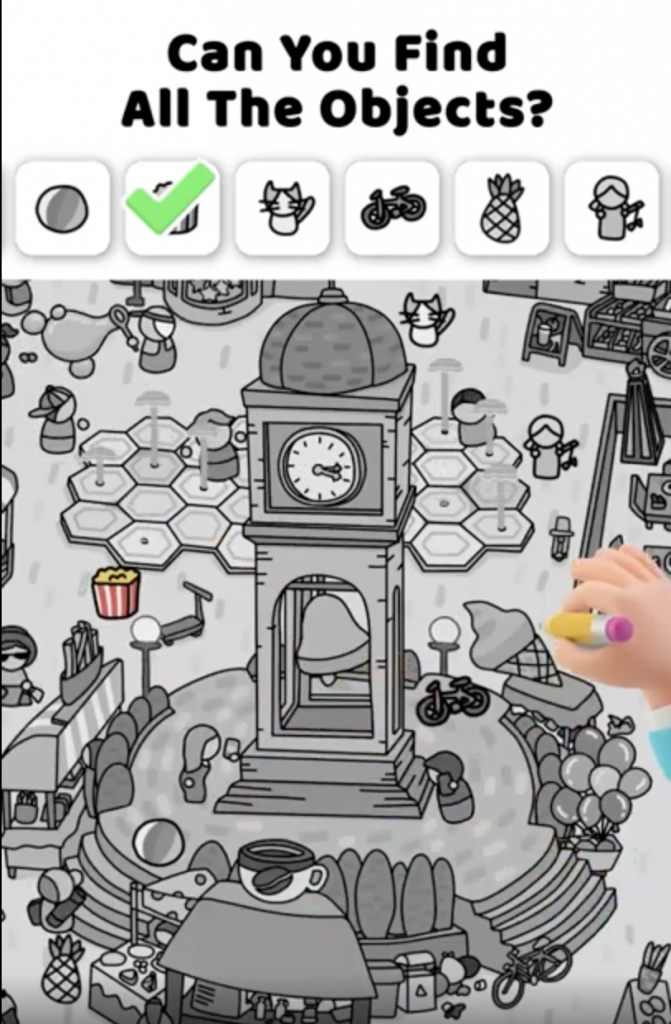
Main scene: a black-and-white fountain plaza.
Main elements: a player's hand and pen, green check marks, target items, and headline text at the top of the screen.
What happens in the first 3 seconds?
- Challenge the viewer's ability with the question "Can you find all the objects?"
- Demonstrate the core interaction by finding and checking off one of the target items.
- Create suspense around whether the player can find every object.
The creative's most distinctive choice is turning the normally colorful game scene into black and white, while restoring emphasis to task items when they are found. The contrast makes progress easy to understand even on a small mobile screen.
The video also remains under 30 seconds. During that time, the "player" repeatedly searches but still fails to find the final item. This deliberately unresolved ending can make viewers impatient to solve the puzzle themselves and therefore more willing to try the game.
Jigsaw Puzzle Ads: Make the Audience the "Loser"
Blockudoku is a 2D game that combines sudoku concepts with block puzzles. It is relatively friendly to new players because there is no time limit, although the difficulty increases as players progress.
Because many jigsaw and block puzzle games share similar core mechanics, their advertising creatives often introduce challenge modes or situations that are not necessarily identical to the in-game experience.
- Video length: 30 seconds
- Video dimensions: Vertical, 720 × 1280
- Advertising platform: Vungle
- Duration: 1 day
- Estimated impressions: 11.8K
Main scene: the game interface.
Main elements: a player's hand, puzzle blocks, an IQ value, and challenge text at the top.
What happens in the first 3 seconds?
- Establish the challenge with the claim "Only people with IQs above 160 can complete the pyramid."
- Demonstrate the objective by fitting blocks into the pyramid.
- Show the IQ score changing in response to the player's actions.
Visually, the creative is simple and contains relatively few elements, allowing the audience to understand the challenge message immediately. The "IQ above 160" framing is designed to provoke viewers and make them want to prove that they can succeed.
Later in the creative, repeated failures and a decreasing IQ value make the viewer feel as if they are participating in the challenge. Frustration becomes part of the hook: the worse the on-screen player performs, the more the audience may want to demonstrate that they can do better.
Physics Puzzle Ads: Give Users Something to Complain About
Pull the Pin is a physics puzzle game in which players remove pins to guide sand through a container and into a target vessel.
The game launched in January 2020 and topped the App Store's free puzzle-game ranking the following month. According to the historical data cited in the original article, it recorded more than 6 million downloads in April 2022. SocialPeta selected a creative originally distributed on TikTok for analysis.
- Video length: 26 seconds
- Video dimensions: Vertical, 540 × 960
- Advertising platform: TikTok
- Duration: 20 days
- Historical interaction data: 3.0K likes, 78 comments, 72 shares
- Original TikTok: View the original creative
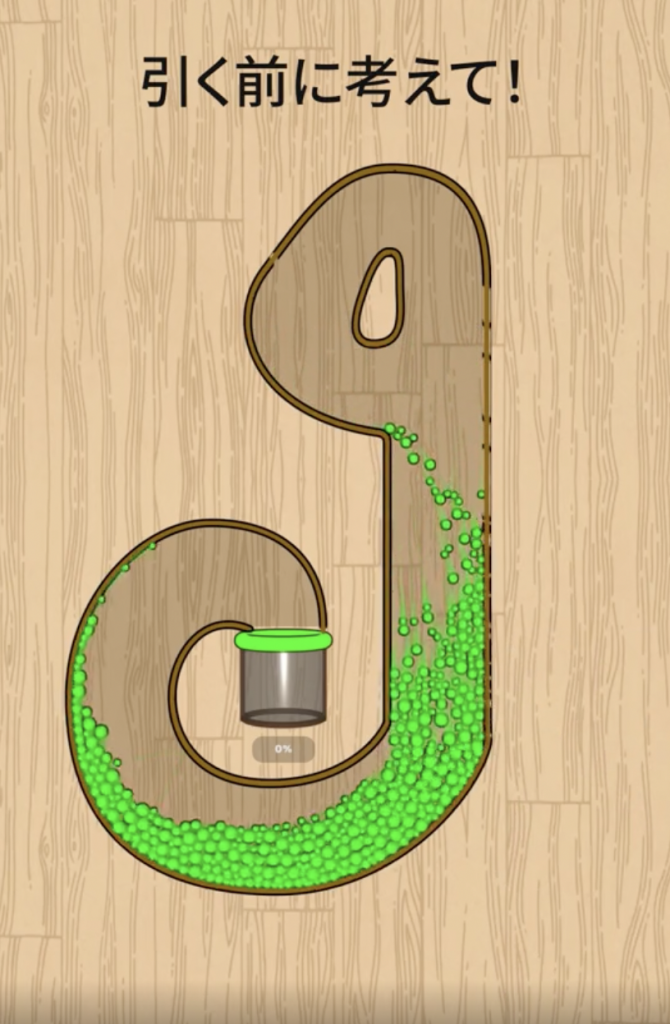
Main scene: the game interface.
Main elements: a player's hand, green sand or balls, pins, and instructional text.
What happens in the first 3 seconds?
- Display the warning "Think it through before pulling it!"
- Demonstrate the objective of filling the target vessel.
- Show the player acting immediately rather than thinking.
- Use the smooth motion of the flowing material as a visual hook.
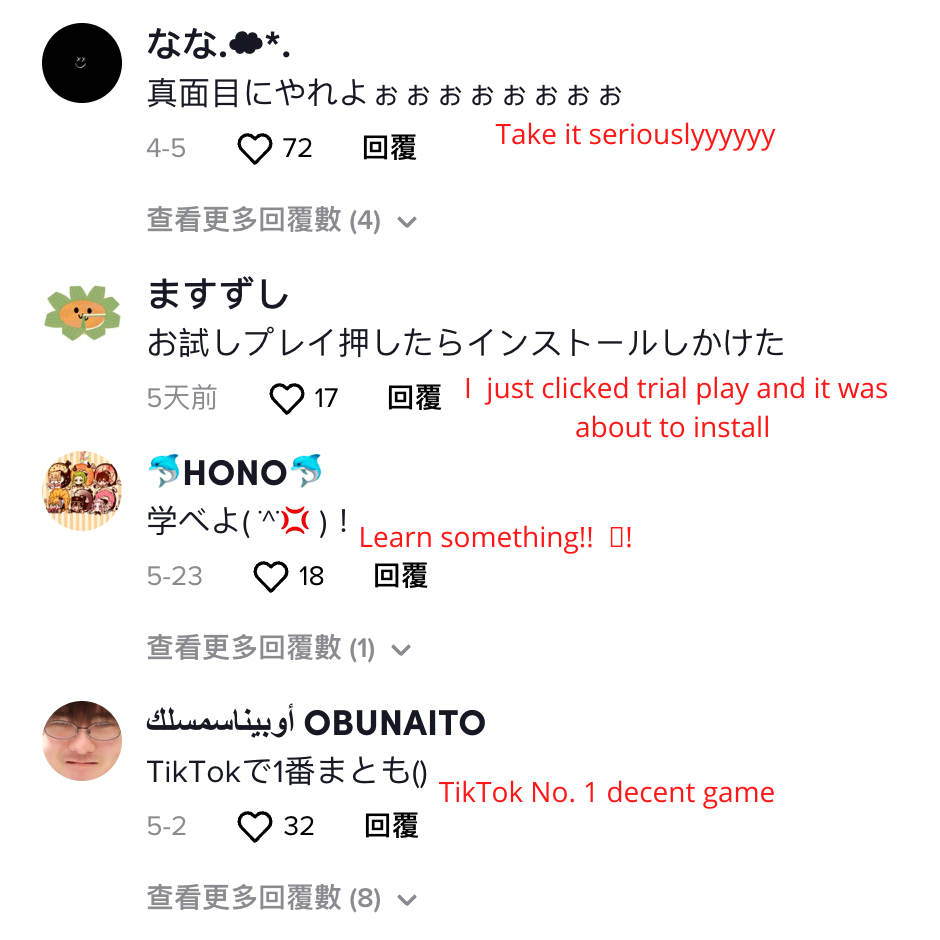
The puzzle itself appears straightforward, but the on-screen player repeatedly acts without thinking. That behavior directly contradicts the instruction telling them to think before pulling a pin.
This contrast is intentional. By showing obviously poor decisions, the ad gives viewers something to criticize. On short-video platforms, comments pointing out the player's mistakes can themselves increase interaction around the creative.