
Attribution Modeling: How to Assign Credit Without Mistaking It for Causality
Attribution modeling explains how conversion credit is distributed across recorded marketing touchpoints. This guide shows what each model can answer, where privacy creates gaps, and when experiments or marketing mix modeling are needed instead.
What is attribution modeling?
Attribution modeling is the process of applying a rule or algorithm to assign conversion credit to eligible marketing touchpoints within a defined dataset and lookback window. It can show how reported credit changes when the rules change. It does not, by itself, prove that a touchpoint caused the conversion.
Path
Which interactions were observed?
A path may include impressions, clicks, sessions, store visits, app installs, emails, or sales activity, depending on what the system can collect.
Rule
How is credit divided?
A model can place all credit on one interaction, divide it by a fixed rule, or estimate fractional credit from available data.
Decision
What will the report change?
The useful output is not a perfect customer story. It is a consistent input for bidding, reporting, creative analysis, and budget review.
Attribution is most useful when it is tied to a clear app promotion strategy and a documented decision. A channel report that informs weekly bid changes needs different evidence from a finance model that allocates next quarter's total marketing budget.
How attribution modeling works
Every attribution result is produced by a measurement specification, whether the team writes it down or accepts a platform default. Four choices determine what the report can see and how it distributes credit.
Outcome
The event and value being attributed, such as a purchase, qualified lead, install, or subscription.
Touchpoints
The channels, clicks, views, sessions, and offline interactions eligible to receive credit.
Scope
The identity rules, reporting scope, lookback window, and direct-traffic treatment used to build the path.
Model
The rule or algorithm that divides credit across the eligible interactions on that path.
A model never has access to the whole customer journey. It has access to the events its platform can observe and join. A podcast exposure, a private message, a cross-device return, or an unconsented app event may be absent even when it influenced the person. The report should therefore be read as credit within the measured system, not a ledger of all human influence.
Common attribution models and their tradeoffs
Rule-based models are useful lenses because their assumptions are visible. Data-driven models can represent more complex paths, but their output is still constrained by observable data and platform coverage. Treat models as alternative allocations of the same measured outcomes, not as competing versions of objective truth.
| Model | How credit is assigned | Useful lens | Main blind spot |
|---|---|---|---|
| First touch | Gives all credit to the earliest eligible interaction. | Diagnosing which sources introduce people to the brand. | Ignores the interactions that nurture and close demand. |
| Last touch | Gives all credit to the final eligible interaction before conversion. | A simple, auditable baseline for conversion capture. | Overvalues closers and undervalues earlier discovery. |
| Linear | Splits credit equally across eligible interactions. | Showing how a longer path would look without positional bias. | Assumes every recorded touchpoint contributed equally. |
| Time decay | Assigns more credit to interactions closer to conversion. | Exploring journeys where recent touches plausibly matter more. | The decay rule is chosen, not learned from causal evidence. |
| Position based | Weights the first and last interactions more than the middle. | Highlighting both demand creation and conversion capture. | The weights are arbitrary unless separately validated. |
| Data driven | Uses observed paths and an algorithm to assign fractional credit. | Finding patterns that a fixed rule cannot represent. | Depends on platform coverage, data quality, and model assumptions. |
Multi-touch attribution is an umbrella term for models that give more than one interaction credit. Linear, time-decay, position-based, and many data-driven approaches fit that description. Multi-touch does not guarantee cross-channel completeness, user-level identity, or causal validity.
What current platforms actually support
Model menus change. A current implementation guide should separate models that are useful concepts from models a specific product still lets you select.
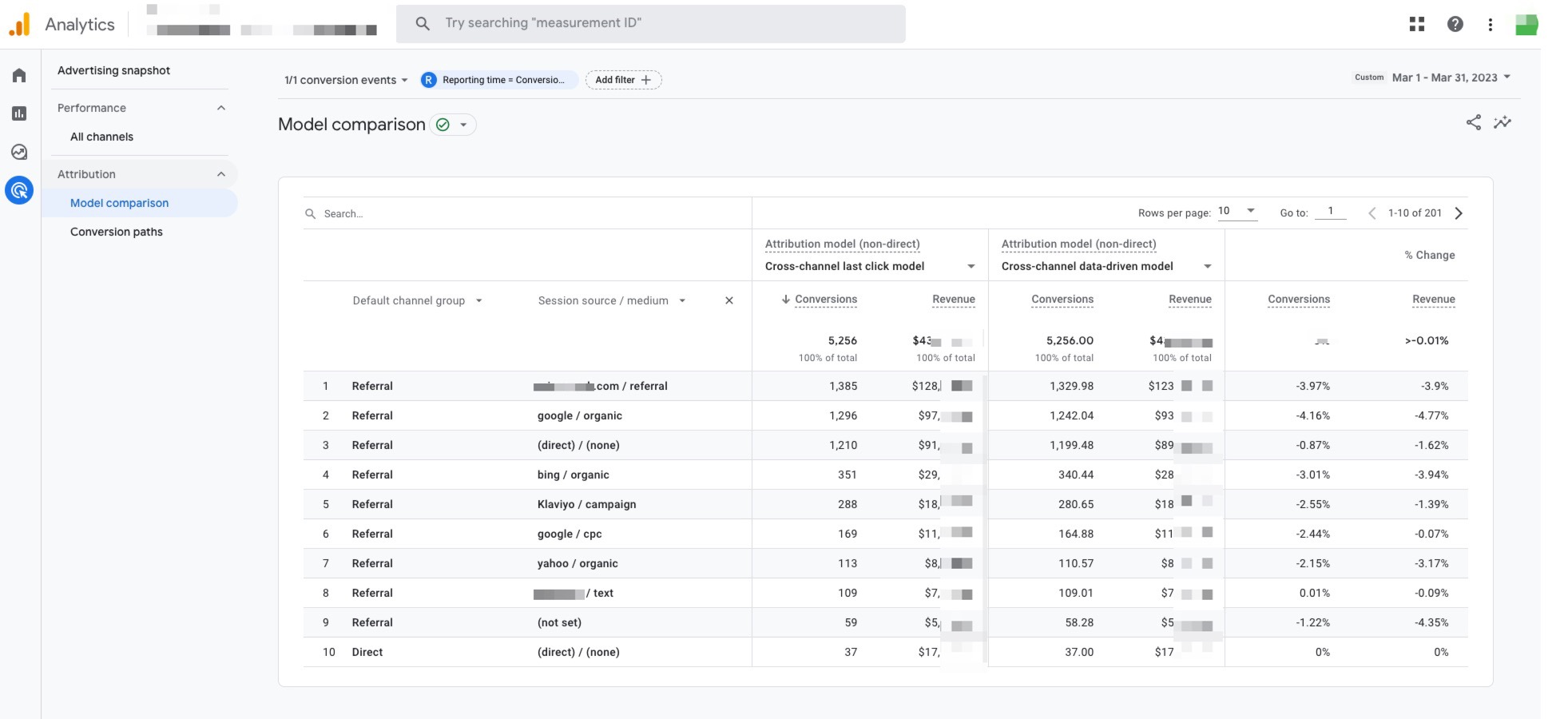
GA4 has three report views
Google Analytics currently lists data-driven attribution, paid and organic last click, and Google paid channels last click in Attribution reports. Data-driven attribution uses converting and non-converting path data and can assign fractional credit.
Four legacy Google models are gone
First click, linear, time decay, and position based are no longer supported in Google Ads or GA4 attribution reports. GA4 marks them unavailable from November 2023. They can still be useful for offline scenario analysis, but not as current GA4 settings.
Official references: Google Analytics attribution overview and Google Ads attribution models.
Privacy and mobile attribution change what can be observed
Privacy controls do not merely remove a column. They change the granularity, timing, and joinability of measurement signals. On Apple platforms, apps must obtain permission through App Tracking Transparency before tracking a user across other companies' apps and websites or accessing the advertising identifier.
Consent
User-level tracking depends on permission and policy. A denied or unavailable identifier cannot be replaced with fingerprinting.
Aggregation
Privacy-preserving systems can report campaign outcomes without exposing a complete person-level journey.
Delay and thresholds
Postbacks can arrive later, and some fields may be absent when privacy thresholds are not met.
Apple's AdAttributionKit measures app installs and re-engagement through signed postbacks while limiting user-level data. Apple documents that the postback detail can depend on a privacy tier and that conversion values or source details may be withheld. This is why mobile teams should not expect attributed totals from different systems to reconcile at the device level.
For implementation context, read the related App Tracking Transparency glossary. Then document which events remain observable without permission and which reports include modeled or aggregate outcomes.
Official references: Apple user privacy and data use and the AdAttributionKit framework overview.
Attribution vs. incrementality and marketing mix modeling
These methods answer different questions. Using them together is more reliable than asking one report to handle path diagnosis, causal proof, and total budget allocation.
| Method | Primary question | Typical input | Best use |
|---|---|---|---|
| Attribution | Which observed touchpoints receive credit? | User, session, event, click, view, and campaign-path data | Reporting, bidding inputs, and path diagnosis |
| Incrementality experiment | What happened because of the marketing activity? | Randomized or credible exposed and control groups | Causal lift for a channel, campaign, audience, or market |
| Marketing mix modeling | How did channel investment contribute over time? | Aggregated outcomes, media, spend, and control variables | Cross-channel planning and budget allocation |
A person who clicked a branded search ad might have purchased without that click. Attribution must assign the observed conversion somewhere, but an experiment can estimate the difference between exposure and a counterfactual control. MMM works at a more aggregated level and can include offline channels and external controls that do not appear in clickstream paths.
Google's open-source Meridian documentation describes MMM as a framework for estimating channel contribution, response curves, and budget allocation, with experiments usable as calibration evidence. See the official Meridian introduction.
How to choose an attribution model
Choose from the decision backward. A sophisticated model with weak coverage can be less useful than a simple model whose limits are understood. Review these five questions before adopting a default.
What action follows?
Use a platform-supported model for bidding and operational reporting. Use experiments or MMM for high-stakes causal and allocation decisions.
How complete is the path?
List channels that are missing, walled off, aggregated, offline, or measured only after consent. Do not reward observable channels simply because they are easier to track.
Is there enough representative data?
Data-driven models need stable, relevant observations. A sparse segment or newly launched channel may not support a reliable learned allocation.
How long is the decision cycle?
Set a window that can capture the real consideration period without attaching old interactions to unrelated demand.
Can stakeholders explain the result?
Keep a transparent baseline and document model changes. A report that cannot be reconciled to its rules will not support durable decisions.
A practical attribution implementation workflow
Implementation starts before a tag is deployed. Align the team on the decision, outcome, scope, and validation plan, then configure the tools to match that specification.
Name the decision
Start with the action the report must support, such as reallocating paid media, evaluating an awareness campaign, or optimizing bids. One attribution view should not be stretched across every decision.
Define the outcome
Choose a business event with a stable definition and value. Separate purchases, qualified leads, subscriptions, and low-intent micro-conversions so easy events do not dominate the model.
Map eligible signals
Document clicks, views, sessions, campaign IDs, first-party events, offline outcomes, consent states, and mobile postbacks. Mark which channels are absent or only partially observed.
Set identity and windows
Choose how events can be joined, how direct traffic is handled, and how far back a touchpoint remains eligible. Apply the same rules when comparing channels or periods.
Keep a baseline model
Compare the operating model with a transparent last-click view. Large credit shifts reveal where assumptions matter and where a decision needs stronger validation.
Validate with causal evidence
Use holdouts, geo experiments, lift tests, or a calibrated marketing mix model for material budget decisions. Feed the result back into planning instead of forcing attribution to answer causality alone.
Monitor and annotate
Track tagging changes, consent behavior, campaign launches, promotions, outages, conversion delays, and model changes. Version the methodology so a reporting shift is not mistaken for market performance.
Creative and competitor research belongs upstream of this workflow. Use ad intelligence to form audience, format, and message hypotheses, then use first-party measurement to evaluate your own campaign outcomes. Competitor ad activity is context, not attribution evidence for your conversions.
How to interpret attribution reports
Begin with reconciliation before optimization. Confirm that the report's definitions match the business question, then examine how credit moves under another model and whether the movement is stable.
Read model sensitivity
Compare data-driven and last-click credit by channel. A large swing is not automatically a reason to move budget. It identifies a channel whose apparent value depends heavily on assumptions and deserves an experiment or deeper cohort analysis.
Read value, not only counts
Compare attributed revenue or qualified outcomes with spend, margin, retention, and payback. A channel can win many low-value conversions and still be a poor allocation choice. Connect the result to a consistent definition of ad spend.
- Allow for reporting delay before judging the most recent dates.
- Segment by market, device, customer type, and conversion type only when sample size remains useful.
- Audit sudden changes against tagging, consent, channel definitions, and model settings.
- Track unattributed and modeled outcomes instead of silently excluding them.
- Compare attributed return with experiment lift and blended business performance.
Common attribution modeling mistakes
Calling credit causal
An attributed conversion can be assigned to a touchpoint that did not create an incremental outcome.
Using an obsolete platform menu
Conceptual models may remain in old tutorials after a platform removes them from its current product.
Comparing different scopes
User, session, and event-level dimensions can apply different source rules even inside the same analytics property.
Ignoring invisible channels
Channels with deterministic clicks can absorb credit that less observable awareness activity helped create.
Changing rules without annotation
A new model, identity method, or window can move reported performance without any change in customer behavior.
Optimizing only to attributed volume
Low-quality leads or short-lived users can look efficient until value, margin, retention, and refunds are included.
Attribution modeling FAQ
What is the best attribution model?
There is no universally best model. Use the model that matches the decision, available signals, and reporting scope. Data-driven attribution can be useful when the platform has enough representative path data, while last-click remains a clear diagnostic baseline. Validate major budget decisions with controlled experiments or a calibrated marketing mix model.
Is attribution the same as incrementality?
No. Attribution distributes credit among observed touchpoints on conversion paths. Incrementality estimates how many outcomes would not have happened without the marketing activity, usually by comparing an exposed group with a credible control group.
What attribution models are available in GA4?
GA4 attribution reports currently provide data-driven attribution, paid and organic last click, and Google paid channels last click. Google removed first-click, linear, time-decay, and position-based models from these reports in November 2023.
Why do attribution reports disagree?
Reports can use different identity rules, attribution windows, event timestamps, channel definitions, eligible touchpoints, view-through rules, consent states, and models. Compare those settings before treating a difference as a tracking error.
How does mobile privacy affect attribution?
User-level mobile paths are incomplete when tracking permission or identifiers are unavailable. Apple provides privacy-preserving attribution through AdAttributionKit, where postbacks can be delayed and some fields depend on privacy thresholds. Teams should combine these signals with first-party events, cohort trends, and experiments.