
App Promotion: A Practical Strategy for Sustainable Mobile Growth
App promotion connects positioning, app-store conversion, paid and organic acquisition, creative testing, activation, and retention. This guide shows how to build that system and judge it by user value instead of download volume.
What is app promotion?
App promotion is the coordinated work used to make a mobile app discoverable, persuade qualified people to install it, activate new users, and bring valuable users back. It can combine app store optimization, paid acquisition, content, creator partnerships, referrals, lifecycle messaging, and product-led growth.
Promotion
The activities that create or capture demand for an app across store, paid, owned, earned, and product channels.
User acquisition
The part of promotion focused on bringing new users into the product, often through measurable campaigns and referrals.
ASO
The practice of improving discovery and conversion inside app stores. It supports promotion but does not replace it.
A store listing may convert demand, while an ad creates demand and onboarding fulfills it. Treating those as separate projects makes it easy to buy installs that never become useful customers. A dedicated App Store Optimization strategy should therefore connect to the same audience, promise, and product event as every campaign around it.
How app promotion works
App promotion is a feedback system, not a sequence that ends at the download. A message reaches an audience, the store page and product turn attention into behavior, and downstream data determines what the team should change next.
Reach
Put a relevant promise in front of a defined audience.
Convert
Match the message from tap to store page and install.
Activate
Deliver the promised value during the first useful session.
Learn
Use retention and revenue to improve audience, creative, and product.
This loop changes the planning question. Instead of asking how to get the most installs, ask which audience-message-channel combination produces the most valuable behavior at an acceptable cost. That decision needs an explicit attribution model plus cohort analysis beyond the attribution report.
What changed in app promotion
Two platform changes have made generic install campaigns less useful. Store destinations can now be tailored to intent, and campaign measurement increasingly relies on privacy-preserving signals rather than a complete user-level trail.
One app can have several relevant store pages
Apple supports up to 70 Custom Product Pages with their own screenshots, previews, promotional text, and optional search keywords. Google Play supports up to 50 Custom Store Listings for segments including countries, search keywords, campaign traffic, and lifecycle states. Promotion can now carry one promise from the source into a matching store experience.
Measurement must tolerate missing detail
Apple requires permission through App Tracking Transparency before an app tracks a person across other companies' apps or websites. Apple's AdAttributionKit measures installs and re-engagement through signed, privacy-preserving postbacks. Promotion plans therefore need event quality, experiments, and cohort trends, not only deterministic user-level attribution.
Choose the right channel mix
A channel belongs in the plan only when its role is clear. Use app-store surfaces to capture demand, paid media to reach and learn, content to educate, partnerships to transfer trust, and product or lifecycle loops to compound value. Most teams need a small mix with distinct jobs, not a presence on every platform.
| Channel family | Primary job | Inputs to control | Signal to judge |
|---|---|---|---|
| App stores | Capture existing intent | Metadata, screenshots, ratings, localization, custom pages | Store-page conversion and qualified organic installs |
| Paid acquisition | Create and scale demand | Audience, bid goal, creative assets, event data, deep links | Cost per activated user, ROAS, and payback |
| Content and search | Answer a problem before the store visit | Useful pages, video, creator content, and distribution | Qualified visits, assisted installs, and branded demand |
| Partners and referrals | Borrow trust and reach | Clear audience overlap, incentive rules, and trackable links | Incremental activated users and referral quality |
| Lifecycle and product | Activate, retain, and re-engage | Onboarding, messaging, deep links, release moments, and value loops | Activation, retention, repeat use, and revenue |
Google's App campaigns illustrate why the goal comes first. The platform offers install, engagement, and Android pre-registration campaign subtypes, and can distribute app ads across Search, YouTube, Google Play, Discover, Display, AdMob, and partner apps. Google recommends sending in-app events back to the campaign so it can optimize beyond a download. Review the official App campaign setup guidance before choosing a bid goal.
iOS vs. Android app promotion
The strategic loop is the same on both platforms, but store destinations, experiments, and attribution plumbing differ. Build one positioning system, then maintain separate execution and measurement plans for iOS and Android.
APPLE APP STORE
Match campaigns to product pages
- Use a Custom Product Page when a campaign promotes a specific feature, content set, or audience promise.
- Use product page optimization to test icons, screenshots, and previews on the default page.
- Plan paid attribution around consented data and Apple's privacy-preserving attribution APIs.
GOOGLE PLAY
Segment listings and test text or graphics
- Route campaign, country, keyword, or lifecycle segments to a relevant Custom Store Listing.
- Run Play Console store listing experiments on graphics or localized text and choose a target metric before launch.
- Connect Google Play, Google Ads, and in-app events with a consistent definition of activation and value.
Build an app promotion plan
A workable plan connects one business outcome to one audience and a testable path. The following sequence keeps positioning, campaign execution, product experience, and measurement aligned.
- 01
Define the valuable action
Choose the outcome that makes a new user meaningful, such as completing onboarding, creating a project, starting a trial, placing an order, or reaching a playable milestone. An install is a delivery event, not proof of value.
- 02
Choose one audience and problem
Write a narrow audience statement that includes the user, the problem, the context, and the alternative they use today. This gives targeting, store copy, and creative the same job.
- 03
Set the message and proof
Turn one product advantage into a concrete promise. Support it with a real workflow, interface, result, review theme, or demonstrated feature. Do not use a claim that the product cannot deliver after the install.
- 04
Prepare the conversion path
Align the ad, landing page, store page, install, deep link, and first session. Remove repeated decisions and make sure the first in-app experience fulfills the promise that earned the tap.
- 05
Instrument the event ladder
Verify install, activation, engagement, subscription or purchase, and revenue events before spending. Document attribution windows, event definitions, and known reporting gaps by platform.
- 06
Run a bounded channel test
Use one primary market, one channel, one optimization event, and a small creative set. Give the test enough time and conversion volume to learn, then diagnose the largest drop in the funnel.
- 07
Scale evidence, not a lucky ad
Increase spend only when user quality remains stable. Expand the winning message into new creative executions, then add markets or channels separately so you can see what changed.
Research and test app promotion creative
Creative research should reveal patterns worth testing, not produce copies of a competitor's ad. Group ads by audience problem, opening hook, product proof, format, offer, and call to action. Then compare how long each pattern has been active across markets and placements.
Observe
Map repeated messages, formats, markets, and flight patterns across comparable apps.
Hypothesize
State why a new hook, proof point, or product-page sequence may change qualified behavior.
Iterate
Keep the audience and destination stable while testing a focused creative variable.
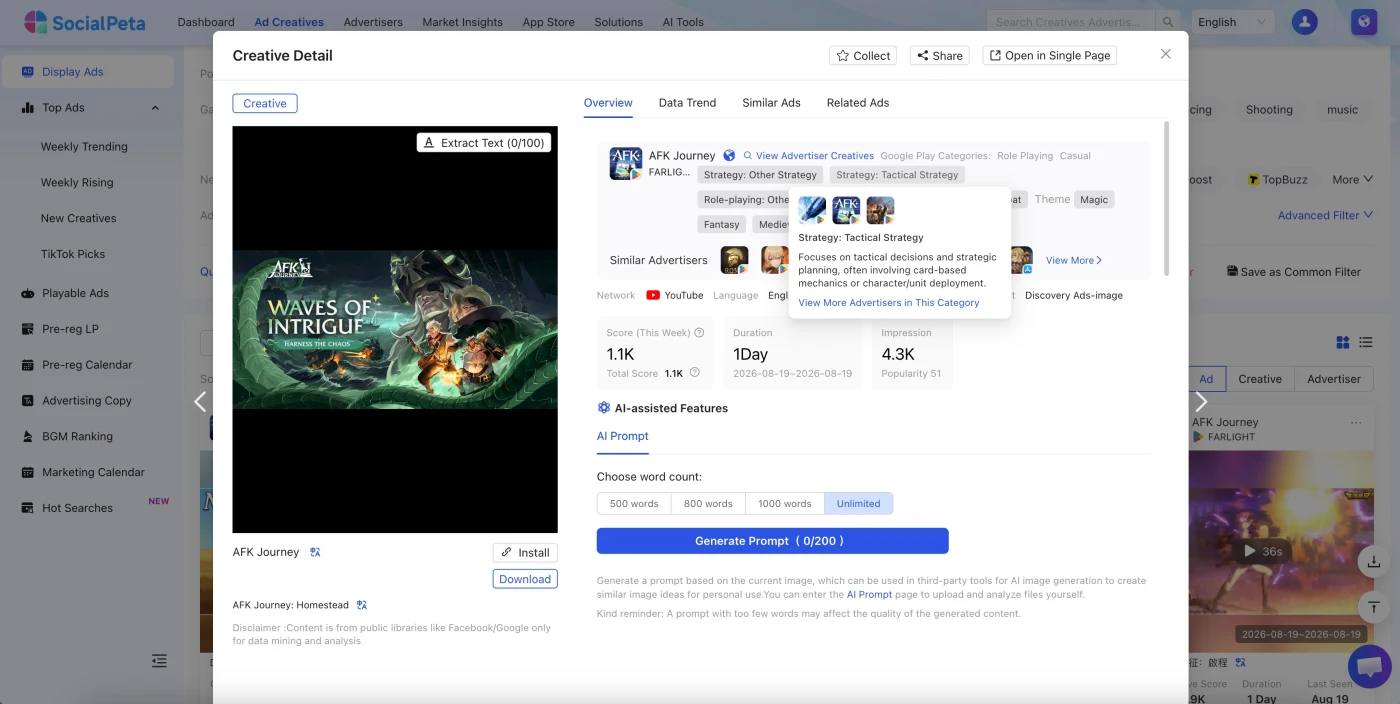
Use Ad Intelligence to narrow the market and creative set, then document the hypothesis in your own test plan. For a deeper view of whether a promising channel can survive higher spend, read the analysis of what makes a user acquisition channel scalable.
Measure growth, not just installs
Install cost answers a delivery question. Sustainable promotion requires a ladder from exposure to business value, viewed by acquisition cohort, market, platform, channel, campaign, creative, and store destination.
Conversion
Store-page conversion rate
Does the destination turn qualified visits into installs?
Activation
Cost per activated user
Do new users reach the first meaningful product outcome?
Retention
Day and week cohort retention
Do acquired users continue to receive value?
Economics
ROAS, LTV, and payback
Does downstream value support the cost and time required to acquire it?
A simple diagnostic order
If spend rises but value does not, check the funnel in order: delivery, click quality, store conversion, activation, retention, monetization, and reporting. Optimizing the ad when onboarding is the real constraint can make the wrong audience arrive faster.
Privacy, policy, and common app promotion risks
Privacy and platform policy are design constraints for the whole promotion system. Audit every analytics and advertising SDK, disclose data practices accurately, request permissions only when required and in context, and keep campaign claims consistent with the real product and store listing.
Optimizing for the cheapest install while ignoring activation and retention
Sending every audience to the same generic store page
Changing audience, bid, creative, destination, and onboarding in one test
Treating attributed conversions as proof that every conversion was incremental
Incentivizing ratings or using promotional claims that violate store or ad-platform rules
Scaling a single winning creative without building new variations around the underlying message
Before launch, verify the current rules on the store and every ad platform you use. For Apple, the official App Store marketing and identity guidelines cover badges, product images, messaging, and legal requirements.
App promotion FAQ
What is app promotion?
App promotion is the coordinated work used to make an app discoverable, persuade qualified people to install it, activate new users, and bring valuable users back. It can combine app store optimization, paid acquisition, content, partnerships, referrals, lifecycle messaging, and product-led growth.
What is the difference between app promotion and ASO?
App promotion covers the full growth system across paid, owned, earned, store, and product channels. App Store Optimization is one part of that system, focused on visibility and conversion inside app stores.
Which channel is best for promoting an app?
There is no universal best channel. Choose a channel by audience fit, creative fit, measurable downstream value, and the amount of budget or time needed to learn. A channel that produces cheap installs but weak activation or retention is not an efficient channel.
How much should I spend on app promotion?
Start with enough budget to test one audience, one promise, and several creative variations without mixing too many variables. Scale only after activated-user cost, retention, revenue, and payback support the decision. The right amount depends on your conversion volume, margins, and learning goal rather than a fixed industry percentage.