
App Store Optimization (ASO): A Practical Guide to Visibility and Conversion
App Store Optimization improves how easily people find an app and how confidently they install it. This guide explains the ranking inputs, store-listing fields, creative tests, and measurements that turn ASO into a repeatable growth process.
What is App Store Optimization?
App Store Optimization (ASO) is the ongoing process of improving an app's visibility in app store search and browse surfaces, then improving the percentage of visitors who install it. It is often called app store SEO, but ASO has two connected goals: discovery and conversion.
Discovery
Help the store understand which searches, categories, and audiences your app matches through relevant metadata, localization, category choices, and a healthy product.
Conversion
Help a qualified visitor decide to install through a clear value proposition, strong icon, persuasive screenshots, accurate previews, ratings, reviews, and local relevance.
ASO supports organic acquisition, but it also improves the landing page used by paid campaigns. That makes it part of a broader app promotion strategy, not a one-time metadata task.
How ASO works
A store first needs enough information to match an app with a relevant query or browse context. The listing then has to earn the install. Search relevance, product quality, user feedback, and conversion behavior all contribute to that system, although Apple and Google do not publish a complete ranking formula.
Match intent
Use accurate language for the problem, feature, or outcome a user is searching for.
Earn the visit
Compete for visibility in search results, categories, recommendations, and featured placements.
Convert demand
Use the listing and product reputation to turn a store visit into a qualified install.
Paid and organic acquisition can influence the same store-page metrics, so measure them together without treating correlation as proof. Use a clear attribution model and annotate campaigns, featuring, releases, and metadata changes.
What changed for ASO in 2025 and 2026
Exact-match keyword placement still matters, but modern app-store discovery is less dependent on one default listing and a short list of isolated terms. The stores now have more ways to interpret intent and show a page tailored to a specific search or audience.
APPLE SEARCH
Natural language and generated app tags
Apple says people can search with natural, everyday language. Search results may also show app tags generated by large language models from the metadata supplied in App Store Connect. Clear descriptions of real features now serve users and machine interpretation at the same time.
APPLE PAGES
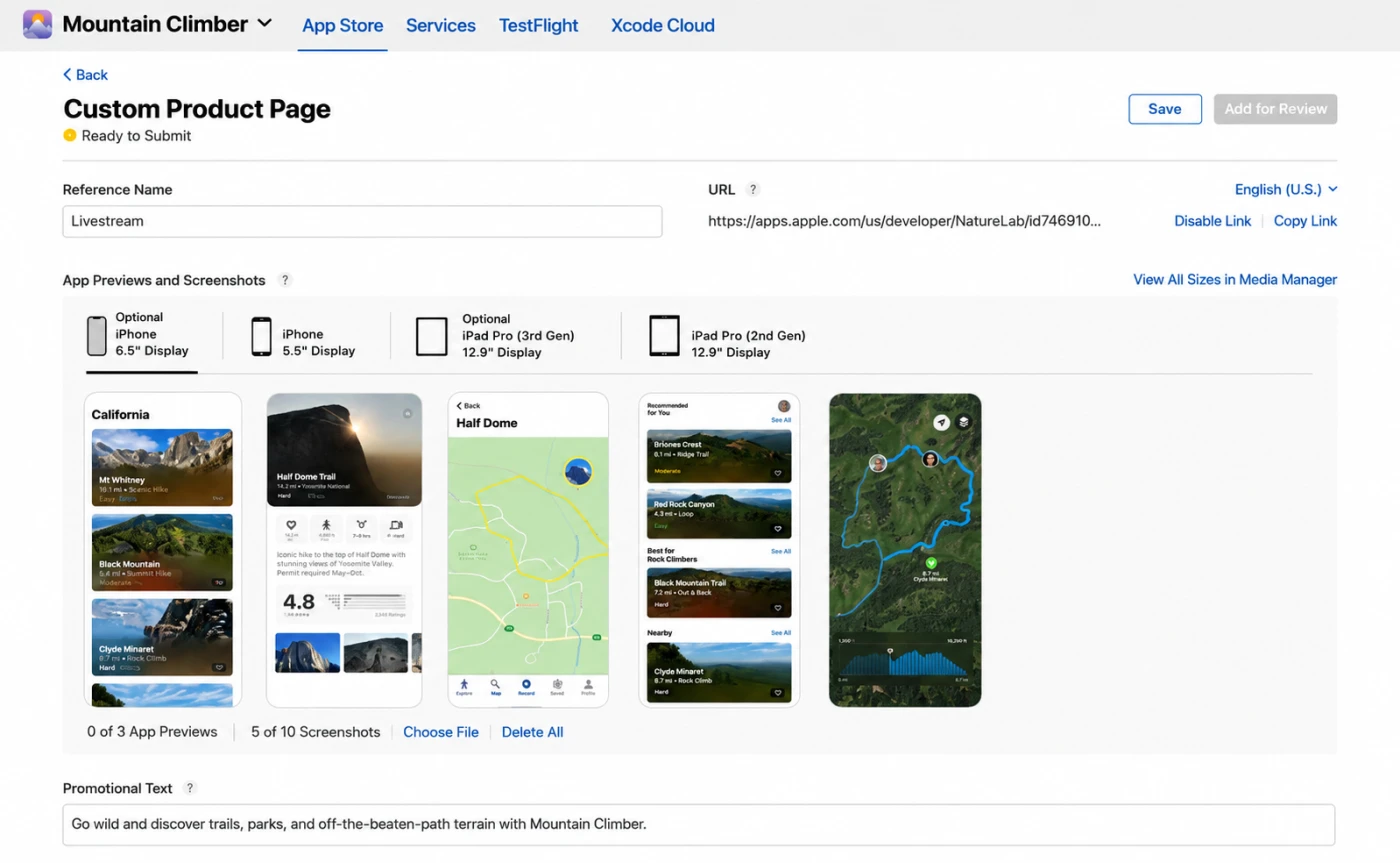
Searchable Custom Product Pages
Apple now allows up to 70 Custom Product Pages. A team can assign approved keywords to a page so the matching page, rather than the default listing, appears for that search. Each page can carry its own screenshots, previews, promotional text, and deep link.
GOOGLE PLAY
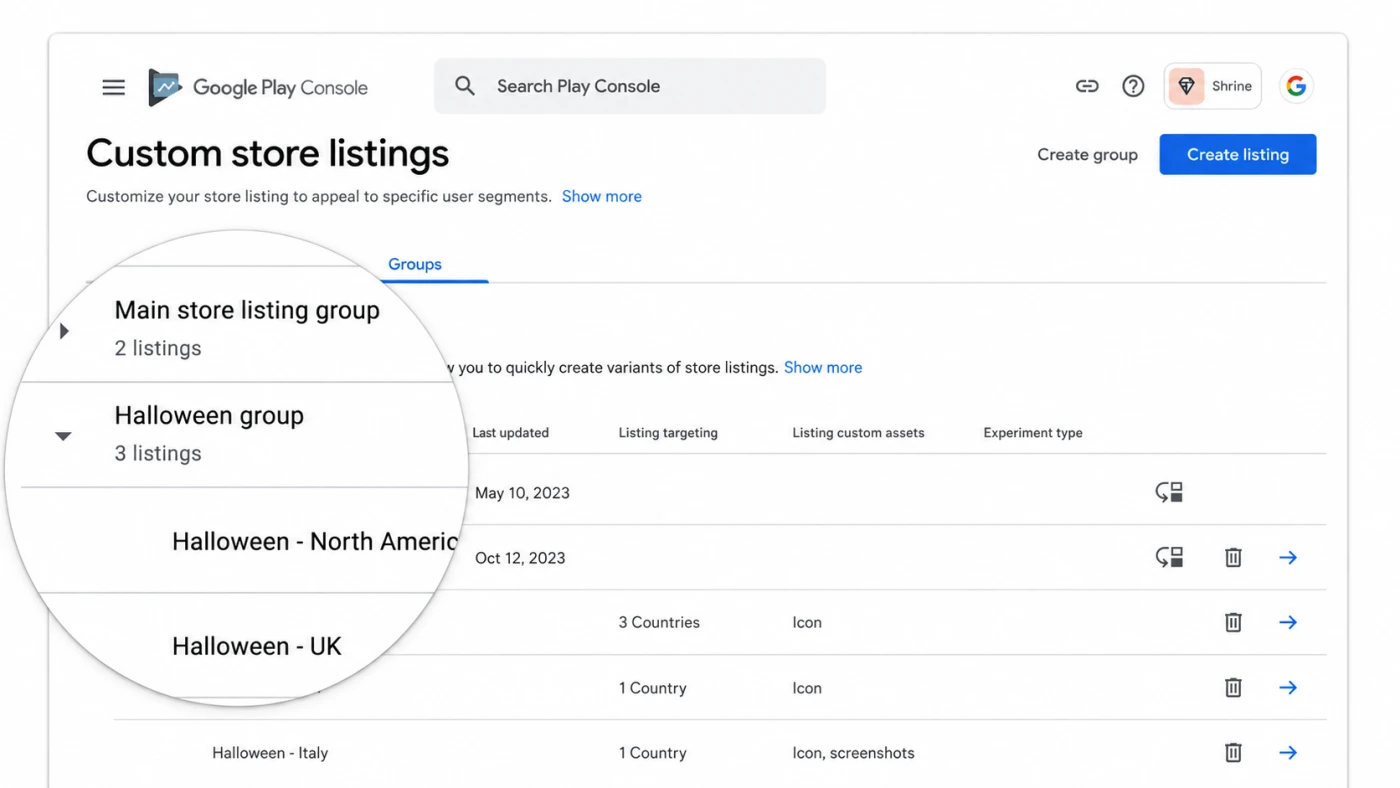
Listings for different audience segments
Google Play supports up to 50 Custom Store Listings. Listings can target countries, search keywords, campaign traffic, and user states such as lapsed or churned users. ASO can therefore align the message with both acquisition intent and lifecycle context.
The practical shift is from one page for everyone to a portfolio of intent-matched pages. Start with the default listing, then build a custom page only when the audience or promise is meaningfully different and there is enough traffic to measure it.
Current platform references: Apple App Store search, Apple Custom Product Pages, and Google Play Custom Store Listings.
Apple App Store vs. Google Play: what changes?
The two stores share the same basic ASO objective, but their fields and discovery systems are not interchangeable. The limits below come from current Apple and Google documentation.
| Element | Apple App Store | Google Play |
|---|---|---|
| Name | 30 characters | 30 characters |
| Supporting metadata | 30-character subtitle and a localized keyword field of up to 100 bytes | 80-character short description and a full description of up to 4,000 characters |
| Creative testing | Product Page Optimization can compare up to three alternate treatments | Store listing experiments test localized text or graphic assets |
| Intent-specific pages | Up to 70 Custom Product Pages, with approved keywords assignable to search-visible pages | Up to 50 Custom Store Listings for markets, keywords, campaigns, and selected user segments |
| Discovery context | Name, subtitle, keyword field, categories, in-app events, ratings, reviews, and product-page behavior | Listing text, category, tags, app content and functionality, ratings, reviews, and engagement |
Official references: Apple product page guidance, App Store metadata limits, and Google Play store listing guidance.
ASO ranking and conversion factors
An ASO audit should separate the factors you can edit directly from the outcomes you can only influence over time. This keeps the team focused on useful work instead of chasing an unofficial checklist of algorithm rumors.
Metadata relevance
App name, subtitle or short description, keyword field, long description, category, and tags help stores and users understand the app.
Creative conversion
The icon, first screenshots, captions, preview video, and feature graphic shape whether a qualified visitor keeps reading and installs.
Ratings and reviews
Ratings and review content affect trust. Apple also states that ratings and reviews influence search ranking.
Product quality
Crashes, poor performance, confusing onboarding, and unmet expectations weaken retention and produce the feedback that future visitors see.
Localization
Localized queries, copy, and visuals can improve relevance and conversion because user intent and category language differ by market.
Fresh, relevant merchandising
In-app events, promotional content, custom pages, and timely creative can connect the listing with a current feature or audience.
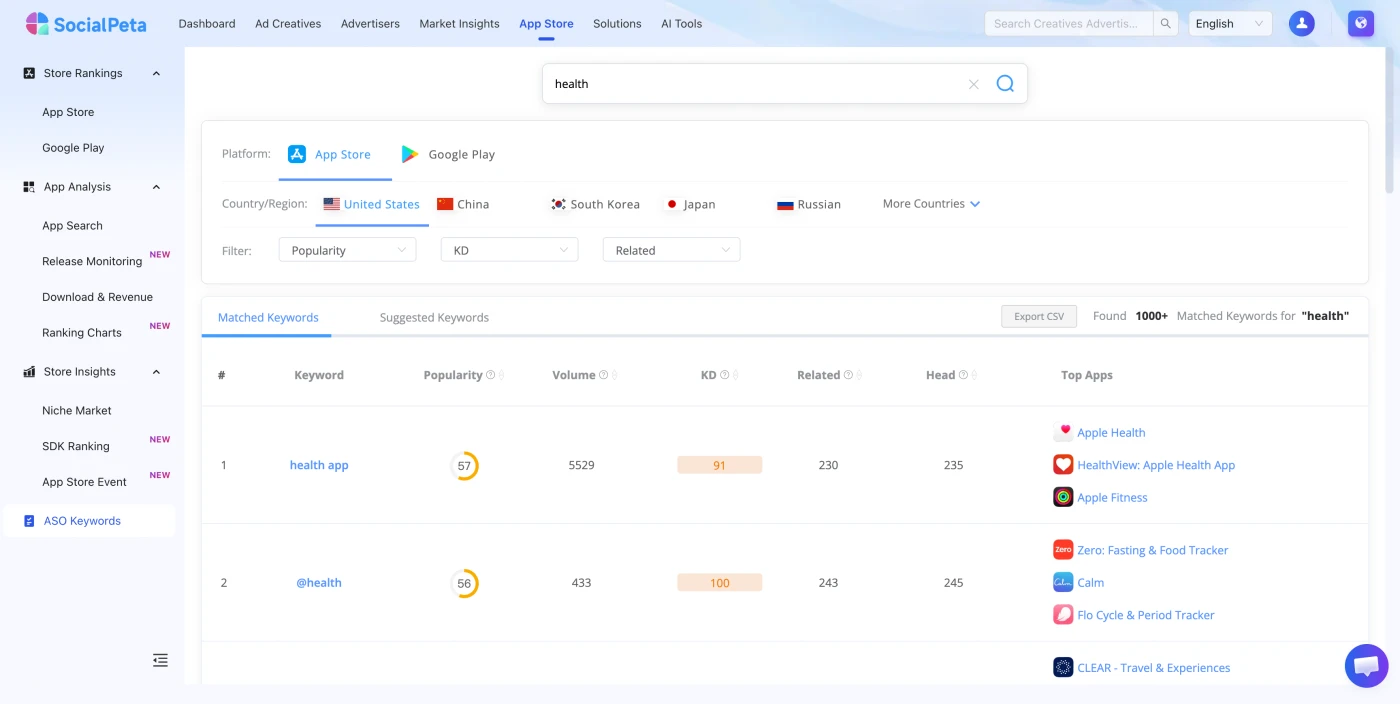
Competitive research adds context to these signals. Use mobile app intelligence to compare rankings, releases, keyword opportunities, downloads, revenue, and category movement before deciding what to change.
A practical ASO strategy, step by step
Good ASO is a research and testing loop. Each update should start with a specific problem, make a controlled change, and end with a documented result.
- 01
Establish a baseline
Record impressions, product-page views, installs, conversion rate, keyword positions, ratings, and review themes by store and market. A baseline prevents a seasonal spike or paid campaign from being mistaken for an ASO win.
- 02
Build a keyword map
Group queries by user intent, feature, use case, audience, and competitor alternative. Compare relevance, demand, and ranking difficulty. A smaller set of closely matched terms is more useful than a long list of popular but vague keywords.
- 03
Rewrite store metadata
Give the highest-value fields a clear job. The name should identify the product, the subtitle or short description should explain its value, and the longer description should answer the questions that block an install.
- 04
Design the first impression
Treat the icon and first screenshots as a short sales sequence. Show the main outcome early, use readable captions, and demonstrate the real product. Adapt the sequence for each market instead of translating words onto the same artwork.
- 05
Run a controlled test
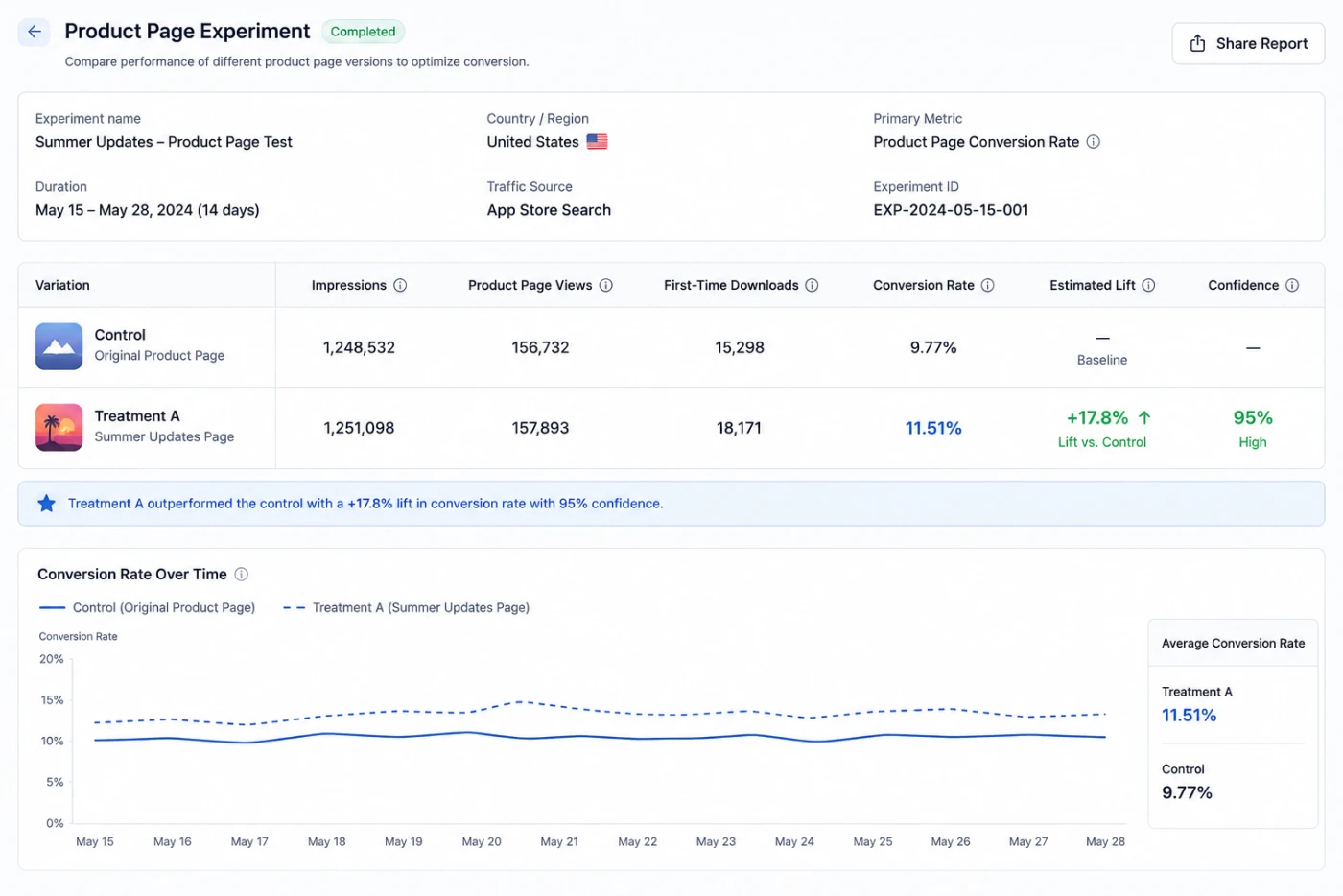
Test one strong hypothesis at a time, such as a clearer first screenshot or a different value proposition. Keep the traffic source and localization in view, and wait for enough data before choosing a winner.
- 06
Improve the product signal
ASO does not stop at the listing. Fix crashes, slow starts, onboarding friction, and repeated review complaints. Ask satisfied users for a rating at an appropriate moment and respond to useful feedback.
- 07
Localize, segment, and repeat
Research each market separately, localize metadata and visuals, then create an intent-specific product page when a keyword cluster or audience needs a different promise. Review performance on a regular cadence and keep a change log.
Write the hypothesis before the test
Example: "Showing the core collaboration workflow in the first screenshot will increase product-page conversion among small-team search traffic." This is more useful than testing a new visual because it looks better.
Apple's official Product Page Optimization guide explains traffic allocation, treatments, duration, and confidence.
ASO vs. SEO
ASO and search engine optimization both begin with search intent, relevance, and useful content. They differ in the surface being optimized and in the action that defines success.
ASO
Win relevant app discovery and installs
- App store search and browse surfaces
- Store metadata, categories, tags, and creative assets
- Ratings, reviews, product quality, and conversion
- Primary outcomes: visibility, store visits, and installs
SEO
Win relevant web discovery and visits
- Search engines and their result features
- Page content, technical accessibility, and site architecture
- Authority, internal links, external links, and user value
- Primary outcomes: impressions, clicks, and site conversions
The channels can reinforce each other. A useful website can capture web searches for the app's category, while a strong store page converts people who arrive through search, referrals, or paid user acquisition.
How to measure ASO performance
Rankings are diagnostic, not the final outcome. Track the full path from exposure to a useful install, and segment the data by store, country, source, device, and time period where possible.
Visibility
Search impressions, browse impressions, keyword coverage, and keyword position
Engagement
Product-page views and the rate at which an impression becomes a store visit
Conversion
First-time downloads divided by relevant product-page views or impressions
Quality
Ratings, review themes, crashes, retention, and downstream value from acquired users
Privacy changes can limit user-level measurement, particularly on iOS. The guide to App Tracking Transparency explains why aggregated and store-reported signals matter when evaluating acquisition performance.
Common ASO mistakes
- Chasing volume without relevance. A popular keyword that describes the wrong intent can bring weak conversion and confuse the listing.
- Copying the same listing across stores. Apple and Google expose different fields, tests, policies, and discovery inputs.
- Changing everything at once. A new title, screenshot set, campaign, and product release make it difficult to explain the result.
- Translating without local research. Direct translation can miss the words, benefits, and visual cues people use in a specific market.
- Ignoring the product after install. A listing cannot compensate for crashes, a poor first session, or promises the product does not keep.
App Store Optimization FAQ
What does ASO mean?
ASO means App Store Optimization. It is the ongoing process of improving an app's visibility in app-store discovery surfaces and increasing the percentage of store visitors who install the app.
What is the difference between ASO and SEO?
ASO improves discovery and conversion inside app stores, while SEO improves a website's visibility in search engines. Both rely on search intent and relevance, but ASO also depends heavily on store metadata, visual assets, ratings, reviews, and app quality signals.
How long does App Store Optimization take?
Metadata changes can affect discovery after a store processes them, but reliable ASO decisions require enough impressions and installs to separate a real improvement from normal variation. Most teams should evaluate trends over several weeks and test one clear hypothesis at a time.
Is ASO free?
Publishing metadata and creative assets does not require a separate ASO fee, but research, localization, design, testing, and analysis take time. Paid user acquisition can support learning, yet it is not a substitute for a relevant and persuasive store listing.