
12 Best Ad Spy Tools in 2026
A practical comparison of free official libraries and paid research platforms for social, mobile, ecommerce, native, affiliate, and creative-team workflows.
The short answer
Use SocialPeta for mobile app and game creative intelligence, the official Meta, TikTok, and Google libraries for free first-party verification, PiPiADS for TikTok commerce, Minea for ecommerce discovery, and AdPlexity or Anstrex for affiliate and native campaigns. No tool can tell you that a competitor ad is profitable.
Best ad spy tools: Quick picks by channel
- Mobile apps and games: SocialPeta
- Free Meta research: Meta Ad Library
- TikTok creative inspiration: TikTok Creative Center
- TikTok ecommerce: PiPiADS
- Ecommerce products and stores: Minea
- Native and affiliate funnels: AdPlexity
- Creative organization and briefs: Foreplay
The fastest buying mistake is choosing a tool because its gallery looks impressive. Coverage has to match the channels, countries, formats, and advertiser types in your weekly brief. A clean answer for one platform is usually worth more than shallow access to ten.
What an ad spy tool can and cannot prove
An ad spy tool helps you find public or observed competitor advertising. Useful records may include the creative, advertiser, copy, call to action, first and last seen dates, market, placement, related variants, and landing page. Paid products often add history, deduplication, alerts, exports, and cross-platform search.
Those records do not reveal a competitor's full account. Missing ads may reflect collection limits, geography, personalization, permissions, or platform rules. A long runtime suggests the creative deserved attention, but it does not disclose spend, conversions, margin, retention, or incrementality. Treat “winning ad” as a search phrase, not a verified financial conclusion.
The right output is an original test hypothesis. A repeated hook might suggest a customer anxiety worth exploring. A cluster of product demonstrations might indicate that clarity matters in the category. The next step is to create your own expression and test it. Copying the asset itself creates legal, brand, and learning problems.
How we chose these 12 tools
We reviewed current search results, official product pages, and common practitioner concerns. The list deliberately includes free platform libraries because they are often the best first check. Paid products earned a place when they offered a clear specialist use case or reduced repeated research work.
- Coverage: the right networks, markets, formats, devices, and advertiser types.
- Search quality: filters that create a comparable set instead of an endless inspiration feed.
- Evidence: dates, source context, landing pages, related ads, and definitions that can be checked.
- Workflow: saved searches, alerts, deduplication, boards, exports, collaboration, and APIs.
- Specialization: a concrete advantage for apps, TikTok commerce, ecommerce, native, affiliate, or creative operations.
We did not rank by vendor-reported database size. Record counts can mix countries, duplicates, formats, and old observations. We also avoided numeric scores because a tool's value changes with the job. SocialPeta is our product and is disclosed as such.
We also separated discovery from verification. A paid platform may be the fastest place to search across channels, group related creatives, and monitor a competitor. The platform's official library may be the better place to confirm the current source record. Using both creates a more reliable chain of evidence than assuming either view is complete. For every important example, note when and where it was observed, then keep interpretation in a separate field.
12 best ad spy tools compared
| Tool | Best for | Main scope | Watch for |
|---|---|---|---|
| 1. SocialPeta | Mobile apps, games, and cross-channel creative research | Searchable creatives, advertiser analysis, mobile networks, countries, formats, copy, creative attributes, and app context | Our product. Validate its coverage with your own advertiser set. |
| 2. Meta Ad Library | Free verification of ads running across Meta products | First-party advertiser and creative records, with additional transparency for social issues, elections, and politics | Research controls and historical depth differ by ad category and region. |
| 3. TikTok Creative Center | TikTok creative inspiration and platform-native examples | Top Ads, trends, filters, creative patterns, and selected performance context | Top Ads is an authorized subset, not a complete view of every advertiser. |
| 4. Google Ads Transparency Center | Free Google advertiser and creative verification | Ads served by verified advertisers across Google surfaces | It is a transparency library, not a full competitor workflow or profitability tool. |
| 5. BigSpy | Broad multi-platform creative discovery | Social and mobile advertising search across several networks and formats | Check freshness, regional depth, and the fields included in your plan. |
| 6. AdSpy | Facebook and Instagram ad research | Social creative search with advertiser, copy, demographic, landing-page, and engagement filters | A focused social product is less useful for open-web or app-network research. |
| 7. PiPiADS | TikTok ads and ecommerce product research | TikTok creatives, advertisers, products, shops, and commerce-oriented signals | Commerce popularity signals do not prove profit or durable demand. |
| 8. Minea | Ecommerce product and ad discovery | Social ads, products, shops, influencer placements, and store research | Its ecommerce lens may add noise for app and B2B marketers. |
| 9. PowerAdSpy | Multi-network social ad search | Creative, keyword, advertiser, call-to-action, landing-page, and platform filters | Test result quality on your niche instead of relying on claimed database size. |
| 10. AdPlexity | Affiliate, native, mobile, and push campaign research | Ads, publishers, placements, landing pages, redirects, devices, carriers, and countries | It is specialized and may require separate products or plans by traffic type. |
| 11. Anstrex | Native and push advertising research | Native and push creatives, publishers, networks, landing pages, and affiliate patterns | Best for its specialist channels, not as a general social library. |
| 12. Foreplay | Saving ads and turning research into creative briefs | Competitor tracking, discovery, swipe files, boards, collaboration, and briefing | Workflow value is stronger than market-level spend intelligence. |
Detailed reviews: Which ad spy tool fits your work?
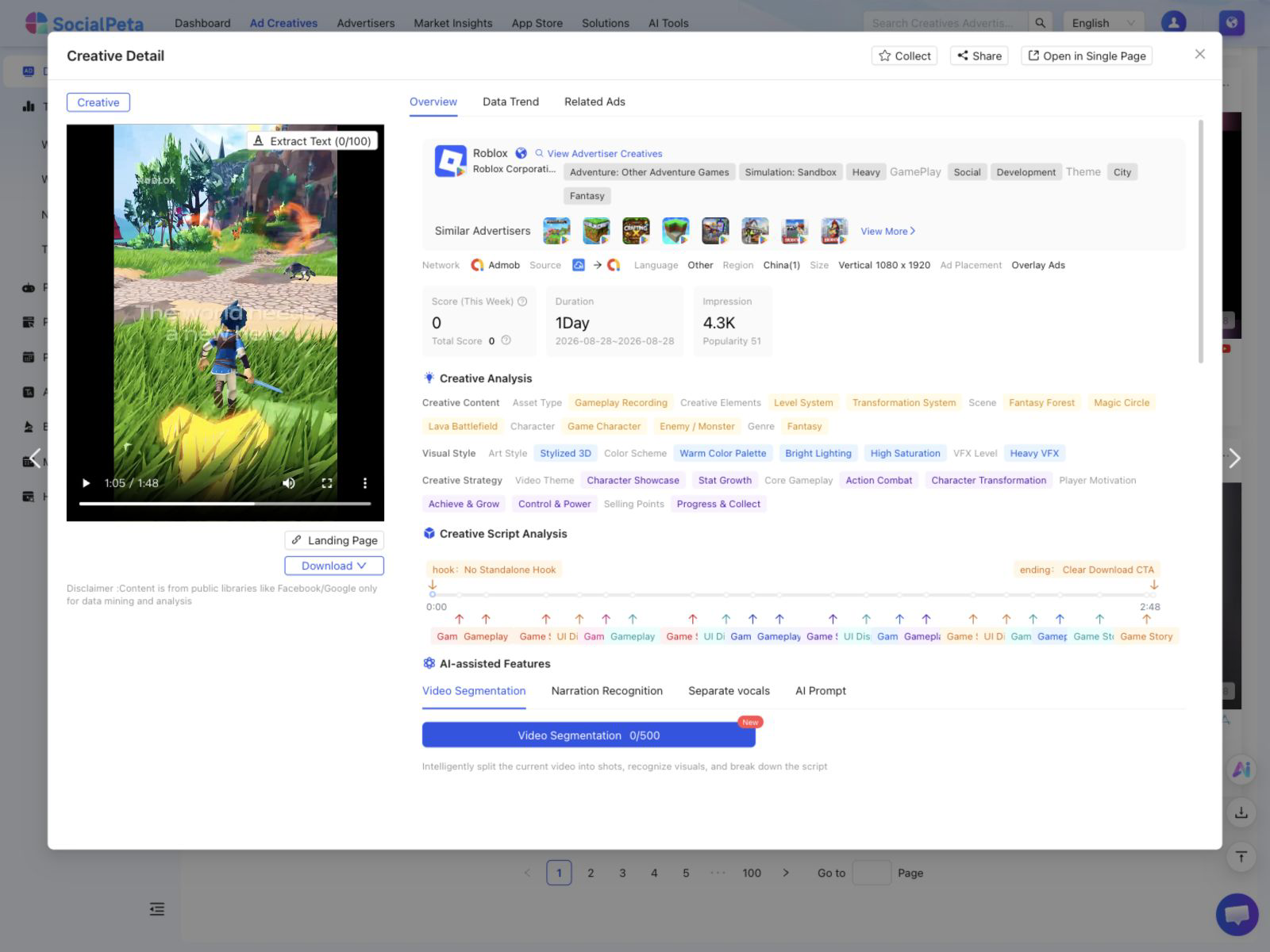
1. SocialPeta
Best for: Mobile apps, games, and cross-channel creative research
Searchable creatives, advertiser analysis, mobile networks, countries, formats, copy, creative attributes, and app context. Our product. Validate its coverage with your own advertiser set.
SocialPeta combines creative search with advertiser and app context. Teams can filter by network, market, language, format, category, time, and creative attributes, then study related ads, copy, channels, countries, media, and campaign signals. It is especially useful when a creative strategist or UA manager needs a structured competitor set instead of isolated inspiration. Since SocialPeta publishes this article, test the same named competitors in every shortlisted product.
2. Meta Ad Library
Best for: Free verification of ads running across Meta products
First-party advertiser and creative records, with additional transparency for social issues, elections, and politics. Research controls and historical depth differ by ad category and region.
Meta's library is the sensible starting point when you need to verify whether a page is currently advertising and inspect the creative as Meta presents it. It is free and first-party. Specialist tools become useful when you need stronger historical comparison, saved monitoring, bulk analysis, or a normalized view across several networks.
3. TikTok Creative Center
Best for: TikTok creative inspiration and platform-native examples
Top Ads, trends, filters, creative patterns, and selected performance context. Top Ads is an authorized subset, not a complete view of every advertiser.
Creative Center is useful for learning the visual language, formats, sounds, and trends native to TikTok. Its Top Ads area is curated from ads advertisers have authorized for display, so absence is not evidence that a brand is inactive. Use it for platform-native inspiration and verify broader competitor coverage elsewhere.
4. Google Ads Transparency Center
Best for: Free Google advertiser and creative verification
Ads served by verified advertisers across Google surfaces. It is a transparency library, not a full competitor workflow or profitability tool.
Google's transparency tool is a useful free check for creatives from verified advertisers across Google surfaces. It helps confirm what an advertiser has run, but it does not recreate keyword bidding, complete spend, conversion results, or a cross-channel plan. Pair it with search intelligence when PPC history is the real question.
5. BigSpy
Best for: Broad multi-platform creative discovery
Social and mobile advertising search across several networks and formats. Check freshness, regional depth, and the fields included in your plan.
This tool is most useful when its specialist focus matches the buying motion. During a trial, search for five known advertisers, one smaller regional competitor, and a campaign you can verify elsewhere. Check duplicates, freshness, landing-page access, market coverage, and whether exports preserve source evidence.
6. AdSpy
Best for: Facebook and Instagram ad research
Social creative search with advertiser, copy, demographic, landing-page, and engagement filters. A focused social product is less useful for open-web or app-network research.
This tool is most useful when its specialist focus matches the buying motion. During a trial, search for five known advertisers, one smaller regional competitor, and a campaign you can verify elsewhere. Check duplicates, freshness, landing-page access, market coverage, and whether exports preserve source evidence.
7. PiPiADS
Best for: TikTok ads and ecommerce product research
TikTok creatives, advertisers, products, shops, and commerce-oriented signals. Commerce popularity signals do not prove profit or durable demand.
This tool is most useful when its specialist focus matches the buying motion. During a trial, search for five known advertisers, one smaller regional competitor, and a campaign you can verify elsewhere. Check duplicates, freshness, landing-page access, market coverage, and whether exports preserve source evidence.
8. Minea
Best for: Ecommerce product and ad discovery
Social ads, products, shops, influencer placements, and store research. Its ecommerce lens may add noise for app and B2B marketers.
This tool is most useful when its specialist focus matches the buying motion. During a trial, search for five known advertisers, one smaller regional competitor, and a campaign you can verify elsewhere. Check duplicates, freshness, landing-page access, market coverage, and whether exports preserve source evidence.
9. PowerAdSpy
Best for: Multi-network social ad search
Creative, keyword, advertiser, call-to-action, landing-page, and platform filters. Test result quality on your niche instead of relying on claimed database size.
This tool is most useful when its specialist focus matches the buying motion. During a trial, search for five known advertisers, one smaller regional competitor, and a campaign you can verify elsewhere. Check duplicates, freshness, landing-page access, market coverage, and whether exports preserve source evidence.
10. AdPlexity
Best for: Affiliate, native, mobile, and push campaign research
Ads, publishers, placements, landing pages, redirects, devices, carriers, and countries. It is specialized and may require separate products or plans by traffic type.
This tool is most useful when its specialist focus matches the buying motion. During a trial, search for five known advertisers, one smaller regional competitor, and a campaign you can verify elsewhere. Check duplicates, freshness, landing-page access, market coverage, and whether exports preserve source evidence.
11. Anstrex
Best for: Native and push advertising research
Native and push creatives, publishers, networks, landing pages, and affiliate patterns. Best for its specialist channels, not as a general social library.
This tool is most useful when its specialist focus matches the buying motion. During a trial, search for five known advertisers, one smaller regional competitor, and a campaign you can verify elsewhere. Check duplicates, freshness, landing-page access, market coverage, and whether exports preserve source evidence.
12. Foreplay
Best for: Saving ads and turning research into creative briefs
Competitor tracking, discovery, swipe files, boards, collaboration, and briefing. Workflow value is stronger than market-level spend intelligence.
Foreplay solves the handoff after discovery. Teams can save references, follow competitors, organize boards, and turn observations into briefs. It makes sense when the recurring pain is lost ads and scattered bookmarks. It is less suitable when the main requirement is estimated spend, publisher paths, or broad market sizing.
Free official libraries versus paid ad spy tools
Start free when the question is narrow: “What is this advertiser running on Meta?” or “Can I verify this Google creative?” Official libraries provide the closest view to the source and cost nothing. They are also useful for checking records discovered in another product.
Pay when the same research repeats across competitors or channels. History, richer filters, deduplication, saved searches, alerts, related creatives, landing-page paths, bulk exports, and collaboration can turn a manual hunt into a consistent process. The saving should be measured in analyst time and better decisions, not the number of ads returned.
Account for collection differences before comparing results. Meta, TikTok, Google, mobile ad networks, and native exchanges expose different fields and apply different transparency rules. A third-party tool may capture a useful observation without seeing every impression or variation. Search from the countries where your team operates, compare first and last seen dates, and keep a link or screenshot of the original record when it informs an important decision.
Contract details matter as much as the search screen. Check whether video playback, landing-page history, downloads, alerts, exports, APIs, team seats, and longer lookback periods require higher plans. Ask how often records refresh and what happens when a platform removes an ad. A low monthly price can become expensive if analysts still rebuild every brief by hand.
A practical stack is one primary paid tool plus the relevant official libraries. Add a second paid specialist only when a valuable recurring channel is poorly covered. For broader media and spend questions, our guide to the best ad intelligence tools explains the wider category.
A safer workflow from competitor ad to original test
- Write the question first. Name the market, channel, audience, format, and time window.
- Build a comparable set. Separate products, regions, formats, and campaign periods. Remove duplicate edits when possible.
- Record observations. Note the hook, offer, proof, visual device, call to action, landing-page continuity, and repeated variants.
- Separate evidence from inference. “Observed for 45 days” is evidence. “Profitable” is an unsupported inference without first-party economics.
- Create an original hypothesis. Translate the pattern into a customer problem or message to test in your own brand voice.
- Measure with your own data. Use campaign, conversion, retention, and margin data to decide whether the idea works for you.
The winning ads testing playbook shows how to move from observed competitor patterns to controlled tests without treating imitation as strategy.
Keep a small research log beside the swipe file. Record the query, filters, date, tool, source URL, and what the analyst inferred. Repeating the same search a month later will show whether the pattern persisted or whether the first result was a temporary burst. This simple habit also helps a creative lead challenge an interpretation without arguing over memory.
Frequently asked questions
What is the best ad spy tool in 2026?
The best choice depends on the channel and research job. SocialPeta fits cross-channel mobile app and game research, Meta Ad Library and Google Ads Transparency Center are useful free first-party sources, PiPiADS focuses on TikTok, Minea on ecommerce product research, and AdPlexity or Anstrex on affiliate and native advertising.
What is the best free ad spy tool?
Start with the official library for the platform you buy on: Meta Ad Library, TikTok Creative Center, or Google Ads Transparency Center. They provide first-party visibility, but their search, history, comparison, export, and cross-channel workflows are more limited than specialist paid tools.
Do ad spy tools show winning ads?
They show observable signals such as how long an ad has appeared, where it was seen, related variants, or platform-specific popularity metrics. Those signals can help prioritize research, but they do not reveal complete spend, conversions, profit, retention, or incrementality. A long-running ad is a clue, not proof of a winner.
Are ad spy tools legal to use?
Competitive research based on public advertising is a common marketing practice, but teams should respect platform terms, privacy rules, trademarks, and copyright. Use competitor work to understand patterns and form original hypotheses, not to copy protected creative assets or misleadingly impersonate a brand.
How many ad spy tools does a team need?
Most teams need one primary research platform plus the official libraries for verification. Add a specialist only when a recurring channel or workflow is poorly covered, such as native affiliate ads, TikTok shop products, or creative briefing. More subscriptions do not fix an unclear research process.
Final verdict
Choose by channel and output. SocialPeta is the best fit here for mobile app and game creative research. Official libraries are the right free starting point. PiPiADS and Minea serve commerce-led workflows, while AdPlexity and Anstrex make sense for specialist affiliate traffic. Foreplay earns its place when the bottleneck is creative organization.
Before paying, run the same ten searches in each product and write down what is missing. The best tool is the one that produces a traceable, original test brief with the least cleanup.