
10 Best Ad Intelligence Tools in 2026
The right platform depends on the evidence you need: creative patterns, paid-search history, publisher paths, modeled spend, mobile-app context, or a workflow your team will actually use.
The short answer
SocialPeta is our pick for mobile app and game creative research. Pathmatics is better suited to enterprise digital spend and media strategy, Similarweb to web-market context, MediaRadar to broad cross-media intelligence, and SpyFu to Google Ads history. Choose the platform that can answer a recurring decision with evidence, not the one with the longest feature page.
Best ad intelligence tools: Quick picks
- Best for mobile app and game creative research: SocialPeta
- Best for enterprise digital media intelligence: Pathmatics by Sensor Tower
- Best for ads plus web traffic context: Similarweb
- Best for broad cross-media prospecting: MediaRadar
- Best for Google Ads history: SpyFu
- Best for creative team workflow: Foreplay
These are job-based recommendations, not a universal score. A platform can be excellent at reconstructing display distribution and still be the wrong choice for mobile-game creatives. Another may estimate media spend well but add friction to a designer's daily workflow.
What ad intelligence means in 2026
Ad intelligence is competitive research built from observable advertising activity. Depending on the product, it may include creatives, copy, advertiser history, publishers, placements, channels, countries, estimated impressions or spend, landing pages, paid-search keywords, and app-market context. An ad spy tool usually starts with the creative. An enterprise intelligence platform is more likely to start with budget allocation, media mix, or market movement. In practice, the labels overlap.
It also differs from first-party analytics. Your ad platform, MMP, CRM, and product analytics tell you what happened in your accounts. Competitive intelligence estimates what is happening outside them. One source cannot replace the other. The most useful workflow combines an external observation with an internal question: a competitor changes video hooks, so your team tests a related messaging hypothesis against its own conversion and retention data.
If you only need to see currently active ads from one platform, begin with its free official library. Paid intelligence becomes worthwhile when you repeatedly need history, comparison, normalization, exports, alerts, cross-channel research, or richer advertiser context.
How we evaluated these platforms
We reviewed the current organic results, official product documentation, and the questions practitioners raise when shopping for competitive-advertising data. We favored tools with a distinct, repeatable job rather than filling the list with near-identical creative feeds.
- Relevant coverage: channels, markets, devices, formats, advertisers, and history that match a real buying pattern.
- Research control: filters, deduplication, comparable sets, change tracking, and traceable source records.
- Decision context: connections among creative, advertiser, publisher, media, app, market, or keyword data.
- Operational fit: saved views, alerts, exports, APIs, permissions, collaboration, and reporting.
- Data honesty: clear distinction among observed facts, modeled estimates, vendor scores, and analyst interpretation.
We did not assign synthetic scores. Pricing, coverage, and packaging change, and a decimal rating would imply a precision the evidence cannot support. SocialPeta publishes this article and appears first because it is the recommended fit for the site's mobile-focused audience. The limitation is disclosed so readers can apply the same trial standard to every option.
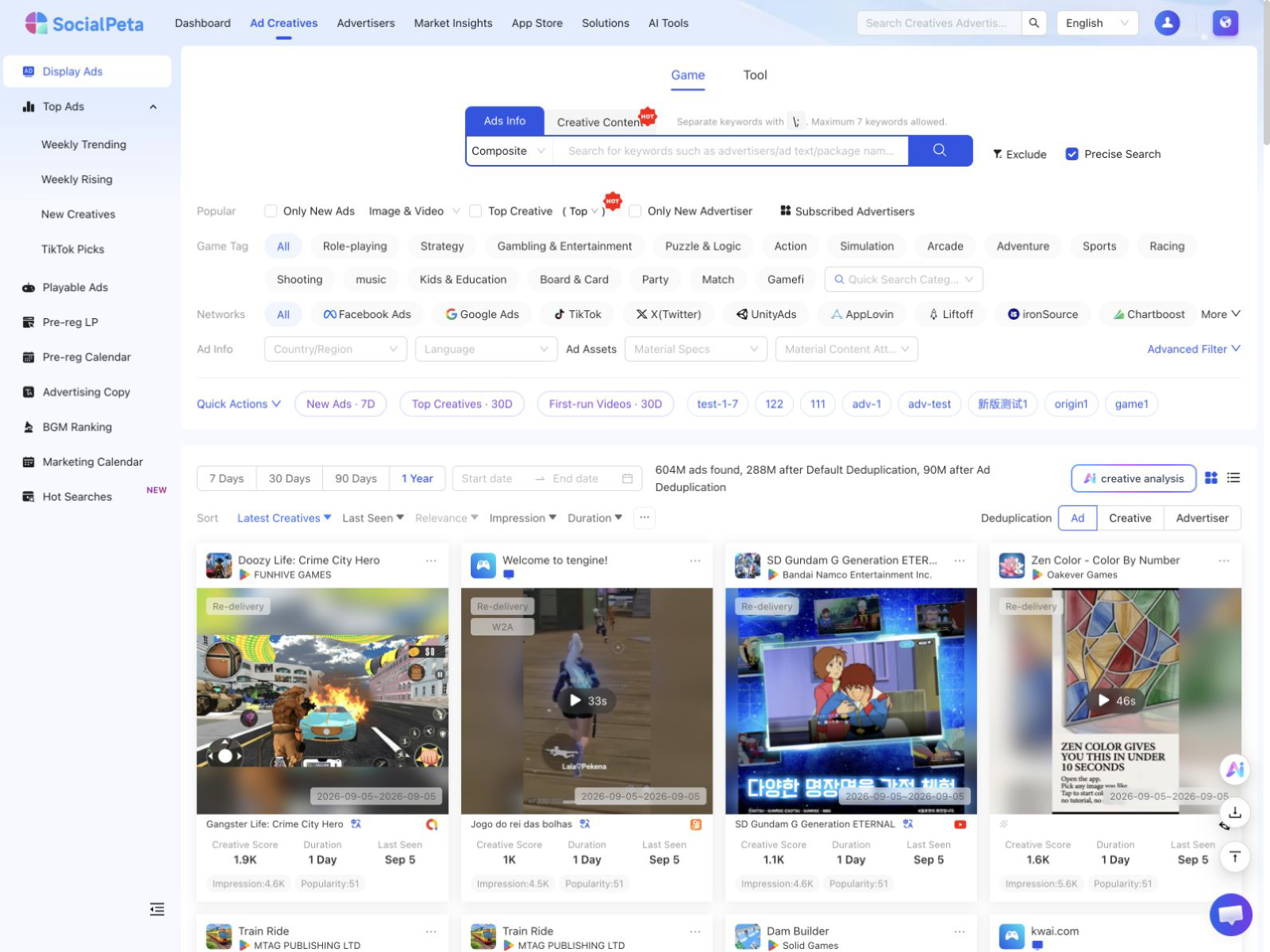
The 10 best ad intelligence tools compared
| Tool | Best for | Research coverage | Watch for |
|---|---|---|---|
| 1. SocialPeta | Mobile app and game creative intelligence | Mobile and web creatives, advertisers, channels, countries, copy, app context | Confirm historical depth and network coverage for your markets |
| 2. Pathmatics by Sensor Tower | Enterprise digital spend and media strategy | Social, display, video, mobile, and OTT market signals | Enterprise scope can exceed the needs of smaller creative teams |
| 3. Similarweb Ad Intelligence | Connecting ads with web traffic and market context | Paid search, display, publishers, creatives, traffic and competitor websites | Less centered on mobile game creative taxonomy |
| 4. Semrush AdClarity | Competitive display, video, and social research in a marketing suite | Advertisers, publishers, creatives, placements, expenditure and buying methods | Coverage varies by market, channel, and subscription |
| 5. MediaRadar | Cross-media planning, sales intelligence, and prospecting | Digital, TV, print, social, video, programmatic, and other media signals | Designed for broad media and sales workflows beyond creative inspiration |
| 6. Adbeat | Display, native, publisher, and landing-page research | Advertisers, publishers, ad networks, creatives, placements and landing pages | Its center of gravity is open-web advertising |
| 7. SpyFu | Google Ads keyword and copy history | PPC keywords, ad copy, competitors, ranking history and search overlap | A specialist for search, not an omnichannel ad monitor |
| 8. AppMagic | Mobile game market research with ad intelligence | Apps, publishers, genres, downloads, revenue, creatives, LiveOps and IAP research | Creative workflow should be tested against dedicated ad-first tools |
| 9. Foreplay | Creative saving, organization, and briefing | Ad discovery, swipe files, competitor tracking, boards and team workflow | It is a creative operations tool more than a media-spend intelligence system |
| 10. Apptica | Mobile app market and advertising intelligence | App stores, downloads and revenue estimates, advertising, usage and market trends | Module depth and regional coverage need contract-level confirmation |
Detailed reviews: Where each tool fits
1. SocialPeta
Best for: Mobile app and game creative intelligence
SocialPeta is the strongest fit when research begins with a mobile app, game, advertiser, or creative concept. Its ad search can be narrowed by network, country, language, format, category, time, and creative attributes. Advertiser analysis then connects the ad set with channels, media, countries, copy, audience signals, competitors, store information, and estimated app performance. That path works well for UA and creative teams that need to turn a broad library into a defensible brief. SocialPeta is our product, so treat this placement as a disclosed recommendation and test it against the same brief as every other vendor.
2. Pathmatics by Sensor Tower
Best for: Enterprise digital spend and media strategy
Pathmatics is built for marketers who need to understand where brands appear to be investing, how media mix changes, which creatives are in market, and where placements run. It is a better match for planning, brand strategy, agency intelligence, and executive competitive reporting than for building a fast swipe file. The useful question in a demo is not whether a famous advertiser appears. Ask whether the platform can reconstruct a known campaign across the exact countries, devices, publishers, and channels that matter to your team, with clear definitions for modeled spend and impressions.
3. Similarweb Ad Intelligence
Best for: Connecting ads with web traffic and market context
Similarweb is useful when the ad is only one part of the question. A growth team can examine paid search or display activity alongside website traffic, referrals, audience behavior, and broader digital-market movement. That context helps when a campaign sends users through web funnels or when the research goal is to understand acquisition strategy rather than creative style alone. Buyers should confirm which ad formats, countries, devices, and historical periods are available in the quoted package because Similarweb's wider product family can make a high-level feature list look broader than the licensed workflow.
4. Semrush AdClarity
Best for: Competitive display, video, and social research in a marketing suite
AdClarity suits teams already working in Semrush that want competitive advertising data close to SEO, content, and paid-search workflows. It can be a practical middle ground for reviewing advertiser activity, publisher relationships, creative examples, placement patterns, and modeled expenditure without procuring a separate enterprise platform. Its value depends on the countries and channels a team actually uses. During a trial, compare the same advertiser in AdClarity and a platform-native library, then note missing formats, delayed observations, and whether the export preserves enough evidence for another analyst to reproduce the finding.
5. MediaRadar
Best for: Cross-media planning, sales intelligence, and prospecting
MediaRadar stands out when the commercial question crosses media types. Agencies, publishers, ad sales teams, and brands can use it to research advertiser activity, category movement, media mix, buying behavior, and prospects. That breadth makes it different from a creative-first spy tool. It may be excessive for a small performance team that mainly needs social ads. A useful evaluation should begin with one category and a short list of known advertisers, then test whether the platform reveals actionable account movement rather than simply returning more records.
6. Adbeat
Best for: Display, native, publisher, and landing-page research
Adbeat remains a focused option for teams studying display and native advertising across the open web. It is especially useful when the research must connect an advertiser to the publishers, networks, creative variants, and landing pages involved in distribution. Media buyers and affiliate researchers can use that chain to map a campaign structure instead of saving isolated screenshots. If your budget is concentrated in Meta, TikTok, or mobile ad networks, test those areas carefully before buying. A strong display database does not automatically translate into deep social or in-app coverage.
7. SpyFu
Best for: Google Ads keyword and copy history
SpyFu belongs on this list because paid search is often lost inside broad ad-intelligence comparisons. It lets marketers inspect which keywords competitors have appeared on, how ad copy changed, and where paid and organic search strategies overlap. That is valuable for search teams, landing-page planners, and agencies preparing an account review. It is not the right primary tool for video creative, mobile-game networks, or cross-channel media mix. The narrower scope is a benefit when Google Ads history is the actual job to be done.
8. AppMagic
Best for: Mobile game market research with ad intelligence
AppMagic is a credible choice when advertising research sits inside a larger mobile-game market or product decision. Teams can move from genre and publisher analysis into ad creatives, LiveOps, monetization, and market estimates. That makes it useful for strategy, publishing, investment, and product teams that need more than a creative feed. Its center of gravity differs from SocialPeta's advertiser-first workflow. Our separate SocialPeta versus AppMagic comparison explains where the two products overlap and where their research paths diverge.
Read the full SocialPeta versus AppMagic comparison for a closer look at creative, market, ASO, and LiveOps workflows.
9. Foreplay
Best for: Creative saving, organization, and briefing
Foreplay is well suited to creative teams whose main problem is operational: saving ads before they disappear, organizing references, following competitors, and turning observations into briefs. The value is less about estimating a brand's total media budget and more about maintaining a shared, searchable memory of creative work. That distinction matters. A team that already has market-level spend intelligence may still use Foreplay as the handoff layer between strategist, copywriter, designer, and editor. Evaluate board structure, deduplication, permissions, and export quality with the people who will use it every week.
10. Apptica
Best for: Mobile app market and advertising intelligence
Apptica combines mobile app market data with advertising intelligence, making it relevant to app marketers who want both acquisition and store context. Teams can use it to study competitors, categories, estimated performance, and ad activity without switching between unrelated products. As with any modeled mobile dataset, the headline breadth is only a starting point. A trial should include smaller regional apps, the ad networks that drive your spend, and a known release or campaign change. That reveals practical coverage more reliably than a demo built around global publishers.
How to read ad intelligence without fooling yourself
Competitive datasets contain several kinds of evidence. A creative file, advertiser name, landing-page URL, or observed placement may be directly captured. Spend, impressions, downloads, revenue, and sometimes audience metrics are usually modeled from a sample. Popularity or creative scores may be vendor-defined composites. Your conclusion about why an ad exists is an interpretation.
Keep those layers separate in every report. Write “observed on these networks during this period” when that is what the record proves. Write “estimated spend increased” when the value is modeled. Avoid “the campaign was profitable” unless you have first-party economics. Longevity can mean durable performance, but it can also reflect a brand campaign, a forgotten ad, a broad testing system, or collection gaps.
Vendor comparisons also require matched units. Ask whether video and display are sampled the same way, whether gross or net revenue is modeled, whether web and in-app placements are both covered, and whether a market total excludes channels the vendor cannot observe. This discipline is more valuable than another dashboard tab.
A 60-minute proof-of-work trial
Give every shortlisted vendor the same task. Choose one competitor you know well, one emerging advertiser, two priority countries, and the channels where your team spends money. Ask an analyst who will use the product, alongside the procurement lead, to complete the following test.
- Find a known campaign and verify the creative, advertiser, dates, markets, and placement context.
- Build a comparable set for the last 90 days and remove obvious duplicates or irrelevant variants.
- Identify one change in creative pattern, channel mix, publisher path, or keyword strategy with links back to source records.
- Export a one-page brief another teammate can understand without opening the platform.
- Record missing markets, unexplained metrics, manual steps, contract limits, and any feature shown in the demo but absent from the quote.
A good platform should shorten the path from question to evidence. If the team spends the hour cleaning irrelevant results, guessing what metrics mean, or rebuilding the export, the database may be large but the workflow is weak. For a deeper mobile comparison, see SocialPeta versus Sensor Tower. For execution after research, use the winning ads testing playbook.
Frequently asked questions
What is the best ad intelligence tool in 2026?
There is no universal winner. SocialPeta is a strong choice for mobile app and game creative research, Pathmatics for enterprise digital spend and media strategy, Similarweb for web and paid traffic context, MediaRadar for broad cross-media sales intelligence, and SpyFu for Google Ads history. Test each platform against your own competitors, markets, and channels.
What is the difference between ad intelligence and an ad spy tool?
An ad spy tool usually begins with searchable competitor creatives. Ad intelligence is broader: it may add estimated spend or impressions, media mix, publisher and placement data, advertiser trends, market context, and reporting. The labels overlap, so buyers should compare actual workflows rather than product categories.
Are ad spend and impression figures exact?
Usually not. Competitive platforms observe a sample and model the rest, so spend, impressions, downloads, and revenue should be treated as directional estimates unless the data comes from your own accounts. Ask every vendor about coverage, methodology, refresh cadence, and known exclusions.
Can ad intelligence prove that a competitor campaign is profitable?
No. A platform may show creative longevity, estimated exposure, media activity, or app-market movement, but it cannot see the competitor's complete costs, attribution, retention, margin, or incrementality. Use the evidence to form a testable hypothesis, then validate it with first-party campaign and product data.
How should a team evaluate ad intelligence software?
Run the same proof-of-work brief in every trial: find a known campaign, reconstruct its channel and market pattern, identify three supported creative observations, and export a decision-ready report. Score coverage, evidence traceability, workflow time, estimate transparency, collaboration, and total contract scope.
Final recommendation
Start with the decision your team repeats. Mobile growth teams that live in creative and advertiser research should put SocialPeta on the shortlist. Enterprise planners who need modeled media mix should examine Pathmatics. Web acquisition teams may get more from Similarweb, while search specialists can stay focused with SpyFu. Creative departments that already have data but lack a usable memory system should look at Foreplay.
The purchase should produce a better weekly decision, not a more impressive dashboard. Define the question, run the same trial, label estimates honestly, and buy the narrowest platform that covers the work.