
10 Best TikTok Ad Spy Tools for Competitor Research in 2026
TikTok ad research splits into creative intelligence, official Top Ads, ecommerce product research, TikTok Shop analytics, and the workflow that turns a saved video into an original test.
The short answer
Use TikTok Creative Center for free platform-native examples. Choose SocialPeta for structured cross-channel research, PiPiADS for TikTok commerce, FastMoss or Kalodata for TikTok Shop operations, Minea for multi-platform product research, and Foreplay for creative organization.
Best TikTok ad spy tools: Quick picks
- Best overall for structured TikTok research: SocialPeta
- Best free official resource: TikTok Creative Center
- Best TikTok-first ecommerce database: PiPiADS
- Best for multi-platform product research: Minea
- Best for TikTok Shop operations: FastMoss and Kalodata
- Best for swipe files and creative briefs: Foreplay
The right choice depends on what happens after you find the video. A mobile game team needs advertiser and app context. A TikTok Shop seller needs products, creators, and store activity. A creative agency may only need reliable saving, tagging, and briefing.
TikTok competitor research is not one job
Creative intelligence finds ads, advertisers, copy, subtitles, formats, dates, markets, and related variants. It helps a strategist understand how a category communicates.
Platform inspiration comes from TikTok Creative Center. Top Ads teaches TikTok-native craft and shows relative engagement moments for selected, authorized ads. It is not a complete competitor archive.
Commerce intelligence connects ads with products, shops, creators, and livestream activity. It supports sourcing and offer research, but external estimates cannot replace margin, return, and fulfillment data.
Creative operations preserve useful examples and turn observations into briefs. This layer matters when a team publishes new videos every week and cannot afford to repeat the research.
How we evaluated the tools
We reviewed current search results, official product pages, TikTok's Top Ads documentation, and recent practitioner discussions. The search results lean heavily toward dropshipping and TikTok Shop. That serves one audience, but it leaves app marketers, game studios, brand teams, and agencies with a blurry comparison.
We evaluated each tool by its real job, TikTok depth, market and time filters, advertiser and product identity, video playback, source context, duplicate handling, landing-page continuity, saved research, export quality, and team handoff. We did not rank by a vendor's raw database count or promise of “winning products.”
SocialPeta is our product and is disclosed as such. No platform received a numeric score because a TikTok Shop seller and an app UA team should reach different conclusions from the same feature list.
The 10 TikTok ad spy tools compared
| Tool | Type | Best for | Watch for |
|---|---|---|---|
| 1. SocialPeta | Cross-platform creative intelligence | TikTok research across apps, games, ecommerce, and global markets | Check coverage with your own advertisers and countries |
| 2. TikTok Creative Center | Official creative resource | Free TikTok-native examples, trends, and selected Top Ads | Top Ads contains advertiser-authorized examples, not every campaign |
| 3. PiPiADS | TikTok commerce intelligence | TikTok ads, products, advertisers, shops, and ecommerce research | Commerce signals do not prove margin or sustainable demand |
| 4. Minea | Multi-platform ecommerce research | Comparing TikTok products with Meta, Pinterest, shops, and influencers | Its product-first workflow can distract non-commerce teams |
| 5. BigSpy | Broad social ad database | Cross-platform creative scanning with TikTok included | Platform breadth can hide uneven TikTok depth |
| 6. FastMoss | TikTok Shop analytics | Products, shops, creators, livestreams, and commerce operations | It is a commerce analytics platform, not a general creative archive |
| 7. Kalodata | TikTok Shop product intelligence | Sales-oriented product, creator, and shop research | Modeled shop figures require careful interpretation |
| 8. PowerAdSpy | Multi-network ad search | Searching TikTok and other channels by copy, advertiser, CTA, and destination | TikTok result quality and plan access should be tested directly |
| 9. Foreplay | Creative workflow and briefing | Saving TikTok references and turning them into team briefs | It is better at organization than commerce or market estimates |
| 10. GetHookd | Creative inspiration and hook research | Finding and organizing short-form ad hooks for production | AI summaries still need human review against the source video |
Detailed reviews: Which TikTok ad spy tool fits?
1. SocialPeta
Best for: TikTok research across apps, games, ecommerce, and global markets
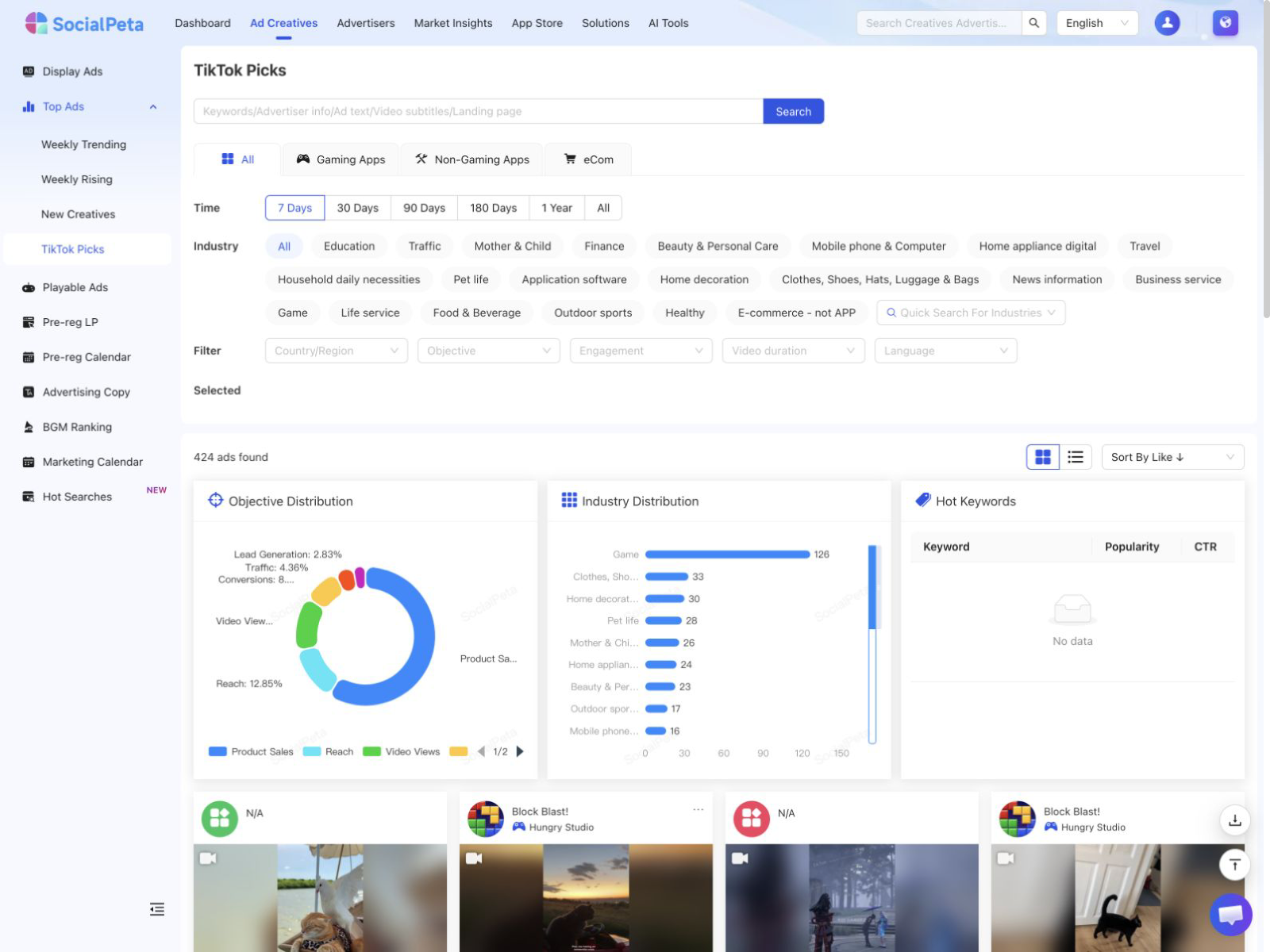
SocialPeta is the strongest fit in this guide for teams that need TikTok creative research beside other acquisition channels. Its dedicated TikTok Picks workflow supports keyword, advertiser, ad text, subtitle, and landing-page search, then narrows results by time, industry, country, objective, engagement, video duration, and language. The page separates gaming apps, non-gaming apps, and ecommerce research and adds distribution views for objectives, industries, and keywords. That structure helps an analyst build a matched set instead of mixing unrelated viral videos. SocialPeta publishes this guide, so compare it with the same advertiser list used for every vendor.
2. TikTok Creative Center
Best for: Free TikTok-native examples, trends, and selected Top Ads
TikTok Creative Center is the sensible free starting point. TikTok says its Top Ads dashboard includes high-performing creatives that advertisers have authorized for display. Filters include region, industry, campaign objective, and other creative dimensions. Detail views can show second-by-second, frame-level relative engagement, which is useful for studying where attention rises or falls. The selection rule is the limitation. A missing advertiser may still be active, and a featured ad does not reveal full spend, conversion quality, or profit. Use Creative Center to learn platform craft and confirm trends, not to reconstruct a complete competitor account.
3. PiPiADS
Best for: TikTok ads, products, advertisers, shops, and ecommerce research
PiPiADS is built around TikTok advertising and commerce, which makes it a natural choice for TikTok Shop sellers, dropshippers, and product researchers. The platform connects creatives with advertisers, products, shops, and engagement or activity signals. That can shorten the path from an ad to the offer behind it. The risk is treating popularity as profit. A frequently seen product may have high returns, expensive fulfillment, thin margin, or an exhausted angle. Test product records, country filters, shop identity, landing pages, and historical depth before relying on a ranking.
4. Minea
Best for: Comparing TikTok products with Meta, Pinterest, shops, and influencers
Minea fits ecommerce marketers who do not want TikTok research isolated from the rest of the store. It combines social ad discovery with product, shop, and influencer context across several channels. This is useful when the team needs to compare how the same product is positioned on TikTok and Meta. It is a weaker fit for app UA or B2B teams that care more about advertiser strategy than product sourcing. During a trial, follow one known product through creative, store, offer, and creator evidence, then check whether the record is current.
5. BigSpy
Best for: Cross-platform creative scanning with TikTok included
BigSpy is useful when a small team wants one general database for TikTok, Facebook, Instagram, YouTube, and other channels. It can produce a quick sample of hooks, formats, products, and advertisers. The research needs tighter controls than the feed suggests. Compare known TikTok ads with the original post or official sources, inspect date and country fields, and remove recycled creative before counting patterns. Buyers focused almost entirely on TikTok commerce should compare it directly with PiPiADS rather than assuming a broader database is deeper.
6. FastMoss
Best for: Products, shops, creators, livestreams, and commerce operations
FastMoss belongs on the list for TikTok Shop teams. Its center of gravity is product, shop, creator, and livestream research rather than ad creative alone. That makes it useful when a marketer wants to understand who is selling, which content and creators support the product, and how the commerce operation fits together. App marketers and non-commerce brands may find much of the platform irrelevant. Evaluate its regional coverage, product matching, creator history, export limits, and the connection between paid ads and organic or shop activity.
7. Kalodata
Best for: Sales-oriented product, creator, and shop research
Kalodata is another commerce-first option for TikTok Shop research. It helps sellers study products, shops, creators, videos, and sales-oriented signals. The value is not a prettier ad gallery. It is the ability to place an ad inside a product and creator ecosystem. Teams should ask how sales estimates are modeled, which markets are supported, and how returns or cancellations affect the picture. Use the tool to shortlist product and content questions, then verify inventory, margin, fulfillment, and customer response in systems you control.
8. PowerAdSpy
Best for: Searching TikTok and other channels by copy, advertiser, CTA, and destination
PowerAdSpy offers a familiar ad-search workflow across several social platforms. It is relevant for teams that want keyword, advertiser, creative, call-to-action, and landing-page filters without buying a TikTok-only product. The tradeoff is the usual one for a multi-network database: a platform logo does not tell you how deep or fresh the underlying records are. Use five known TikTok advertisers, one local brand, and a recent campaign to test playback, metadata, duplicate handling, and source links.
9. Foreplay
Best for: Saving TikTok references and turning them into team briefs
Foreplay addresses what happens after discovery. Creative teams can save references, follow competitors, organize boards, collaborate, and build briefs without losing the source in a folder of screen recordings. This becomes useful when TikTok research is a weekly production input. It does not replace a product-research platform or a market-intelligence dataset. Test whether the team can preserve captions, landing pages, dates, and a useful note about the hook, then hand the board to a creator without a separate cleanup step.
10. GetHookd
Best for: Finding and organizing short-form ad hooks for production
GetHookd is oriented toward creative teams that want to move quickly from competitor videos to hook ideas and production work. It can be useful when the bottleneck is reviewing a large number of short-form ads and extracting openings worth discussing. Automated analysis is only a first pass. It can miss tone, visual irony, creator credibility, or the relationship between the first line and the landing page. Keep the source video beside every generated note and rewrite the idea in the brand's own language.
How to analyze a TikTok competitor ad
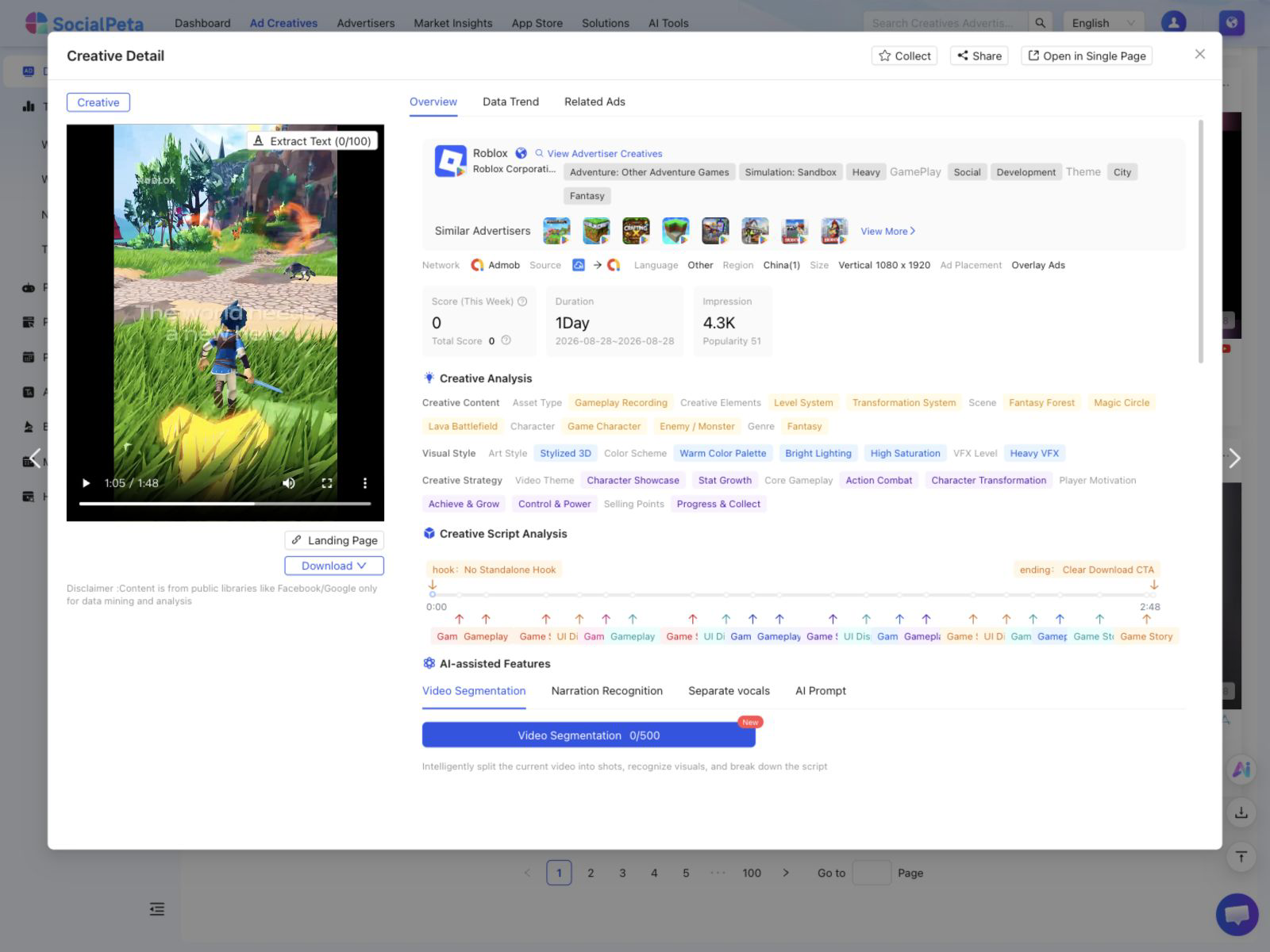
Start with the first frame, not the category label. TikTok ads often win or lose attention before the proposition is fully stated. Write down what appears on screen, what the viewer hears, and what action the creator performs in the first few seconds.
- Capture the spoken hook and on-screen hook separately. They may do different jobs.
- Identify the format: creator testimonial, demonstration, skit, before-and-after, comparison, reply, livestream clip, or product montage.
- Record the problem, promise, proof, objection handling, offer, and call to action.
- Mark changes in pace, framing, subtitles, sound, and scene at meaningful moments.
- Open the destination and check whether the product, claim, offer, and visual style continue after the click.
- Group repeated angles across several advertisers before writing an original hypothesis for your brand.
A public like count or a long observation period can help prioritize review. Neither proves paid efficiency. Organic distribution, audience size, campaign objective, targeting, spend, and post-click quality all affect the outcome.
A weekly TikTok competitor research routine
Keep the watchlist small enough to learn from. Ten direct competitors and five adjacent creators are often more useful than an unfiltered feed. Search the same markets, languages, and time window every week.
- Check TikTok Creative Center for platform-native examples and current creative techniques.
- Run saved searches in the paid tool and note genuinely new videos, hooks, products, or objectives.
- Separate paid ads, organic creator content, shop videos, and livestream clips. Do not treat them as one dataset.
- Choose three ads for full breakdown and preserve the source, date, market, destination, and transcript.
- Write one or two original tests with a reason, audience, primary variable, and success metric.
- Review the test with first-party campaign and conversion data before keeping the pattern.
Browse the public SocialPeta Ad Library and filter for TikTok to build a quick sample, then use the broader ad spy tool workflow when research needs filters, advertiser context, and channel comparison. The best ad spy tools guide covers alternatives outside TikTok.
Frequently asked questions
What is the best TikTok ad spy tool for competitor research?
SocialPeta is the best fit in this guide for structured TikTok creative research across apps, games, and ecommerce. PiPiADS is more specialized for TikTok commerce, Minea connects ads with ecommerce product research, and Foreplay is better for creative organization. TikTok Creative Center is the best free starting point.
Is TikTok Creative Center a complete TikTok ads library?
No. TikTok says Top Ads contains high-performing ads that advertisers authorized for display in Creative Center. It is useful for platform-native examples and frame-level engagement analysis, but it is not a complete archive of every competitor campaign.
Can TikTok ad spy tools identify winning products?
They can surface products, shops, ads, engagement, run duration, and other public or modeled signals. Those signals do not prove profit, available inventory, refund rates, fulfillment quality, attribution, or durable demand. Validate the product with first-party tests and unit economics.
What should I analyze in a TikTok competitor ad?
Record the first frame, spoken and on-screen hook, creator style, problem setup, demonstration, proof, offer, sound, pacing, duration, call to action, and landing-page match. Compare ads from the same market and period instead of mixing unrelated audiences.
How often should a team research TikTok competitor ads?
A weekly review is practical for active creative teams. Use a fixed competitor set and saved filters, then log new hooks, repeated offers, format shifts, and ads that persist. A monthly synthesis can turn those observations into original test briefs without chasing every short-lived trend.
Which TikTok ad spy tool should you choose?
Use TikTok Creative Center if you need free creative inspiration and selected performance context. Choose SocialPeta for structured TikTok research across app, game, ecommerce, and other acquisition channels. PiPiADS is the focused commerce option. FastMoss and Kalodata serve TikTok Shop operations, while Minea is useful when products travel across several social platforms. Foreplay fits teams whose biggest problem is research organization.
The paid tool should produce a source-backed test brief faster than the free workflow. If it cannot, keep the subscription budget for production and testing.