
Ad Tech Explained: The Systems Behind Digital Advertising
Ad tech connects media buyers with publishers, moves campaign decisions through automated systems, serves the creative, and records what happened. This guide maps the stack without treating every platform or metric as interchangeable.
What is ad tech?
Ad tech, short for advertising technology, is the software, technical standards, and operating infrastructure used to buy, sell, deliver, verify, and measure advertising. It connects an advertiser's campaign with available media on websites, apps, streaming services, retail media, and other digital environments.
Transact
Set budgets, expose inventory, evaluate opportunities, and complete direct or auction-based media purchases.
Deliver
Select an eligible creative, serve it into the placement, and enforce format, frequency, and policy controls.
Account
Record delivery, viewability, clicks, conversions, cost, quality signals, and the limits of the available data.
Ad tech is broader than programmatic advertising. A directly sold sponsorship can still use an ad server, creative approval, verification, and reporting tools. Programmatic describes an automated buying method inside the wider technology system.
The ad tech ecosystem
The ecosystem is easier to understand by asking who controls the budget, who controls the inventory, and which system performs each decision. One company may provide several functions, but the roles remain distinct.
| Role or system | Primary job | Decision it controls |
|---|---|---|
| Advertiser and agency | Define the campaign outcome, audience, creative, budget, and acceptable inventory. | What to buy and what success means |
| Demand-side platform (DSP) | Evaluate available impressions and execute buying rules across connected supply. | Whether and how much to bid |
| Ad exchange | Connect eligible demand and supply for automated transactions. | Which transaction clears under the auction or deal rules |
| Supply-side platform (SSP) | Package publisher inventory, apply controls, and connect it with buyers. | Which demand may compete for the placement |
| Publisher and ad server | Create inventory, prioritize eligible campaigns, and render the selected ad. | What can serve in a specific placement |
| Data, consent, and identity services | Collect or communicate permitted audience, privacy, and matching signals. | Which signals may lawfully and technically be used |
| Measurement and verification | Assess delivery, outcomes, invalid traffic, viewability, and brand suitability. | Whether the result meets the agreed quality definition |
An ad exchange is therefore not a synonym for a DSP or SSP. It is the transaction layer between buying and selling systems, although commercial platforms can combine these roles.
How a programmatic ad transaction works
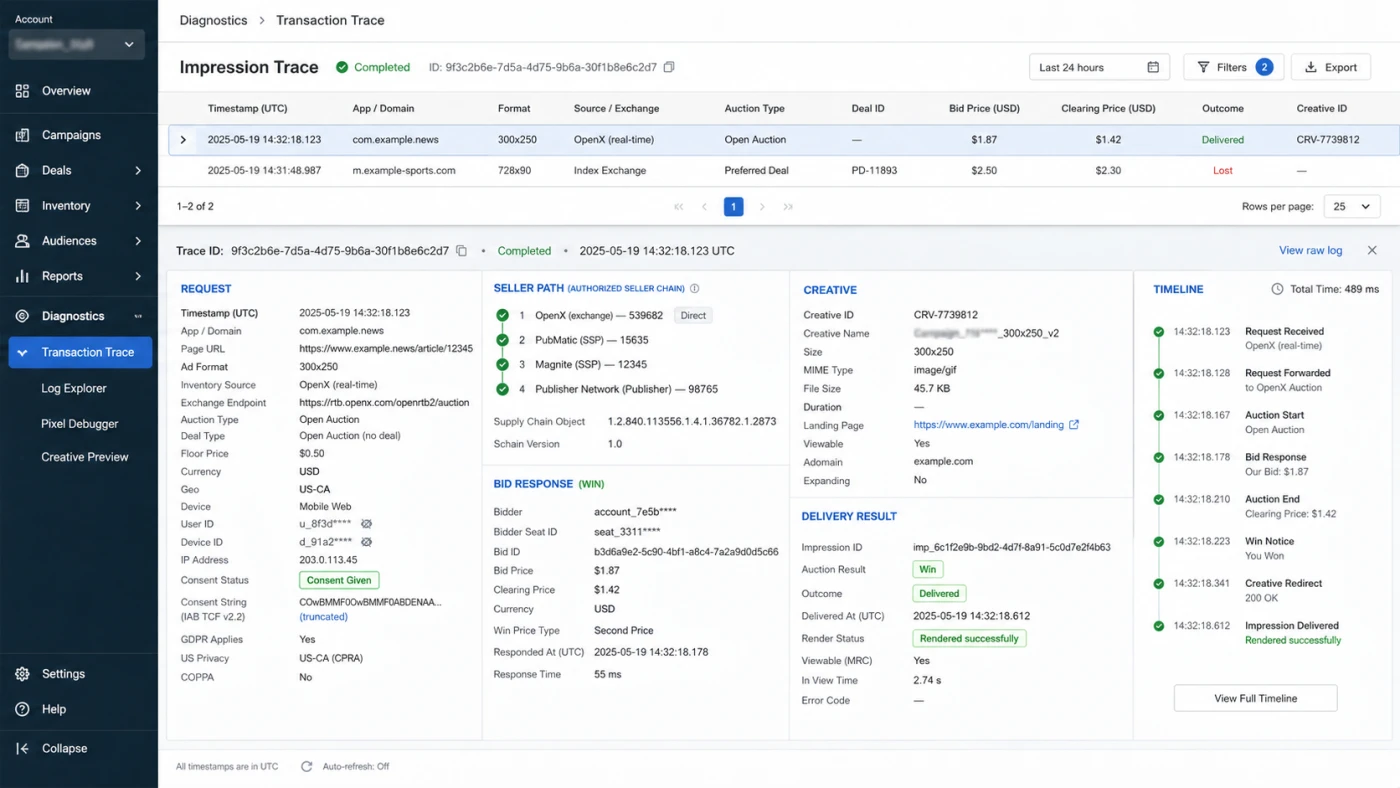
A programmatic transaction is a sequence of eligibility and pricing decisions, not simply a contest for the highest headline bid. Deal terms, format compatibility, privacy signals, publisher rules, and creative approval can determine which demand is allowed to compete.
- 01
Opportunity
A page, app, or stream creates an ad opportunity with placement, format, content, device, and permitted signal fields.
- 02
Supply path
The publisher ad server or SSP applies inventory controls and sends the opportunity through one or more authorized selling paths.
- 03
Evaluation
A DSP compares the request with campaign eligibility, pacing, frequency, prediction, deal, and price rules.
- 04
Selection
The exchange and supply systems apply auction or deal logic, then return an eligible winning response.
- 05
Delivery
The ad server renders the approved creative and records delivery events. Independent services may also evaluate quality.
- 06
Outcome
Exposure and interaction data are reconciled with conversions or business results according to the chosen attribution method.
IAB Tech Lab's OpenRTB 2.6 specification defines a common request and response model for real-time transactions, including site, app, device, impression, deal, bid, price, and creative fields. It does not promise a universal auction duration or business rule, so the legacy claim that every RTB trade completes within a fixed number of milliseconds has been removed.
Ad tech vs. MarTech
Ad tech and marketing technology can exchange data, but they solve different operating problems. The useful distinction is not whether a tool uses customer data. It is whether the tool primarily manages paid media inventory or the company's broader customer and marketing workflow.
Ad tech
Paid media execution
Buying and selling inventory, bidding, campaign serving, frequency, creative delivery, verification, media cost, and advertising attribution.
MarTech
Owned customer workflow
CRM, email, lifecycle messaging, content, automation, lead management, customer analytics, and owned-channel experiences.
A conversion API or customer data platform may sit at the boundary. Define data ownership, permitted use, identifiers, retention, and reconciliation rules before connecting the systems. A technical connection does not create permission to repurpose data.
What changed in ad tech in 2025 and 2026
Planning around a single forecast for third-party identifiers is no longer credible. Platform policies, user choices, regulation, and browser implementation now produce different signal conditions by environment. A resilient stack has to work when user-level matching is available and when it is not.
Chrome changed direction
Google first kept Chrome's existing user choice for third-party cookies, then announced in October 2025 that it would retire most Privacy Sandbox advertising technologies, including Topics, Protected Audience, and Attribution Reporting.
Mobile permission remains explicit
Apple requires ATT permission when app data is linked with data from other companies for cross-app or cross-site targeting or measurement. App teams are also responsible for third-party SDK behavior and may not replace denied permission with fingerprinting.
Interoperability matters more
Teams need first-party measurement, contextual inputs, aggregated reporting, experiments, and transparent supply paths that do not depend on one proposed replacement identifier.
Current platform references: Google's October 2025 Privacy Sandbox update and Apple's user privacy and data-use guidance.
How to choose an ad tech stack
Start with decisions and evidence, not a vendor checklist. A smaller stack with clear ownership can outperform a larger collection of overlapping tools that report different numbers and cannot explain their supply paths.
- 01
Define the job
State the business outcome, inventory types, buying methods, markets, optimization window, and decisions the system must support.
- 02
Map permitted signals
Document which first-party, contextual, device, consent, and platform signals exist in each environment. Do not assume the web and mobile app have the same permissions.
- 03
Design measurement first
Choose event definitions, attribution rules, experiment design, source of truth, data retention, and reconciliation tolerances before launch.
- 04
Audit interoperability
Check APIs, log-level exports, naming conventions, creative IDs, consent propagation, deduplication, and whether data remains portable if a vendor changes.
- 05
Inspect supply and fees
Identify direct and reseller paths, exchange and platform fees, auction mechanics, invalid-traffic controls, and inventory exclusions.
- 06
Pilot with a decision rule
Test a bounded market or campaign against a baseline. Decide in advance which quality, cost, incrementality, and operational thresholds justify expansion.
Competitive research can inform creative and placement hypotheses before media is purchased. Use an ad intelligence platform to study observable market activity, then validate the hypothesis in your own delivery and outcome data.
Measurement and quality checks
A dashboard metric is useful only when its event definition, denominator, attribution window, and exclusions are known. Compare delivery, quality, and business outcomes as separate layers before deciding that a campaign or platform worked.
Delivery
Eligible requests, bids, wins, served impressions, reach, frequency, pacing, and spend explain whether the system executed as intended.
Media quality
Viewability, invalid traffic, brand suitability, placement, and supply-path checks test whether the purchased opportunity met its quality definition.
Response
Clicks, completed views, site or app events, and conversion rates describe observed behavior, not necessarily incremental impact.
Business outcome
Incremental conversions, revenue, margin, retention, or qualified leads connect media activity with the result the organization values.
An ad impression is a delivery event, not proof that a person paid attention or that the ad caused a conversion. Connect impression reporting to a documented attribution model and use controlled experiments when the decision requires a causal answer.
Common risks and mistakes
The most expensive failures are often not bidding errors. They are unclear data rights, opaque reselling, inconsistent event logic, unsafe creative, and optimization toward a proxy that does not represent business value.
Treating consent as a UI layer
Consent and platform permission must control collection, sharing, targeting, and measurement behavior downstream. Recording a choice without enforcing it is not a working privacy design.
Trusting an opaque supply path
Unauthorized or unnecessarily indirect inventory paths can add fees and make quality harder to inspect. Validate seller authorization and intermediary identity.
Optimizing one platform's conversion count
A platform can be internally consistent while using a different window or credit rule from the business source of truth. Reconcile and test incrementality.
Buying tools before defining ownership
Every integration needs an owner for taxonomy, consent, QA, incident response, vendor changes, and data retention. Otherwise the stack degrades after launch.
Equating personalization with permission
The technical ability to join identifiers does not establish a lawful basis or platform permission. Minimize data and document each purpose.
Supply transparency references: IAB Tech Lab's ads.txt and app-ads.txt guidance and sellers.json and SupplyChain documentation. The European Commission's GDPR principles overview explains purpose limitation, data minimization, storage limitation, and data protection by default.
Ad tech FAQ
What does ad tech mean?
Ad tech means the software, standards, and operational systems used to buy, sell, deliver, verify, and measure advertising. It includes tools such as ad servers, demand-side platforms, supply-side platforms, exchanges, consent systems, and measurement services.
What is the difference between ad tech and MarTech?
Ad tech primarily manages paid media transactions and delivery across advertising inventory. MarTech manages a company's broader marketing operations and known customer relationships, including CRM, email, content, automation, and lifecycle messaging. The systems may share data, but their operating roles are different.
Is programmatic advertising the same as ad tech?
No. Programmatic advertising is one part of ad tech. It automates media buying and selling through rules, direct programmatic deals, or auctions. Ad tech also includes direct campaign serving, creative management, consent, verification, attribution, analytics, and publisher monetization systems.
Do all programmatic ads use real-time bidding?
No. Real-time bidding is an auction for an individual opportunity, but programmatic also includes automated guaranteed and preferred deals with negotiated terms. The buying method should be identified separately from the software used to execute it.
How should a company choose an ad tech stack?
Start with the business outcome, inventory types, markets, privacy obligations, and measurement design. Then compare platforms on signal access, interoperability, supply transparency, controls, reporting quality, total fees, data portability, and the operational work required to keep integrations accurate.