
10 Best App Marketing Intelligence Tools in 2026
A job-based comparison for app-market estimates, competitor research, ASO, ad creatives, reviews, mobile games, and cross-platform growth planning.
The short answer
Choose SocialPeta when app-market research needs to connect with competitor ads and advertisers. Sensor Tower fits broad enterprise market intelligence, AppMagic fits mobile-game product and LiveOps research, AppTweak and MobileAction fit ASO-led growth, and AppFollow fits review operations. None of them replaces your MMP or product analytics.
Best app marketing intelligence tools: Quick picks
- Best for app intelligence plus ad creatives: SocialPeta
- Best for enterprise market breadth: Sensor Tower
- Best for mobile game strategy and LiveOps: AppMagic
- Best ASO-led market workflow: AppTweak
- Best for ASO plus Apple Ads: MobileAction
- Best for reviews and reputation operations: AppFollow
- Best for apps plus web context: Similarweb
This list is ordered for teams comparing external market and competitor data. A developer who mainly needs store reviews will rank it differently from a publisher deciding which game genre to enter. Start with the decision, then choose the dataset.
What app marketing intelligence includes, and what it does not
App marketing intelligence studies the market outside your own account. Typical questions include which apps or publishers are growing, how category share is moving, where rankings changed, what competitors advertise, which keywords and store assets they use, and how users rate their experience. The data may combine observed store records with modeled downloads, revenue, usage, audience, or advertising signals.
Three neighboring categories are easy to confuse. ASO software focuses on store discovery and conversion, including keywords, metadata, rankings, creatives, and reviews. Product analytics measures behavior inside your app, such as onboarding, feature adoption, and retention. A mobile measurement partner attributes installs and downstream events to your campaigns. Some vendors connect these jobs, but the underlying evidence remains different.
A competitive platform can suggest that a rival gained downloads after a launch, ranking change, LiveOps event, or advertising push. It cannot see the rival's full attribution, unit economics, or product funnel. Your own analytics remains the source of truth for your users. Market intelligence adds context and helps decide where to investigate.
How we evaluated these tools
We reviewed current search results and official product documentation, then organized the shortlist around recurring app-growth decisions. We favored tools that offer a distinct working advantage rather than another generic dashboard.
- Market coverage: stores, countries, categories, apps, publishers, history, and meaningful regional depth.
- Metric transparency: clear definitions for downloads, revenue, active users, engagement, keywords, reviews, and ad signals.
- Competitive workflow: comparable sets, saved competitors, trends, alerts, segment analysis, and source-level evidence.
- Marketing usefulness: a path from market observation to ASO, creative, media, reputation, or launch action.
- Operational fit: exports, APIs, team permissions, reporting, support, and a contract that matches who will use it.
We do not use a weighted score because it would hide the main tradeoff. A deep review-management product should not lose points for lacking LiveOps analysis, and a market-sizing platform should not win simply because it has more modules. SocialPeta publishes this guide and its inclusion is disclosed.
The 10 best app marketing intelligence tools compared
| Tool | Best for | Main scope | Watch for |
|---|---|---|---|
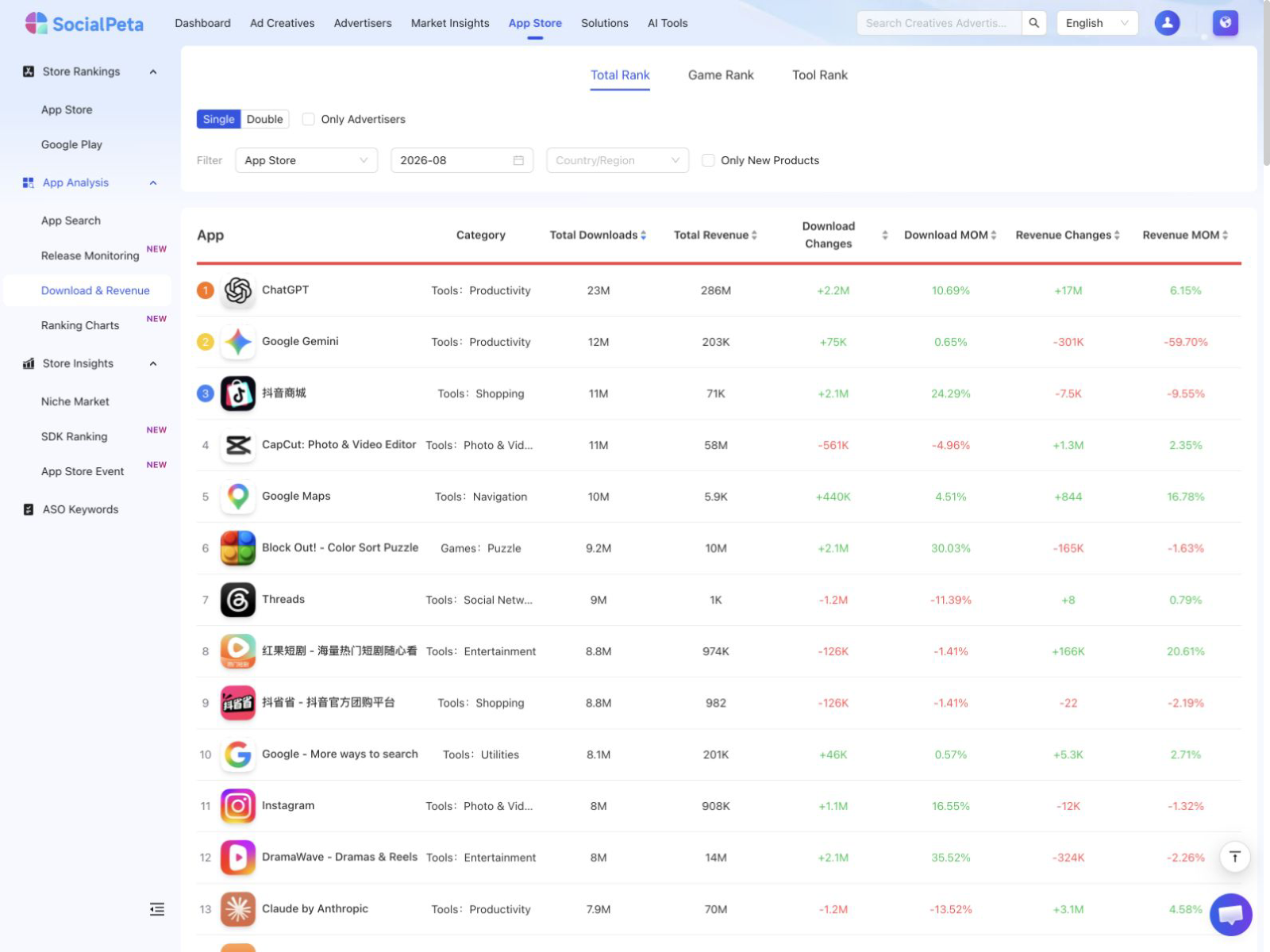
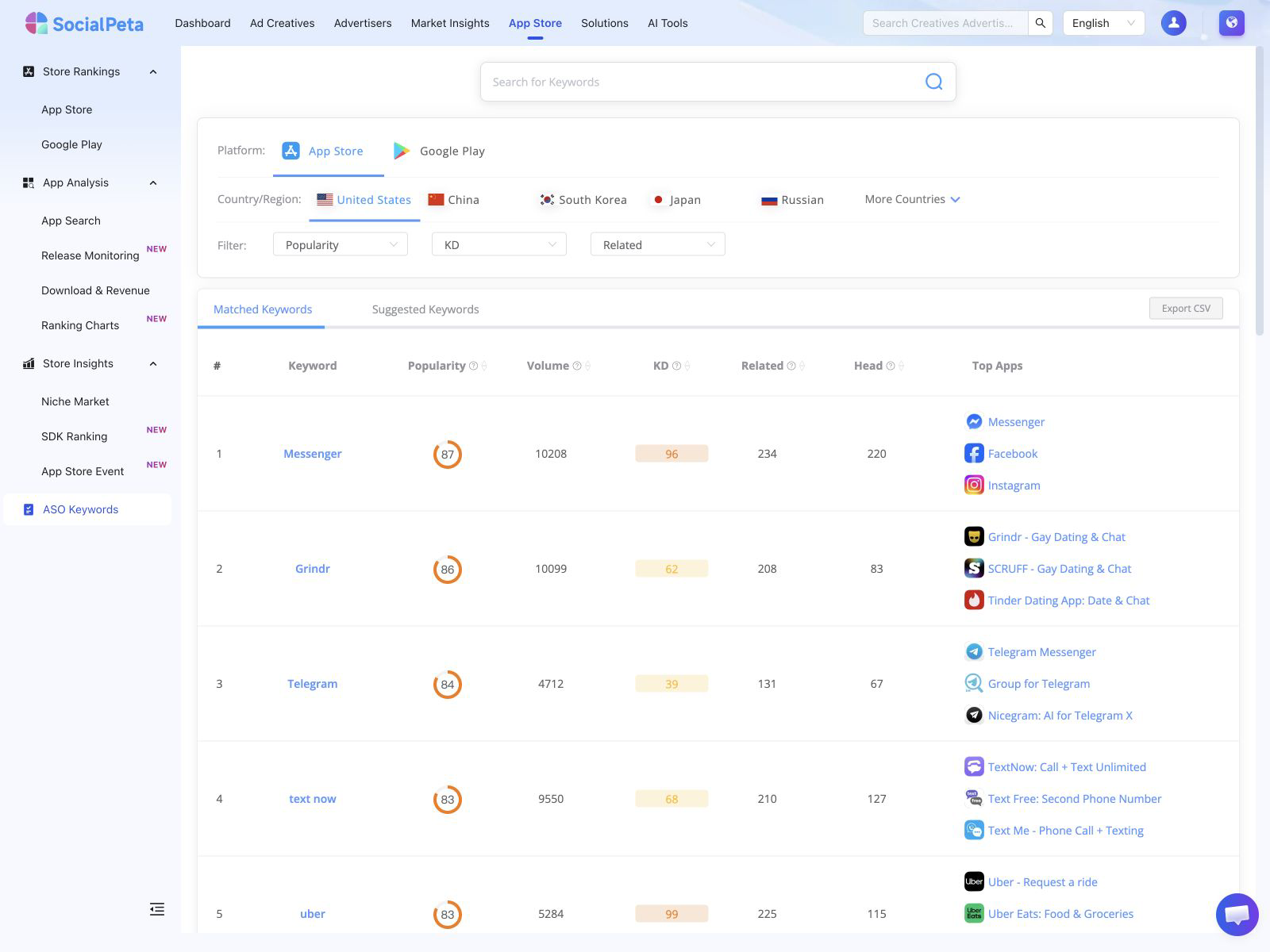
| 1. SocialPeta | Connecting app-market signals with ad creatives and advertisers | App search and detail, rankings, downloads and revenue estimates, ASO keywords, releases, store events, SDKs, market segments, and advertising context | Our product. Confirm the specific stores, markets, networks, history, and exports in your plan. |
| 2. Sensor Tower | Enterprise digital market and app portfolio intelligence | Downloads and revenue estimates, publishers, categories, engagement, retention, audience and broader digital-market products | Broad scope and enterprise packaging require a tightly defined use case. |
| 3. AppMagic | Mobile game genres, products, monetization, and LiveOps | Game taxonomy, apps and publishers, downloads and revenue, Ad Intelligence, LiveOps, IAP, retention and active-user signals where available | Teams centered on non-game ASO or review operations may prefer a different workflow. |
| 4. AppTweak | ASO-led market and competitor research | Keywords, metadata, creatives, rankings, reviews, downloads and revenue estimates, market and Apple Ads intelligence | Check which intelligence and automation modules are included in the quote. |
| 5. MobileAction | ASO and Apple Ads workflows | Keyword and competitor research, app profiles, store visibility, reviews, ad intelligence, and Apple Ads optimization | Its value is highest for teams that will use the store and Apple Ads workflow regularly. |
| 6. Appfigures | Accessible app research, monitoring, and developer workflows | Downloads and revenue estimates, ranks, reviews, keywords, competitors, SDKs, audience, reporting, and APIs | Depth varies by feature and plan, so test the exact export or API you need. |
| 7. Similarweb App Intelligence | App engagement connected with web-market context | App performance, usage, engagement, retention, reviews, audience, and cross-platform digital behavior | Confirm store, country, device, and historical coverage for your market. |
| 8. Apptica | Mobile app market and advertising intelligence | Store performance, downloads and revenue estimates, competitors, usage, advertising, and market trends | Regional app and ad-network coverage should be tested with known examples. |
| 9. AppFollow | Review management, ratings, and ASO operations | Review monitoring and replies, ratings, sentiment, competitors, metadata and keyword workflows | It is less centered on ad creative or broad market sizing. |
| 10. App Radar by SplitMetrics | ASO execution for growing app teams | Keyword research and tracking, metadata, competitor monitoring, store optimization, reviews, and performance reporting | Market-intelligence depth depends on plan and is narrower than enterprise suites. |
Detailed reviews: Where each platform fits
1. SocialPeta
Best for: Connecting app-market signals with ad creatives and advertisers
App search and detail, rankings, downloads and revenue estimates, ASO keywords, releases, store events, SDKs, market segments, and advertising context. Our product. Confirm the specific stores, markets, networks, history, and exports in your plan.
SocialPeta is useful when the research must connect an app's store and market movement with its advertising behavior. Teams can move among app search, rankings, estimated downloads and revenue, releases, ASO keywords, market segments, advertisers, creatives, channels, and countries. That joined workflow suits UA, creative, publishing, and agency teams. It also reduces the temptation to explain growth from a single chart. The caveat is ownership: SocialPeta publishes this article, so buyers should verify coverage with known apps and compare the same task elsewhere.
2. Sensor Tower
Best for: Enterprise digital market and app portfolio intelligence
Downloads and revenue estimates, publishers, categories, engagement, retention, audience and broader digital-market products. Broad scope and enterprise packaging require a tightly defined use case.
Sensor Tower has the broadest enterprise position in this shortlist, spanning store intelligence and additional products for audience, usage, advertising, and digital markets. It makes sense for research, strategy, investment, and global portfolio teams that need standardized reporting across many apps and countries. Breadth can add cost and procurement complexity. Define the recurring decisions and licensed modules before evaluating a polished demonstration.
See our full SocialPeta versus Sensor Tower comparison.
3. AppMagic
Best for: Mobile game genres, products, monetization, and LiveOps
Game taxonomy, apps and publishers, downloads and revenue, Ad Intelligence, LiveOps, IAP, retention and active-user signals where available. Teams centered on non-game ASO or review operations may prefer a different workflow.
AppMagic is especially strong for mobile-game market structure. Detailed genre classification, publisher research, Ad Intelligence, LiveOps analysis, IAP research, and app estimates let a team study the product and business model behind growth. It is a natural fit for studios, publishers, investors, and game designers. Its acquisition by Sensor Tower in 2026 also makes current packaging and roadmap questions worth raising during procurement.
See our full SocialPeta versus AppMagic comparison.
4. AppTweak
Best for: ASO-led market and competitor research
Keywords, metadata, creatives, rankings, reviews, downloads and revenue estimates, market and Apple Ads intelligence. Check which intelligence and automation modules are included in the quote.
AppTweak places ASO at the center. Keyword research, metadata, store creatives, rankings, competitor monitoring, reviews, market intelligence, and Apple Ads workflows support teams responsible for discoverability and conversion in the stores. It is a good choice when market data needs to end in an ASO action. Confirm which market-intelligence features, automations, countries, and user seats are included.
5. MobileAction
Best for: ASO and Apple Ads workflows
Keyword and competitor research, app profiles, store visibility, reviews, ad intelligence, and Apple Ads optimization. Its value is highest for teams that will use the store and Apple Ads workflow regularly.
MobileAction also serves ASO-led teams, with strong relevance for Apple Ads operations. App profiles, keyword and competitor research, reviews, paid visibility, and ad intelligence can support an integrated store-growth process. Teams should test how easily an insight becomes a keyword, campaign, or metadata decision, and whether Android and non-US market coverage meets their needs.
6. Appfigures
Best for: Accessible app research, monitoring, and developer workflows
Downloads and revenue estimates, ranks, reviews, keywords, competitors, SDKs, audience, reporting, and APIs. Depth varies by feature and plan, so test the exact export or API you need.
This platform earns its place through a specific balance of market data and operating workflow. Test it with a known app, a smaller regional competitor, a category change, and one export your team already produces manually. The practical questions are coverage, definitions, time saved, and whether another analyst can reproduce the conclusion.
7. Similarweb App Intelligence
Best for: App engagement connected with web-market context
App performance, usage, engagement, retention, reviews, audience, and cross-platform digital behavior. Confirm store, country, device, and historical coverage for your market.
This platform earns its place through a specific balance of market data and operating workflow. Test it with a known app, a smaller regional competitor, a category change, and one export your team already produces manually. The practical questions are coverage, definitions, time saved, and whether another analyst can reproduce the conclusion.
8. Apptica
Best for: Mobile app market and advertising intelligence
Store performance, downloads and revenue estimates, competitors, usage, advertising, and market trends. Regional app and ad-network coverage should be tested with known examples.
This platform earns its place through a specific balance of market data and operating workflow. Test it with a known app, a smaller regional competitor, a category change, and one export your team already produces manually. The practical questions are coverage, definitions, time saved, and whether another analyst can reproduce the conclusion.
9. AppFollow
Best for: Review management, ratings, and ASO operations
Review monitoring and replies, ratings, sentiment, competitors, metadata and keyword workflows. It is less centered on ad creative or broad market sizing.
AppFollow is the clearest specialist for review operations. It helps teams monitor feedback, ratings, sentiment, competitors, and store performance, then route or answer reviews at scale. That work affects reputation, support, product discovery, and store conversion. It is not the primary choice for ad creative research or top-down market sizing, which is exactly why it belongs as a distinct option rather than a weaker copy of an enterprise suite.
10. App Radar by SplitMetrics
Best for: ASO execution for growing app teams
Keyword research and tracking, metadata, competitor monitoring, store optimization, reviews, and performance reporting. Market-intelligence depth depends on plan and is narrower than enterprise suites.
This platform earns its place through a specific balance of market data and operating workflow. Test it with a known app, a smaller regional competitor, a category change, and one export your team already produces manually. The practical questions are coverage, definitions, time saved, and whether another analyst can reproduce the conclusion.
How to use download, revenue, and engagement estimates responsibly
Third-party app intelligence relies on models because Apple and Google do not publish every competitor's complete commercial performance. Estimates can be useful for direction, relative scale, seasonality, category shares, and sudden changes. They are not audited statements. Two vendors can disagree while still showing the same broad trend.
Revenue definitions deserve special care. Ask whether the estimate covers consumer spend, net or gross revenue, in-app purchases, subscriptions, advertising revenue, taxes, refunds, and store fees. Many market products focus on store revenue and exclude advertising or commerce conducted elsewhere. A free app with a large ad business may therefore look small in a store-revenue ranking.
Keep a short evidence label beside every chart: observed store record, vendor estimate, first-party measurement, company disclosure, or analyst inference. Use ranges when precision is not defensible. For a board or investment decision, cross-check with company filings, press releases, rankings, ad activity, web traffic, and your own category knowledge.
Recommended tool stacks by team
A mobile UA and creative team can use SocialPeta as the external competitor layer, platform libraries for verification, an MMP for attribution, and product analytics for downstream quality. The important handoff is from competitor observation to an original test brief.
A game publisher or strategy team may start with AppMagic for genre, product, LiveOps, and monetization research, then add SocialPeta when creative and advertiser analysis is a recurring job. One product can be enough if the other question appears only occasionally.
An ASO team should prioritize AppTweak, MobileAction, or App Radar based on keyword markets, workflow, Apple Ads needs, reporting, and seats. Add AppFollow when review volume and response operations require dedicated ownership.
An enterprise market research group can evaluate Sensor Tower, Similarweb, and Apptica with a matched set of countries and smaller apps. Do not judge only on flagship coverage. Regional depth and reproducible exports usually decide whether the dataset works at scale.
A proof-of-work test before you buy
Give every vendor the same brief. Choose one market you know, two established competitors, one smaller local app, and a recent event such as a launch, ranking shift, major update, or advertising push.
- Size the category for one store, country, and 12-month period, with metric definitions attached.
- Explain the recent change using at least two independent signals, such as rankings plus ads or reviews plus release history.
- Find the competitors' keyword, creative, review, or market pattern that would change a real decision.
- Export a chart and source table that another analyst can reproduce.
- Document unavailable markets, excluded revenue, modeled fields, API limits, seat rules, and modules outside the quote.
Score the output on decision value, evidence clarity, coverage, workflow time, and total cost. A huge database that cannot explain your regional competitors is less useful than a narrower product your team trusts and uses every week.
Frequently asked questions
What is the best app marketing intelligence tool in 2026?
The answer depends on the decision. SocialPeta is strong when app-market research must connect to ad creatives and advertisers, Sensor Tower for broad enterprise digital market intelligence, AppMagic for mobile game and LiveOps research, AppTweak or MobileAction for ASO-led workflows, and AppFollow for review operations and store reputation.
What is app marketing intelligence?
App marketing intelligence uses observable and modeled market data to study competitors, categories, downloads, revenue, rankings, keywords, reviews, ads, publishers, and market movement. It supports decisions before and around campaign execution. It does not replace first-party product analytics or attribution.
Are app download and revenue estimates accurate?
They are directional estimates, not audited financial statements. Results vary by store, country, category, business model, and vendor methodology. Compare trends and relative movement, request methodology notes, and validate important conclusions against public disclosures and your own data where possible.
Is an ASO tool the same as an app intelligence platform?
No. ASO tools focus on store discovery and conversion, including keywords, metadata, rankings, creatives, and reviews. App intelligence platforms usually add market size, publisher and category analysis, estimated downloads and revenue, engagement, advertising, or audience signals. Some products cover both categories.
Can app intelligence replace an MMP or product analytics tool?
No. An MMP measures attribution across your campaigns, while product analytics measures behavior inside your app. Competitive intelligence estimates what is happening outside your account. A mature team may use all three, with clear rules about which source answers each question.
Final verdict
SocialPeta is the strongest starting point for readers who want app-market intelligence tied directly to advertising and creative research. Sensor Tower suits broad enterprise portfolios, AppMagic suits mobile-game strategy, AppTweak and MobileAction suit ASO-led teams, and AppFollow suits review operations.
There is no reason to buy every category. Map each recurring decision to one source of external intelligence, one source of first-party truth, and one owner. Then run a matched trial. The best platform will make the evidence clearer and the next action easier.