
10 Best Facebook Ad Spy Tools in 2026
The right Facebook ad spy tool depends on the job: official verification, historical search, ecommerce product research, competitor monitoring, or a cleaner handoff from research to creative briefing.
The short answer
Start with Meta Ad Library for a free first-party check. Choose SocialPeta for structured cross-market creative and advertiser research, AdSpy for a Meta-focused archive, Minea for ecommerce products, Foreplay for swipe files and briefs, or Atria for ongoing competitor monitoring.
Best Facebook ad spy tools: Quick picks
- Best overall for structured Meta research: SocialPeta
- Best free first-party source: Meta Ad Library
- Best Meta-focused historical search: AdSpy
- Best for ecommerce product discovery: Minea
- Best for creative organization: Foreplay
- Best for recurring competitor monitoring: Atria
These products are not interchangeable. Meta Ad Library is an official transparency source. AdSpy and AdHeart are searchable creative archives. Minea follows a commerce research job. Foreplay and Atria organize repeated creative work. Pick the category before comparing feature lists.
Four types of Facebook ad spy tools
Official verification. Meta Ad Library shows ads from the platform itself and is the right place to confirm a Page and current creative. It has fewer workflow controls than a specialist product.
Historical creative search. SocialPeta, AdSpy, BigSpy, PowerAdSpy, and AdHeart collect and index observed ads. They add filters, history, related records, and cross-platform context, but collection is never identical to a competitor's private account.
Commerce and funnel research. Minea and AdPlexity connect the creative to products, stores, offers, or landing-page paths. That helps performance teams answer what happens after the click.
Creative operations. Foreplay and Atria reduce the work of saving ads, monitoring brands, grouping patterns, and writing briefs. They become useful when the same research happens every week.
How we evaluated the tools
We reviewed the current organic results, official product material, Meta documentation, and recent practitioner discussions. Most ranking pages repeat vendor database counts and monthly prices. Those numbers age quickly and say little about whether the tool can answer a real brief.
We looked instead at platform fit, country and format filters, advertiser identity, historical context, duplicate handling, source traceability, landing-page continuity, saved research, export quality, and collaboration. We also checked whether each tool has a distinct role. A second swipe-file product did not earn a place simply because it had a different interface.
No numeric scores appear here. A Meta-only affiliate researcher and a mobile game UA team should not rank the same product equally. SocialPeta is our product and appears first because it matches this site's cross-market audience. The disclosure lets readers apply the same proof-of-work test to every vendor.
The 10 Facebook ad spy tools compared
| Tool | Type | Best for | Watch for |
|---|---|---|---|
| 1. SocialPeta | Creative and advertiser intelligence | Structured Facebook research across apps, games, and markets | Test the exact advertisers and countries in your weekly brief |
| 2. Meta Ad Library | Official first-party library | Free verification of ads currently running across Meta technologies | Commercial-ad history and fields vary by region and category |
| 3. AdSpy | Meta-focused historical search | Detailed Facebook and Instagram creative filtering | Its specialist scope is less useful for teams centered on other channels |
| 4. BigSpy | Multi-platform ad database | Broad creative discovery across Meta and other social platforms | Breadth can create noise and uneven depth between channels |
| 5. Minea | Ecommerce product and ad research | Connecting Meta creatives with products, stores, and commerce signals | Its ecommerce lens adds little for many app, B2B, and brand teams |
| 6. Foreplay | Creative workflow and swipe files | Saving competitor ads and turning references into briefs | It is a workflow product, not a market-spend intelligence system |
| 7. AdPlexity Social | Performance and affiliate intelligence | Meta funnels, landing pages, offers, and affiliate research | The workflow is specialized and pricing may exceed casual research needs |
| 8. PowerAdSpy | Multi-network social ad search | Keyword, advertiser, CTA, and landing-page searches on a budget | Result quality and useful features vary by platform and plan |
| 9. AdHeart | Meta creative database | Fast Facebook and Instagram inspiration searches | Confirm history, exports, and collaboration features before buying |
| 10. Atria | Competitor tracking and creative strategy | Monitoring named brands and organizing Meta creative patterns | It is closer to a creative-operations layer than a raw global archive |
Detailed reviews: Which Facebook ad spy tool fits?
1. SocialPeta
Best for: Structured Facebook research across apps, games, and markets
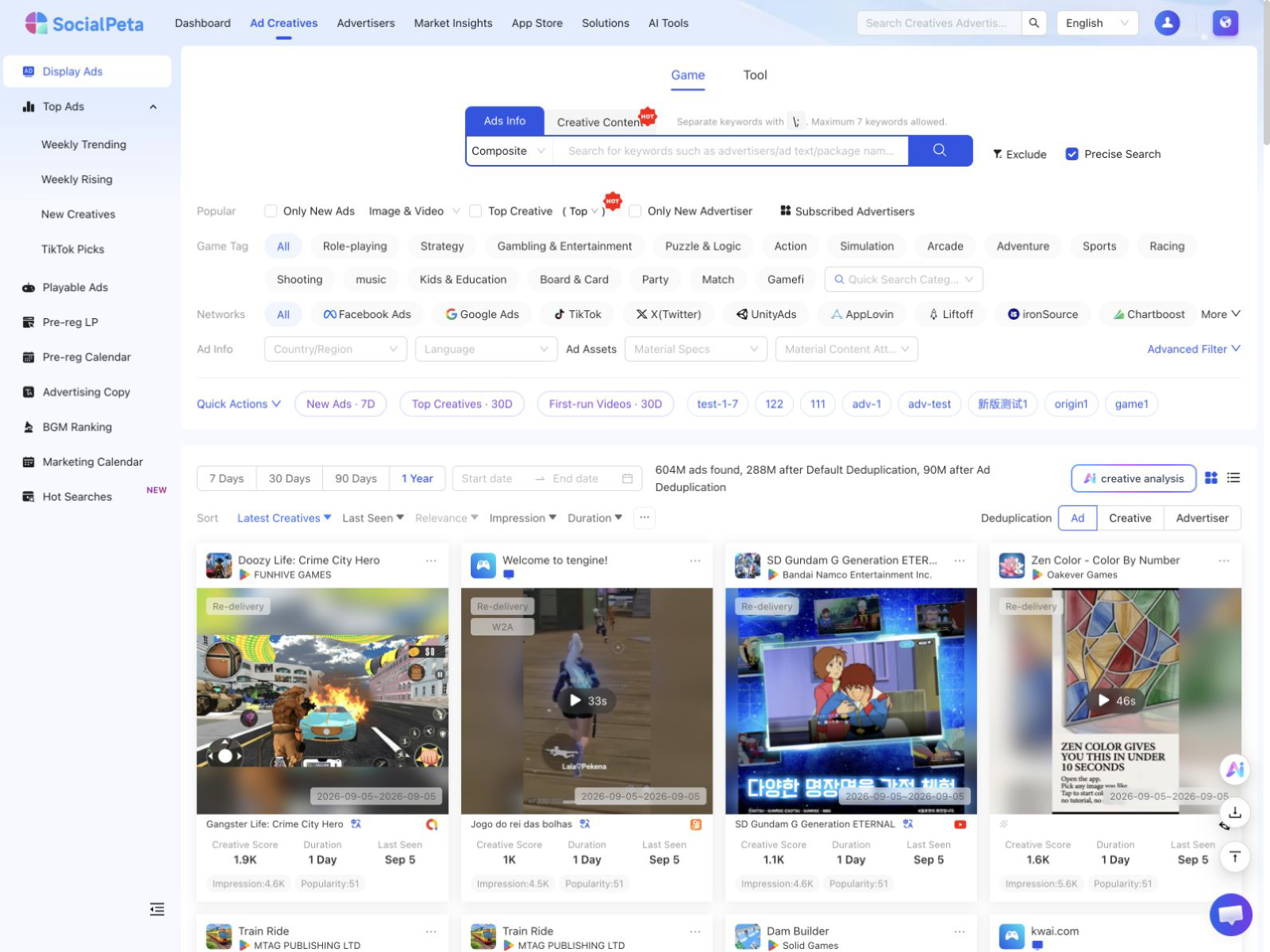
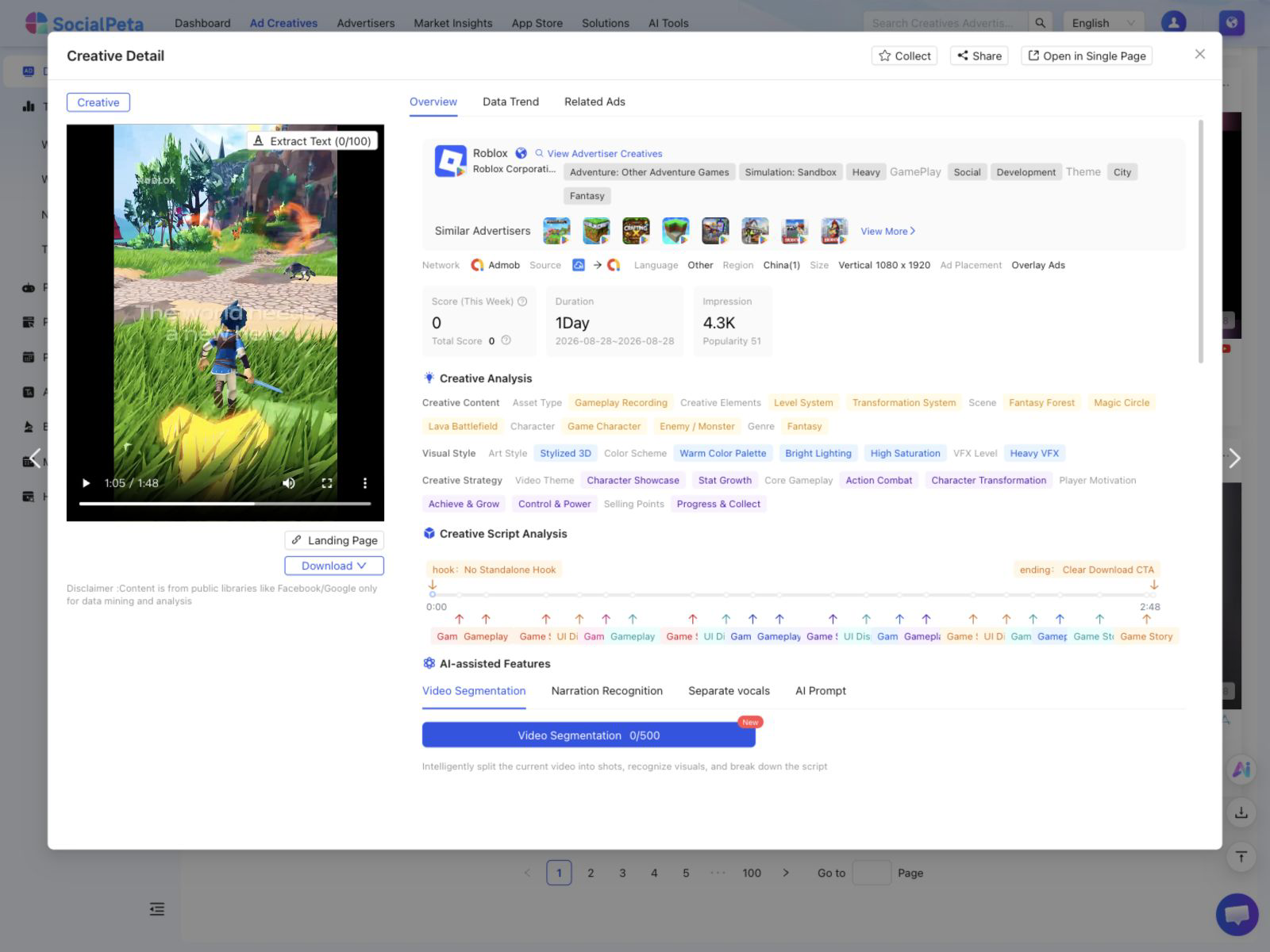
SocialPeta fits teams that need more than a scrollable Meta swipe file. Its creative search can narrow a research set by network, country, language, format, category, time, advertiser, and creative attributes. Deduplication helps prevent small edits from dominating the sample. From there, advertiser and creative detail views add related ads, copy, landing-page context, channel activity, and app information where available. This is useful for a UA manager comparing Facebook with TikTok, Google, and mobile ad networks. SocialPeta publishes this guide, so the recommendation is disclosed. Run the same competitor task in every shortlisted tool.
2. Meta Ad Library
Best for: Free verification of ads currently running across Meta technologies
Meta Ad Library is the first place to check a named competitor. Search by advertiser or keyword, confirm the Page identity, choose the relevant country, and inspect the ads Meta presents. Meta's API documentation says the public library is the route for all ads currently running across its technologies, while deeper API history applies to specific regulated categories and ads delivered in the UK or EU. That distinction matters. The library is authoritative for the record it shows, but it is not a complete creative-operations workspace. It does not turn a Page into a clean historical comparison or prove spend and results.
3. AdSpy
Best for: Detailed Facebook and Instagram creative filtering
AdSpy is the focused choice for researchers who spend most of their time inside Facebook and Instagram advertising. It is known for search controls around ad text, advertiser, Page, landing page, affiliate signals, demographics, and engagement. The narrower platform scope can be an advantage when the research question is precise. A useful trial should check whether it finds older campaigns from your category, how it handles Page aliases, and whether the landing pages still resolve. Engagement on a public post is context, not a direct readout of paid campaign performance.
4. BigSpy
Best for: Broad creative discovery across Meta and other social platforms
BigSpy suits small teams that want Facebook research beside TikTok, Instagram, YouTube, and other platforms. Its appeal is coverage and a familiar search-first workflow. That same breadth requires discipline. Search a fixed advertiser set, compare results with Meta Ad Library, and note which dates, countries, placements, and original-post links survive in the record. If a team needs only Meta monitoring, a more focused archive or tracking product may reach the answer with less cleanup.
5. Minea
Best for: Connecting Meta creatives with products, stores, and commerce signals
Minea makes sense when the research decision is partly about what to sell. It connects social advertising with product, shop, influencer, and store research, so a dropshipping or DTC team can follow the path beyond the creative. That is different from general ad intelligence. Product popularity and ad activity still do not disclose margin, returns, shipping reliability, or durable demand. Include an established brand and a smaller store in the trial, then verify important ads in Meta's own library.
6. Foreplay
Best for: Saving competitor ads and turning references into briefs
Foreplay is for teams that already know what to watch but keep losing the work in screenshots, bookmarks, and chat threads. Its value is competitor tracking, saving ads, organizing boards, collaboration, and creative briefing. That makes it a strong option for agencies and in-house creative teams with a recurring research ritual. It is less appropriate when procurement expects modeled spend, category sizing, or deep app-market context. Evaluate it with the strategist, copywriter, and editor who will use the output, not only the media buyer.
7. AdPlexity Social
Best for: Meta funnels, landing pages, offers, and affiliate research
AdPlexity Social is aimed at performance marketers who need to follow the campaign beyond the ad. The useful chain is creative, advertiser, offer, landing page, and funnel path. That can be a better fit than a visual swipe file for affiliates and media buyers. It also means the product should be tested with a real offer category and known funnel, not a famous consumer brand chosen for the demo. Check historical depth, mobile and desktop landers, redirects, and the fields available in exports.
8. PowerAdSpy
Best for: Keyword, advertiser, CTA, and landing-page searches on a budget
PowerAdSpy is often shortlisted by teams that want several social channels without an enterprise contract. Its filters cover common research entry points such as keyword, advertiser, call to action, creative type, and landing page. The right question is whether those filters return a reliable set in your niche. Test exact competitor Pages, regional advertisers, and a campaign that you can verify independently. A low entry price does not save money if analysts still remove duplicates and rebuild missing context by hand.
9. AdHeart
Best for: Fast Facebook and Instagram inspiration searches
AdHeart is a direct creative-search option for Facebook and Instagram. It works best for buyers who want a large pool of references and familiar filters without a broader market-intelligence suite. The practical evaluation is simple: search the same ten Pages, phrases, domains, and countries you use in real work. Then compare duplicate handling, video playback, ad text, destination links, and first and last seen fields with the official library. If the tool only produces more thumbnails, it has not solved the research problem.
10. Atria
Best for: Monitoring named brands and organizing Meta creative patterns
Atria is relevant when the team wants ongoing competitor tracking rather than occasional database searches. It helps marketers follow named brands and study creative themes, hooks, and changes over time. This is a useful distinction. Discovery products ask, 'What ads exist in this category?' Tracking products ask, 'What changed in the competitors we already care about?' In a trial, add the same competitors your team reviews every Monday and see whether the alerts and summaries reduce manual checking without hiding the source records.
A reliable Meta competitor research workflow
Begin with identity. Brands often advertise through regional Pages, product Pages, agencies, or names that differ from the domain. Record the Page name, Page ID when available, website, market, and date of research before comparing creatives.
- Use Meta Ad Library to confirm the Page and capture currently visible ads.
- Use a paid archive to extend the time window, search copy or domains, and group related variants.
- Choose one market, format, product, and time period. Do not mix a US video launch with an older European image campaign.
- Remove near-duplicate crops, captions, and aspect-ratio edits before counting creative patterns.
- Code the hook, offer, proof, visual device, call to action, destination, and landing-page match.
- Write an original test hypothesis and validate it with your own campaign, conversion, retention, and margin data.
An ad that has appeared for months deserves inspection. It does not automatically deserve imitation. Long runtime may reflect budget, broad rotation, a brand campaign, collection gaps, or simple neglect. The competitor's actual conversion economics remain private.
For a detailed Page-level method, use the Facebook Page ad research guide. You can also browse the public SocialPeta Ad Library and filter for Facebook before committing to a paid tool.
How to test a paid Facebook ad spy tool
Give every vendor the same 60-minute assignment. Use three direct competitors, one small regional advertiser, two countries, and a known campaign from the last year. Ask the analyst who will use the platform to complete the task.
- Find the known campaign and verify its Page, copy, creative, dates, and destination.
- Build a comparable set without obvious duplicates and explain the exclusion rules.
- Show one older creative change and one current cross-platform difference.
- Save the research, share it with a teammate, and export a brief that keeps source links.
- List missing advertisers, broken media, unclear metrics, plan limits, and manual cleanup time.
Do not buy based on the vendor's hand-picked demo account. Your smallest competitor often reveals more about coverage than a global brand. If the team also researches TikTok, YouTube, native, or mobile networks, compare the broader best ad spy tools and the dedicated SocialPeta ad spy tool workflow.
Frequently asked questions
What is the best Facebook ad spy tool in 2026?
SocialPeta is the best fit in this guide for structured cross-market creative and advertiser research. AdSpy is a focused Meta archive, Minea is better for ecommerce product research, and Foreplay is better for saving ads and building creative briefs. Start with Meta Ad Library if you only need a free check of ads currently running.
What is the best free Facebook ad spy tool?
Meta Ad Library is the best free first-party source. It lets you search ads across Meta technologies by advertiser or keyword. General commercial-ad history and fields are more limited than the transparency available for regulated categories or certain regions, so it is better for verification than full historical analysis.
Can Facebook ad spy tools show exact spend or ROAS?
No. A tool may show observed creatives, run dates, placements, engagement signals, or modeled estimates. It cannot see a competitor's complete account costs, attribution, revenue, margin, or incrementality. Use external signals to form a test idea, then judge it with your own campaign and business data.
How do I research a competitor's Facebook ads?
Confirm the correct Page, choose one market and time window, separate active ads from historical records, remove minor duplicates, and code the hook, offer, proof, format, call to action, and landing-page continuity. Save source links and keep observations separate from assumptions about performance.
Is it legal to use Facebook ad spy tools?
Competitive research based on public or lawfully collected advertising is common, but access rights, platform terms, privacy rules, and intellectual-property law still apply. Do not copy protected creative assets, impersonate advertisers, bypass access controls, or collect personal data without a lawful basis. Seek legal advice for your jurisdiction and use case.
Which Facebook ad spy tool should you choose?
Use Meta Ad Library if your task is occasional and advertiser-specific. Choose SocialPeta when you need structured Facebook research beside apps, games, other social channels, and mobile networks. AdSpy is the cleaner specialist choice for deep Meta search. Minea and AdPlexity fit commerce and funnel questions. Foreplay or Atria make sense when the problem is repeated tracking and handoff.
A paid tool should reduce research time and produce a traceable brief. If it only gives the team more ads to scroll, stay with the free library.