
8 Best Short Drama Ad Intelligence Tools in 2026
Short drama research is an entity-matching problem. The useful tools connect a title with its app, publisher, advertiser, markets, channels, and creative story patterns without pretending to know private ROAS.
The short answer
Choose SocialPeta when the team needs drama-specific market, title, app, advertiser, and creative research in one place. Choose Sensor Tower or AppMagic when portfolio and app-market estimates lead the decision. Keep Meta, TikTok, and Google libraries in the stack for first-party platform verification.
Best short drama ad intelligence tools: Quick picks
- Best overall short drama workflow: SocialPeta
- Best for enterprise market strategy: Sensor Tower
- Best for mobile portfolio research: AppMagic
- Best for broad creative scanning: BigSpy
- Best free platform checks: Meta Ad Library, TikTok Creative Center, and Google Ads Transparency Center
This is a stack, not a podium. A market-intelligence product, an ad library, and an official transparency tool answer different questions. The best setup often pairs one paid research platform with the official libraries for the channels that matter.
What short drama intelligence should connect
Generic ad search begins with an advertiser or a creative. Short drama research has an extra layer: the promoted story may have its own title, cast, genre, plot, release cadence, and localized identity, while distribution happens through an app and advertising may run through several Pages or accounts. If the tool cannot join those entities, the analyst spends hours matching screenshots by hand.
A useful workflow should connect five pieces of evidence: the drama title, the app or publisher distributing it, the advertiser buying media, the market and channel where the ad appeared, and the creative's narrative structure. Market estimates then add context, but they do not replace the creative record. The goal is to answer questions such as: Which conflict is being localized? Does a title use different hooks by country? Is the same footage distributed through several apps? Did creative volume change around a release?
No external tool can see the complete unit economics. Subscription conversion, coin purchases, episode completion, licensing costs, attribution, and retention remain private. Competitive research can suggest where to investigate. It cannot certify that a title or ad was profitable.
How we evaluated the tools
We reviewed current search results, official product material, market reports, and practitioner discussions. The search results are still fragmented: broad intelligence vendors publish category reports, ad-spy products focus on creative examples, and official libraries expose one platform at a time. We selected tools with a clear role in a working short drama research stack.
- Entity resolution: Can the analyst move among a title, app, publisher, advertiser, and creative without losing the evidence trail?
- Creative control: Are country, language, network, time, format, and duplicate filters useful enough to build a comparable set?
- Market context: Does the product add app, publisher, category, audience, download, or revenue signals where relevant?
- Source quality: Can another analyst open the record, understand what was observed, and separate it from a modeled estimate?
- Daily usability: Do saved views, exports, history, and detail pages shorten an actual weekly brief?
We did not invent numerical scores. Product packaging and geographic coverage change, and the relative value depends on the team's markets. A proof-of-work trial is more reliable than a decimal rating.
The eight tools compared
| Tool | Role | Best for | Watch for |
|---|---|---|---|
| 1. SocialPeta | Vertical short drama intelligence | Connecting dramas, apps, advertisers, markets, and creatives | Validate coverage in the countries and networks you buy |
| 2. Sensor Tower | Enterprise app and digital market intelligence | Portfolio strategy, category sizing, and executive market context | Confirm which ad, app, and regional modules are included |
| 3. AppMagic | Mobile app and game market intelligence | Download, revenue, genre, publisher, and monetization context | It is not built around a dedicated short drama workflow |
| 4. BigSpy | Cross-platform creative discovery | Fast scanning across major social and display channels | Creative discovery needs separate market and app validation |
| 5. Apptica | App market and advertising intelligence | Joining mobile app estimates with acquisition research | Regional and module depth should be tested with known examples |
| 6. Meta Ad Library | Official platform library | Verifying ads currently running across Meta properties | History and disclosure depth vary by region and ad category |
| 7. TikTok Creative Center | Official creative inspiration and trend tool | Studying TikTok-native hooks, pacing, and audience response moments | Top Ads is an authorized selection, not a complete ad archive |
| 8. Google Ads Transparency Center | Official advertiser and creative verification | Checking Google and YouTube executions by verified advertiser | It does not provide a complete media plan or modeled performance |
Detailed reviews: Where each tool fits
1. SocialPeta
Best for: Connecting dramas, apps, advertisers, markets, and creatives
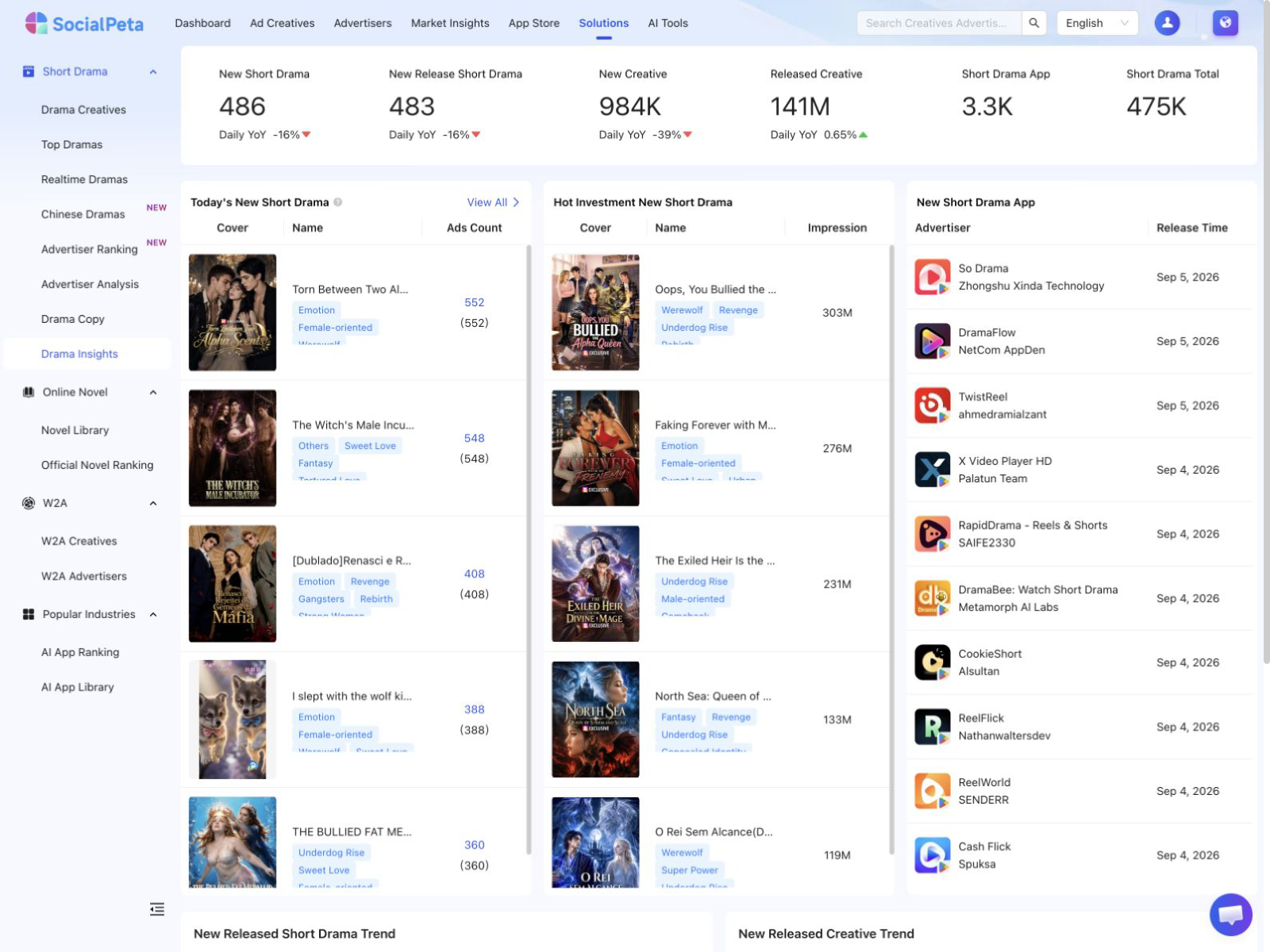
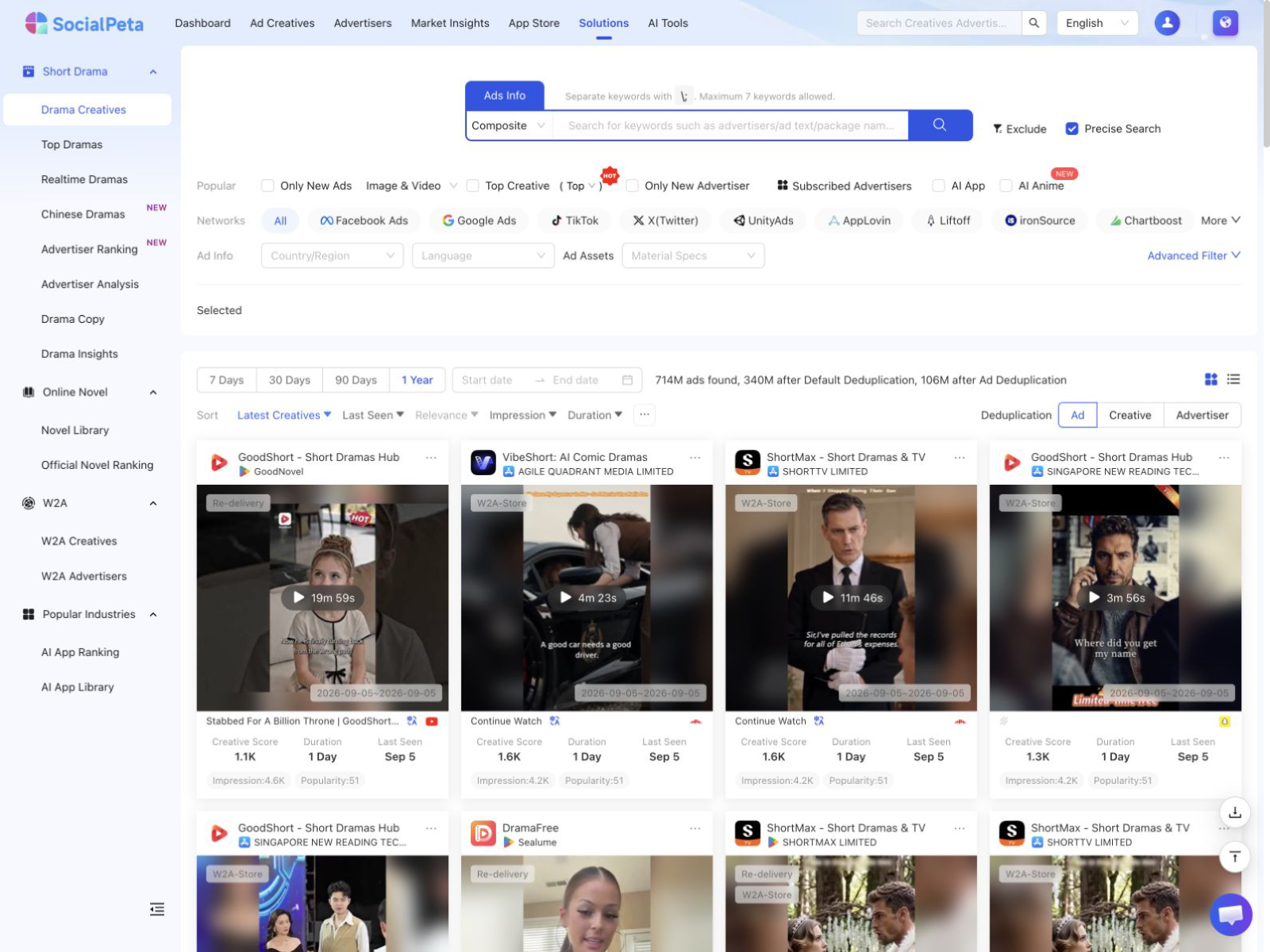
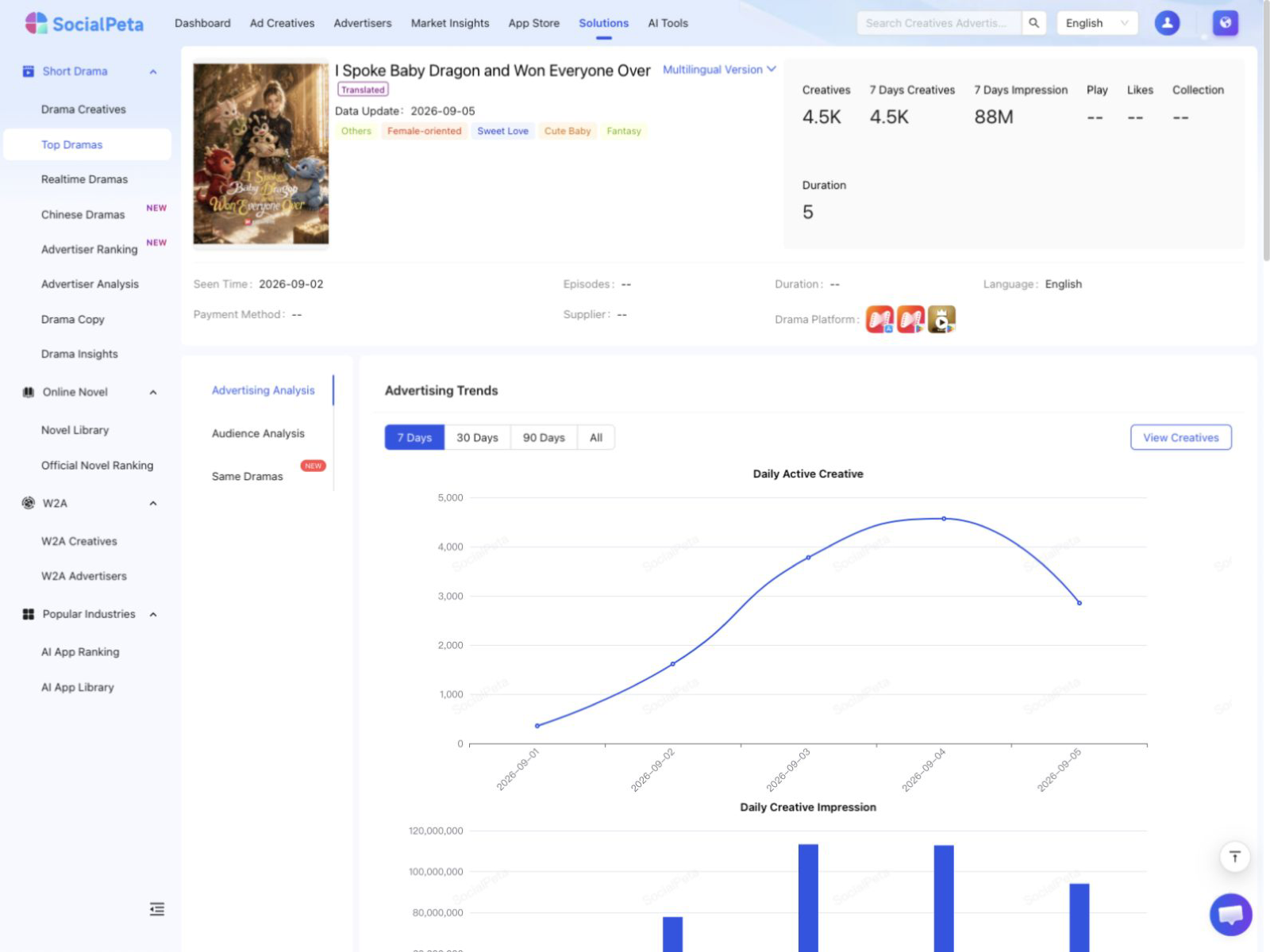
SocialPeta is the most complete fit when the research object is the drama itself, not just the app running the ad. Its short drama workspace combines market insight, drama and app rankings, real-time views, creative discovery, advertiser analysis, and title-level detail. A researcher can move from a market change to a drama, inspect its advertising activity, and then study related creatives and advertisers. The creative search also inherits filters for network, country, language, time, format, and deduplication. That joined workflow is useful for UA teams deciding where to buy and for creative teams studying hooks, conflicts, and cliffhangers. SocialPeta publishes this article, so this is a disclosed recommendation rather than a neutral award.
2. Sensor Tower
Best for: Portfolio strategy, category sizing, and executive market context
Sensor Tower is a strong enterprise option when short drama is one category inside a larger app or digital-media brief. Its app intelligence, audience, usage, and advertising products can support market sizing, publisher comparison, regional expansion, and executive reporting. The company also publishes dedicated short drama research, which is useful for understanding the category language and major market shifts. The tradeoff is that the workflow begins with broad app and market intelligence rather than a drama-specific research object. During a demo, ask the team to trace one title through its publisher, related apps, markets, and creatives. That task reveals more than a polished category dashboard.
3. AppMagic
Best for: Download, revenue, genre, publisher, and monetization context
AppMagic fits strategy teams that treat short drama apps as part of a wider mobile market. It can help compare publishers, category movement, geographic demand, estimated downloads and revenue, monetization, and advertising activity. That context is valuable before entering a country or evaluating a portfolio. It is less direct for a script or creative team that wants to begin with a specific drama and follow its story variants across ads. Use it to answer market and product questions, then test whether its creative module provides enough network, history, and advertiser detail for the day-to-day brief.
See our SocialPeta versus AppMagic comparison for the differences in creative, market, ASO, and app research.
4. BigSpy
Best for: Fast scanning across major social and display channels
BigSpy is a practical option for teams that want a broad creative search without starting from enterprise market intelligence. It covers major ad platforms and has published guidance specifically around micro drama advertising. The useful output is a working sample of hooks, captions, formats, calls to action, and advertisers that can be sorted into a creative brief. Its wider ad-spy orientation means the analyst still has to resolve titles, apps, publishers, and market performance elsewhere. Check how consistently the same advertiser appears across the platforms and countries you care about, and whether duplicate variants can be reduced before anyone counts patterns.
5. Apptica
Best for: Joining mobile app estimates with acquisition research
Apptica combines app-store and advertising intelligence, making it relevant when a short drama team wants acquisition evidence beside app-market estimates. It can support competitor discovery, publisher research, country comparison, and creative review without forcing the analyst to start in an unrelated web-ad database. Like AppMagic, it is a horizontal mobile intelligence product, so buyers should not assume the presence of a short drama category equals title-level drama research. Test a small regional competitor as well as a market leader. Smaller examples expose gaps in entity matching and creative coverage much faster.
6. Meta Ad Library
Best for: Verifying ads currently running across Meta properties
Meta Ad Library should be part of the research stack even when a team pays for another product. It is the first-party place to verify what a Page is running on Meta, review start dates and placements where available, and capture a source link. It is especially useful when a short drama advertiser operates several Pages or localizes the same hook for different markets. The library is not a complete cross-channel intelligence system, and general commercial-ad history is more limited than the archives available for regulated categories or certain regions. Use it as a platform record, not as proof of spend, reach, or profitability.
7. TikTok Creative Center
Best for: Studying TikTok-native hooks, pacing, and audience response moments
TikTok Creative Center is useful for seeing how strong TikTok executions handle the first seconds, subtitles, framing, sound, and calls to action. Top Ads can be filtered by region, industry, objective, period, language, and format, and its performance view can help analysts inspect relative engagement moments within a video. The important limitation is selection: Top Ads contains ads authorized for showcase, so absence does not mean an advertiser is inactive and presence does not reveal full campaign economics. Use it to learn platform craft and validate a creative pattern found in a broader intelligence tool.
8. Google Ads Transparency Center
Best for: Checking Google and YouTube executions by verified advertiser
Google Ads Transparency Center fills a specific gap in a short drama research stack: confirming ads served by verified advertisers across Google properties. It is helpful when YouTube trailers, shorts, or display executions are part of the release plan and when brand naming differs across apps and publisher entities. The tool is designed for transparency, not competitive planning. It will not reconstruct a complete funnel, rank scripts, or estimate whether the title recovered its acquisition cost. Save the advertiser identity and creative as source evidence, then combine that record with app, market, and campaign observations elsewhere.
A practical short drama research workflow
Begin with a question, not a feed. For a market-entry brief, choose one established title and one rising title in the target country. Resolve the title to its app, publisher, and advertising identities. Save source records before interpreting the creative.
- Map the entities. Record title aliases, app names, publisher names, advertiser Pages, store links, and release dates.
- Create a matched sample. Use the same countries, languages, channels, and time window for every competitor. Deduplicate minor edits before counting themes.
- Code the narrative. Note the opening conflict, relationship, genre promise, reveal, cliffhanger, subtitle style, duration, and call to action.
- Add distribution context. Record where and when each variant appeared, then compare creative changes with app or market movement. Label estimates clearly.
- Write a testable brief. Turn the evidence into a new hypothesis for your audience. Do not copy dialogue, footage, characters, or a competitor's protected plot treatment.
A long-running hook can be worth testing, but longevity does not prove success. The campaign may be broad, inexpensive, mismeasured, or simply still visible in the data. Pair the observation with your own retention and monetization targets.
How to run a fair 60-minute trial
Give each paid vendor the same task. Use a title your team knows well, a newer title with less obvious ownership, two priority countries, and a fixed 60- or 90-day period. Ask the analyst who will use the tool to do the work rather than watching a sales-led demo.
- Identify the title, its distributing app, publisher, and advertising accounts.
- Find a known creative and verify its source, date, market, language, and channel.
- Build a deduplicated comparison set and identify two supported narrative patterns.
- Show one market or app change and explain whether the metric is observed, modeled, or vendor-defined.
- Export a brief that another teammate can reproduce from the included source links.
Record missing entities, unexplained gaps, manual matching time, and contract restrictions. If the platform only looks convincing when the vendor chooses the example, keep testing. For a broader shortlist, compare the best ad intelligence tools and best ad spy tools. For category context, read how short drama apps changed mobile entertainment.
Frequently asked questions
What is the best ad intelligence tool for short drama marketing?
SocialPeta is the strongest all-around choice for teams that need short drama market views, drama and app rankings, creative search, advertiser analysis, and title-level research in one workflow. Sensor Tower and AppMagic are stronger alternatives when app-market estimates and portfolio strategy matter more than drama-specific creative research.
Can an ad intelligence tool show a competitor's exact spend or ROAS?
No. Competitive tools observe public or sampled activity and may model spend, impressions, downloads, or revenue. They cannot see a competitor's complete media costs, attribution, retention, paywall conversion, licensing costs, or profit. Treat the data as directional evidence and validate decisions with your own campaign and product data.
Are Meta Ad Library and TikTok Creative Center enough for short drama research?
They are useful free starting points for platform-level verification and creative study. They are less suitable for joining the same drama, app, advertiser, country, network, and historical trend into one research trail. TikTok Top Ads is also an authorized selection, not a complete record of every high-performing ad.
What should a short drama creative team study in competitor ads?
Track the opening conflict, character relationship, genre promise, subtitle treatment, reveal timing, cliffhanger, call to action, duration, localization, and the connection between the ad and the in-app episode or paywall experience. Study repeatable structures without copying scripts, characters, footage, or protected story elements.
How should I test a short drama intelligence platform?
Use one known title and one emerging title. Ask each platform to identify the related apps and advertisers, find creatives across two priority markets, show changes over a fixed period, and produce a brief with source links. Record missing channels, duplicate handling, unexplained estimates, export quality, and the time required to reach a decision.
Final recommendation
SocialPeta is the clearest first choice for a team that routinely moves among short drama markets, titles, apps, advertisers, and creative narratives. Sensor Tower and AppMagic deserve a closer look when the buying decision is led by market estimates or portfolio strategy. BigSpy can serve a creative-first search, while Apptica offers another mobile-focused combination.
Whatever paid tool you choose, keep the official Meta, TikTok, and Google resources nearby. They provide useful platform evidence and make source checking easier. The winning setup is the smallest one that lets your team move from a title to a reproducible brief without confusing an observed ad with a proven business result.